
What Roof Slope Angle Is Needed for Aluminum Insulated Panels to Drain Heavy Rainwater Completely to Gutters?
If you are installing aluminum insulated panels for your factory, warehouse, house, or sunroom roof, one critical question always comes up:
how many degrees should the roof tilt to ensure all heavy rainwater flows quickly into the drainage gutters without any standing water?
The roof slope angle directly affects drainage speed, anti-leak performance, roof service life, and whether the aluminum insulated panels will deform under ponding weight.
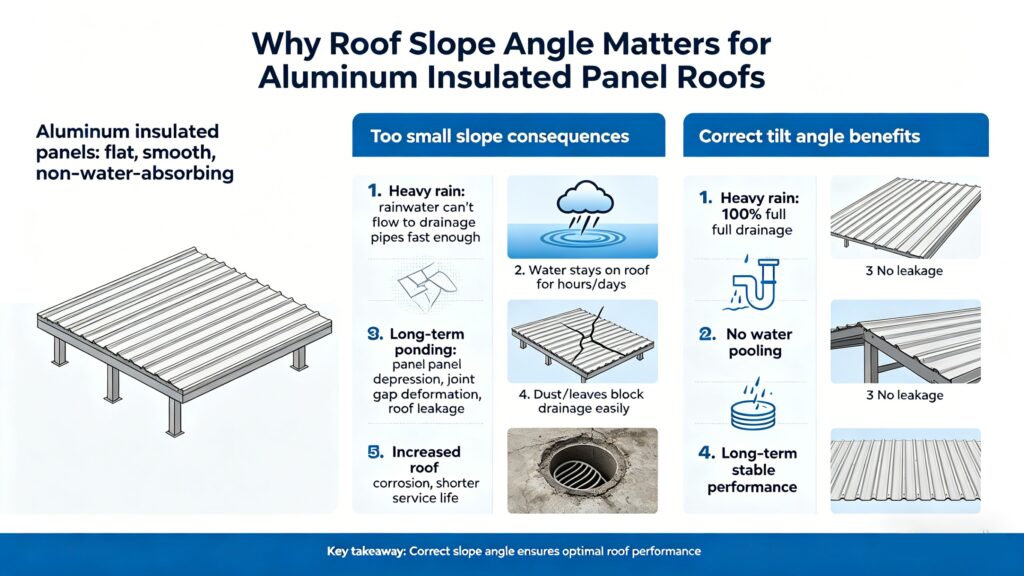
Why Roof Slope Angle Matters for Aluminum Insulated Panel Roofs
Aluminum insulated panels are flat and smooth on the surface. They do not absorb water. However, if the slope is too small:
- Rainwater cannot flow into the drainage pipes fast enough during heavy storms
- Water stays on the roof for hours or days
- Long-term water ponding causes panel depression, joint gap deformation, and roof leakage
- Dust and leaves block drainage lines easily
- Roof corrosion risk increases, shortening panel service life
Only with the correct tilt angle can aluminum insulated roofs achieve 100% full drainage during heavy rain, no water pooling, no leakage, and long-term stable performance.
Standard Roof Slope Angle for Aluminum Insulated Panels (Engineering Parameters)
We provide clear angle data based on international roofing construction standards and real factory project experience.
1. Minimum Safe Slope (Light Rain & Normal Weather)
Minimum angle: 2.9 degrees (5% slope ratio)
This is the lowest acceptable tilt for aluminum insulated panel roofs.
Suitable for areas with low rainfall, no typhoon, no heavy downpour.
It can drain normal daily rainwater slowly into gutters.
⚠ Not recommended for heavy rain seasons or coastal areas.
2. Recommended Best Slope (Most Areas, All Seasons)
Best balance angle: 5.7 degrees to 8.5 degrees (10% to 15% slope ratio)
This is the most widely used slope for aluminum insulated panel roofing worldwide.
Perfect performance in heavy rain, thunderstorms, and strong wind weather.
All rainwater flows rapidly along the aluminum panel surface into the drainage system.
No water stays on the roof at all.
It also keeps the roof stable, saves materials, and reduces construction cost.
3. Heavy Rain & Typhoon Area Special Slope
Heavy climate angle: Above 11.3 degrees (20% slope ratio)
For tropical regions, coastal cities, rainy seasons, and frequent typhoon areas.
Fastest rainwater flowing speed.
Prevents backflow, overflow, and gutter blockage during extreme storms.
Highly safe for large factory rooftops and wide-span warehouse roofs.
How to Check If Your Roof Slope Is Correct Before Installation
Before laying aluminum insulated panels, contractors can verify the angle easily:
- Use a level meter or laser slope tester to measure the roof beam tilt
- Confirm gutter height is lower than the roof edge
- Ensure no low spots or sunken areas on the steel structure frame
- Match panel installation direction with the water flow direction
Correct angle + high-quality aluminum insulated panels = zero roof leakage for 30 years.
What Happens If the Slope Is Too Flat?
If the roof angle is below 2.8 degrees:
- Heavy rain will accumulate on the aluminum panels
- Panel middle parts slowly sink due to water weight
- Waterproof sealing joints open gradually
- Roof begins leaking after one or two rainy seasons
- Repair cost is very high later on
It is always better to set a slightly higher slope than a too-flat roof.
Final Professional Advice for Buyers & Builders
For all aluminum insulated panel roof projects:
- Use 5.7° to 8.5° slope for most regular buildings
- Use over 11.3° slope for rainy, coastal, and tropical areas
- Never go below the minimum 2.9° safety angle
Correct roof slope ensures perfect rainwater drainage, protects your roof investment, and keeps the building dry all year round.
Our factory has enough professional roof design solutions to match different local weather, roof sizes, and drainage systems for your perfect aluminum insulated panel roofing project.