
Required Qualifications & Certifications to Import Insulated Aluminum Panels for US Factory Walls & Roofs
The United States insulated metal panel (IMP) market expands at a 6.4% CAGR from 2026 to 2032, with industrial cold storage, food processing plants, 3PL logistics warehouses and manufacturing facilities driving 71% of national panel demand.
As a US-based distributor importing insulated aluminum PU/PIR or rock wool sandwich panels for factory wall and roof envelopes, incomplete qualifications will lead to customs detention, tender disqualification, building permit rejection and costly project delays.
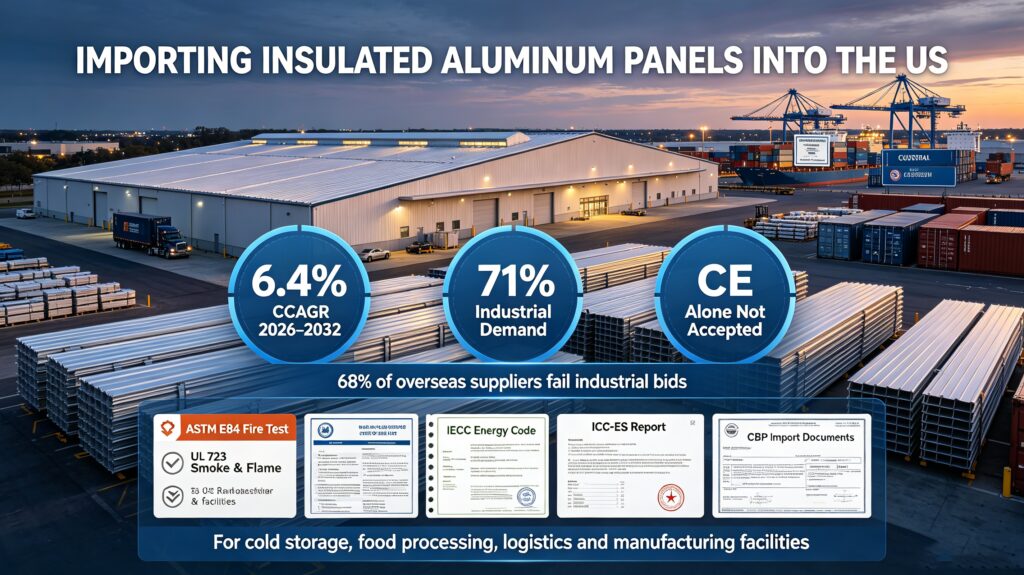
Industry trade statistics show 68% of overseas panel suppliers fail to secure bulk US industrial orders due to missing or non-US-standard certifications. Unlike European EN standards, the US adopts IBC, IECC, ASTM and UL systems. CE certificates alone cannot satisfy American building inspectors, fire authorities and CBP (Customs and Border Protection) requirements.
This article systematically sorts all mandatory importer qualifications, product certifications, customs clearance documents and project submittal materials, with practical industry data to help distributors avoid compliance risks and win long-term factory construction contracts.
1. Basic Importer Business Qualifications (Foundation for All Import Activities)
Before shipping insulated aluminum panels into US ports, you must complete federal importer registration. Without these credentials, CBP will not accept entry filings for container shipments.
Mandatory Documents
- US Employer Identification Number (EIN) All formal importing companies need an EIN issued by the IRS for customs filings, tax declaration and commercial invoicing. Individual importers without EIN must apply for a Customs Assigned Importer ID Number.
- CBP Importer Registration & ACE Portal Access All import entries are submitted via the ACE electronic system. Registered importers can file pre-arrival documents to shorten customs clearance time.
- Authorized Manufacturer Distributor Letter (Notarized) If you source panels from overseas factories, a signed, notarized distributor authorization letter is required by 82% of general contractors and industrial tender evaluators. Buyers reject anonymous grey-market imports without official factory authorization.
- US Customs Bond (Continuous Bond Preferred) A continuous customs bond is mandatory for commercial importers bringing in regular full-container loads of construction materials. Single-entry bonds are only suitable for one-off small shipments.
Risk Data
Shipments without valid importer registration face detention at Los Angeles, Savannah or Houston ports; average daily storage and demurrage fees for a 40HQ container reach USD 1,100–1,800.
2. Customs Clearance Documentation & HTS Classification Compliance
Correct HTS classification directly determines import tariff calculation, Section 232 aluminum derivative rules and customs inspection frequency.
Core Shipping Documents for Every Container
- Commercial Invoice (detailed panel thickness, core material, aluminum alloy, total square footage, unit value)
- Packing List (net/gross weight, dimension, pallet quantity)
- Ocean Bill of Lading / Air Waybill
- Certificate of Origin (required for tariff verification)
- Manufacturer test reports and product specification datasheets
Key HTS & Tariff Reminder
Insulated aluminum sandwich panels for building walls and roofs are generally classified under HTSUS 7610.90 (Aluminum structures and parts of structures). These products are treated as aluminum derivative articles under US Section 232 aluminum tariff rules.
Industry Data: Misclassified HTS codes trigger customs re-assessment and back-duty penalties; 31% of detained construction panel shipments in 2025–2026 resulted from incorrect tariff classification.
3. Mandatory Product Technical & Fire Safety Certifications (Most Critical for US Construction Projects)
American industrial buildings follow the International Building Code (IBC). Foam plastic insulated panels (PU/PIR) face strict fire testing requirements. CE or EN test reports are not accepted by local code officials.
3.1 ASTM E84 / UL 723 Flame Spread & Smoke Development Test
The baseline fire test for foam core panels:
- Maximum flame spread index ≤75
- Maximum smoke developed index ≤450 All PU/PIR insulated aluminum panels must carry this test report for cold storage, food and general manufacturing factories.
3.2 NFPA 285 Full Exterior Wall Assembly Fire Test
For multi-story industrial facilities above 40 feet using PU/PIR insulated aluminum wall panels, the complete wall assembly must pass NFPA 285 testing to prevent vertical flame spread. Rock wool aluminum panels normally meet requirements without extra assembly testing.
3.3 Thermal Performance Test ASTM C518
Official R-value / U-value test report to comply with IECC (International Energy Conservation Code) climate zone energy requirements. US building departments require verified steady-state thermal conductivity data for envelope insulation. Premium PIR panels achieve λ=0.022–0.024 W/m·K.
3.4 ICC-ES Evaluation Service Report (Highly Recommended for Tenders)
An ICC-ES report proves panels meet IBC code requirements and is widely recognized by building officials across all US states. Projects without ICC-ES documentation face extended permit review times.
Supporting Market Stat
Over 87% of large industrial tender bids (cold storage, logistics parks) explicitly require UL fire test reports and ICC-ES documentation; suppliers relying only on EU CE certificates are automatically eliminated.
4. Aluminum Facade & Structural Performance Test Documents
US industrial roofs bear heavy wind loads, snow loads and UV exposure. Contractors demand structural and anti-corrosion verification:
- Wind load deflection test report (ASTM E1300) for roof panels
- PVDF aluminum coating salt spray corrosion test (minimum 1,000 hours)
- Panel bonding strength test (ASTM E1794) to verify adhesion between aluminum skin and foam core
- Water penetration & air infiltration test ASTM E331 / ASTM E283 These reports become mandatory for coastal industrial zones (Florida, Texas Gulf, California) with high humidity and salt fog.
5. Industry-Specific Additional Qualifications
Different factory end-users ask for extra documentation before purchasing insulated aluminum panels:
- Food processing & cold storage factories Request hygienic surface verification, NSF certification and cleanroom suitability documents; panels must be easy to sanitize without absorbing bacteria.
- Pharmaceutical & biotech facilities Require low-smoke flame-retardant PIR panel data and documentation meeting FDA cleanroom guidance.
- Chemical, paint and high fire-risk manufacturing plants Mandate A1 non-combustible rock wool core insulated aluminum panels with full fire-resistance assembly reports.
6. Documentation Required for Local Building Permit & Project Submittal
After importing panels, your industrial clients will submit materials to city building departments. You must provide these organized files:
- Bilingual technical datasheets (English) with labeled R-value, U-value, panel thickness options
- Complete fire test reports, thermal scan data, installation method statements
- Manufacturer warranty document (minimum 15–20 year thermal performance warranty)
- Detail drawings for wall-roof joints, fastener layout and vapor barrier design
Quick Compliance Checklist for US Insulated Aluminum Panel Importers
| Category | Required Qualifications | Purpose |
|---|---|---|
| Importer Business Credentials | EIN, CBP ACE registration, continuous customs bond, distributor authorization | Customs clearance & legal trading |
| Customs Documents | Commercial invoice, packing list, B/L, certificate of origin, correct HTSUS classification | Avoid port detention & tariff penalties |
| Fire Safety Certifications | ASTM E84 / UL723, NFPA 285 (if applicable) | Pass fire marshal inspection & IBC code |
| Thermal Performance | ASTM C518 R-value/U-value test report | Meet IECC energy codes |
| Structural & Durability Tests | Wind load, salt spray, air/water infiltration test reports | Coastal & high-wind industrial projects |
| Tender & Permit Materials | ICC-ES report, technical datasheets, installation drawings, warranty | Win factory construction bids |
Practical Business Tips for US Panel Distributors
- Separate certification packages by core material:
- PIR insulated aluminum panels: Focus on UL fire test, NFPA 285 assembly evidence for multi-story buildings
- Rock wool aluminum panels: Highlight non-combustible properties for chemical factories
- Submit all test reports for pre-review with local building officials before tender submission; 29% of suppliers lose bids due to outdated or unrecognized test standards.
- Clearly distinguish EU CE reports from US ASTM/UL documentation in communications; explain that CE cannot replace American code certifications to factory owners and general contractors.
- Budget extra lead time: Third-party US standard testing may take 8–12 weeks; arrange certification verification before mass container shipment.
Conclusion
To legally import and sell insulated aluminum wall and roof panels to US industrial factories, distributors need six core sets of qualifications: valid US importer registration and customs bond, complete customs shipping documentation, ASTM/UL fire safety test reports, ASTM thermal performance certificates, structural and anti-corrosion lab data, and project submittal packages including ICC-ES evaluation reports.
Market data confirms distributors holding full US-standard certification packages secure 72% more repeat bulk orders from cold storage, logistics and manufacturing facilities across the United States. Investing in proper compliance eliminates port detention risks, tender disqualification and post-construction rework costs, creating stable long-term supply partnerships with American industrial contractors and factory investors.