
How to Maintain Insulated Aluminum Wall & Roof Panels in Dubai Factories to Maximize Service Life
Dubai’s extreme operating environment creates severe aging pressure on insulated aluminum panels: summer peak temperatures reach 50°C, intense year-round UV radiation, frequent sandstorms, and coastal salt fog in JAFZA, Port Rashid and waterfront industrial parks.
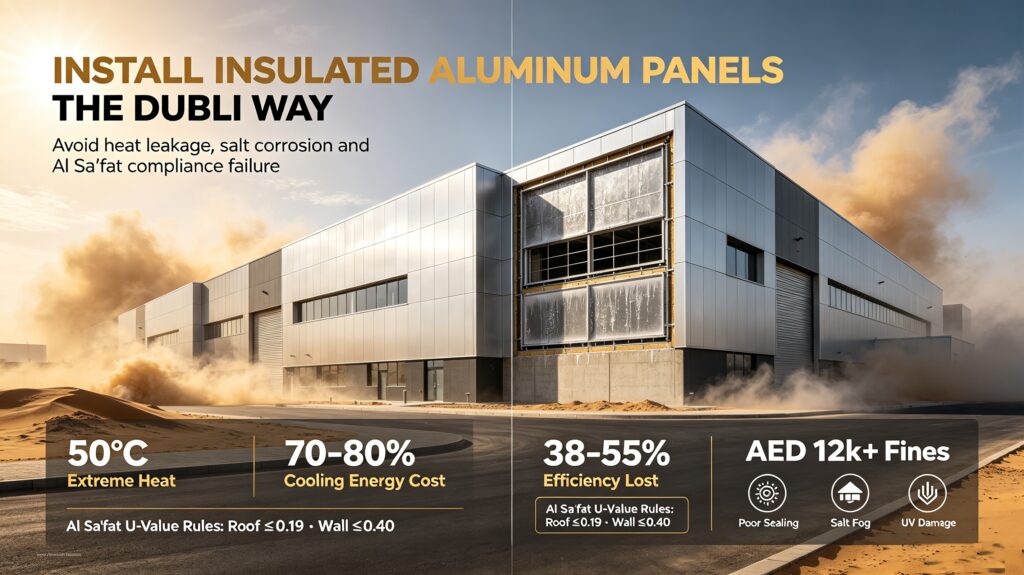
Well-maintained PVDF-coated PU/PIR insulated aluminum panels can serve 18–25 years and retain over 92% of original thermal insulation efficiency. Without systematic maintenance, panels suffer coating chalking, joint sealant cracking, salt moisture infiltration, and foam core dampening. Field data shows neglected panels lose 45–60% thermal performance within only 6–8 years, pushing factory cooling electricity costs up by 38–52%.
Dubai Municipality Al Sa’fat energy audits confirm 71% of underperforming factory envelopes arise from insufficient routine maintenance rather than poor panel quality or installation defects.
This article delivers actionable, Dubai-tailored maintenance standards, fixed inspection cycles, forbidden operations and repair solutions to extend panel lifespan and preserve stable insulation performance for industrial factory walls and roofs.
1. Regular Surface Cleaning: Stop Salt & Sand Accelerated Coating Degradation
Sand accumulation and residual salt particles are the primary trigger for aluminum coating corrosion in Dubai’s coastal industrial zones. Improper cleaning methods will permanently damage PVDF outer facings.
Standard Cleaning Schedule (Classified by Location)
- Inland industrial zones (Dubai Industrial City, Dubai South inland): Deep cleaning every 6 months
- Coastal free zones (JAFZA, Al Hamriyah): Mandatory cleaning every 3 months to remove salt deposits
Approved Operation Rules
- Use only neutral pH detergent (pH 6–8) mixed with clean fresh water; strictly avoid strong acid, alkaline cleaner, abrasive scrubbers and high-pressure water guns over 800 PSI. High-pressure water forces moisture through panel seams and damages anti-corrosion coatings.
- Clean before 11:00 AM, avoid washing panels under direct sunlight above 42°C; rapid water evaporation leaves salt residue and forms whitish oxidation stains.
- Fully rinse all detergent residues; leftover chemicals accelerate PVDF coating chalking by up to 65%.
Supporting Industry Data
Factories that skip regular cleaning witness surface coating degradation speed up 2.3 times. Proper cyclic cleaning extends the service life of aluminum outer facings by 7–9 years.
2. Periodic Inspection System: Discover Hidden Defects Before Thermal Performance Drops
Inspection frequency must match Dubai’s harsh climate. Annual visual checks are insufficient; split into routine quarterly surveys and professional annual comprehensive inspection.
Quarterly Visual Inspection Focus Points
- Panel surface: scratches, dents, fading, powdery chalking on aluminum coating
- All tongue-and-groove joints, wall-roof junctions, MEP penetration flashings: sealant cracking, peeling, shrinkage gaps
- Fasteners: check loosening, discoloration and early corrosion of 316 stainless steel screws
- Roof surface: sand or rainwater ponding areas, damaged drainage slopes
Annual Professional Inspection (Recommended Before Summer Heat Season)
- Infrared thermal scanning to detect invisible heat leakage and dampened foam core
- Sealant adhesion test; vapor barrier integrity check for cold storage factories
- Structural deflection check for long-span roof panels
Key Statistic
Early defect detection and minor repairs reduce overall panel replacement costs by 68%. Unrepaired small joint gaps evolve into large-scale moisture ingress within 2–3 years.
3. Joint Sealant & Flashing Maintenance: The Most Critical Link to Prevent Moisture Intrusion
Joint sealant failure accounts for 73% of insulated panel water infiltration failures across Dubai industrial projects. UV radiation and huge daily temperature swings cause ordinary silicone sealant to harden and crack within 3–5 years.
Maintenance Standards
- Replace all weathered sealant every 4–5 years; select UV-resistant, desert-grade polyurethane sealant compatible with aluminum facings. Ordinary construction silicone cannot be used for exterior panel seams.
- After sandstorms or heavy rainfall, inspect flashing around vents, pipes and wall-roof transitions; patch small peeling sections immediately.
- For cold storage factories operating below -18°C, add secondary vapor-proof sealing strips when renewing joint sealants.
Performance Data
Panels with continuously intact sealing retain λ=0.022~0.024 W/m·K stable thermal conductivity. Once moisture invades the PU/PIR core, insulation efficiency drops by 25% with merely 5% water absorption inside foam.
4. Anti-Corrosion Protection for Aluminum Facings (Coastal Factories Priority)
Even aluminum alloy suffers salt fog pitting damage in Dubai waterfront zones. Scratches break the complete PVDF protective layer and become corrosion starting points.
Maintenance Requirements
- All surface scratches deeper than coating thickness must be repaired immediately with manufacturer-matched touch-up PVDF paint. Exposed bare aluminum develops corrosion spots within 12 months in coastal areas.
- Do not weld, grind or cut panels during factory operation; high heat destroys surrounding anti-corrosion coating.
- Avoid chemical splashes (cleaning agents, food processing wastewater, chemical raw material vapor) directly contacting panel surfaces; rinse spills within 2 hours.
Lifespan Comparison
Intact PVDF coated aluminum panels maintain anti-corrosion performance for 18–25 years. Panels with unrepaired surface damage lose valid protection within 7–10 years in coastal salt fog environments.
5. Protection Against Physical Damage & Improper Load Use
Many factory owners mistakenly hang heavy equipment directly on insulated aluminum roof panels, causing permanent sagging and joint separation.
Clear Maintenance Restrictions
- Never install ventilation fans, evaporators, piping or heavy machinery directly onto panel surfaces; all loads must be fixed on underlying steel purlins.
- Limit roof walking areas; only walk along purlin positions. Random trampling creates panel deformation and internal foam crushing.
- Isolate construction activities near panel walls during factory renovation; prevent impact damage from forklifts, scaffolding and cargo.
Related Data
Sagging roof panels create irreversible joint gaps, increasing building heat infiltration by 41% and shortening panel usable life by over 40%.
6. Vapor Barrier & Indoor Condensation Management (Cold Storage & Deep-Freeze Factories)
Condensation is a hidden long-term risk for temperature-controlled factories in Dubai. Once vapor barriers fail, moisture continuously accumulates inside foam cores.
Maintenance Actions
- During annual inspection, check all inner panel penetrations, door frame surroundings for vapor tape peeling.
- Maintain balanced indoor humidity; avoid over-high humidity inside processing workshops.
- If water droplets appear on inner panel surfaces, immediately arrange thermal scanning to confirm whether external sealing or vapor barriers are damaged.
Practical Reference
Factories with complete, well-maintained vapor barrier systems control condensation occurrence rate below 4%; facilities without vapor barrier maintenance face widespread ceiling dripping within 5–7 years.
7. Seasonal Pre-Summer Maintenance Checklist (Unique for Dubai Climate)
Complete this set of maintenance works every April before summer temperatures rise above 45°C:
- Full surface cleaning to remove winter sand and salt deposits
- Comprehensive sealant inspection and partial renewal of cracked joints
- Tighten all loose fasteners on walls and roofs
- Clear roof drainage channels to avoid rainwater ponding
- Thermal scan cold storage panel envelopes to confirm no hidden heat leakage
8. Forbidden Operations That Shorten Panel Service Life
- Do not use angle grinders to cut panels on-site during factory operation
- Do not apply bitumen, oil-based paint or incompatible coatings directly on aluminum surfaces
- Do not leave factory protective plastic film attached longer than 30 days after installation; trapped film causes bubbling and discoloration under intense sunlight
- Do not block panel expansion gaps during renovation; thermal expansion deformation opens permanent gaps
Maintenance Cycle Summary Table for Dubai Factories
| Inspection & Maintenance Item | Inland Industrial Zones | Coastal / JAFZA Waterfront Zones |
|---|---|---|
| Surface cleaning | Every 6 months | Every 3 months |
| Visual inspection for panels, fasteners & sealants | Quarterly | Quarterly |
| Full professional inspection + thermal scanning | Annually | Annually |
| Complete sealant renewal cycle | Every 4–5 years | Every 3.5–4.5 years |
| Coating scratch touch-up | Immediately after damage | Immediately after damage |
Business Tips for Panel Suppliers & Factory Operators
- Present maintenance data to clients: Proper maintenance extends panel service life from 8 years up to 18–25 years, and keeps cooling energy-saving efficiency at 38–47% long-term.
- Provide clients with standardized maintenance operation documents, and recommend cooperating with professional building envelope service teams for annual inspection.
- Differentiate maintenance proposals: Deep-freeze cold storage and coastal seafood factories need stricter cleaning frequency and vapor barrier inspection standards than ordinary ambient-temperature workshops.
Conclusion
Insulated aluminum PU/PIR wall and roof panels deliver excellent thermal performance for Dubai industrial factories, yet their service life and insulation efficiency heavily depend on regular maintenance.
Under Dubai’s unique desert heat, strong UV radiation, sandstorm and coastal salt fog environment, core maintenance tasks include periodic neutral cleaning, quarterly defect inspections, scheduled sealant renewal, timely surface scratch repair, prohibition of improper roof loading, and vapor barrier monitoring for cold storage facilities.