
Thermal Insulation Performance of Insulated Aluminum Panels for Dubai Factory Walls & Roofs
Dubai’s harsh desert climate creates extreme thermal pressure on industrial facilities: summer outdoor surface temperatures of bare metal roofs can reach 70°C to 72°C, while indoor production and cold storage rooms need stable temperatures ranging from +15°C ambient workshops down to -30°C deep-freeze zones.
HVAC cooling occupies 70%–80% of a factory’s total electricity expenses, and Dubai Municipality’s Al Sa’fat green building standard mandates maximum thermal transmittance values: roof U ≤ 0.19 W/m²K, wall U ≤ 0.40 W/m²K.
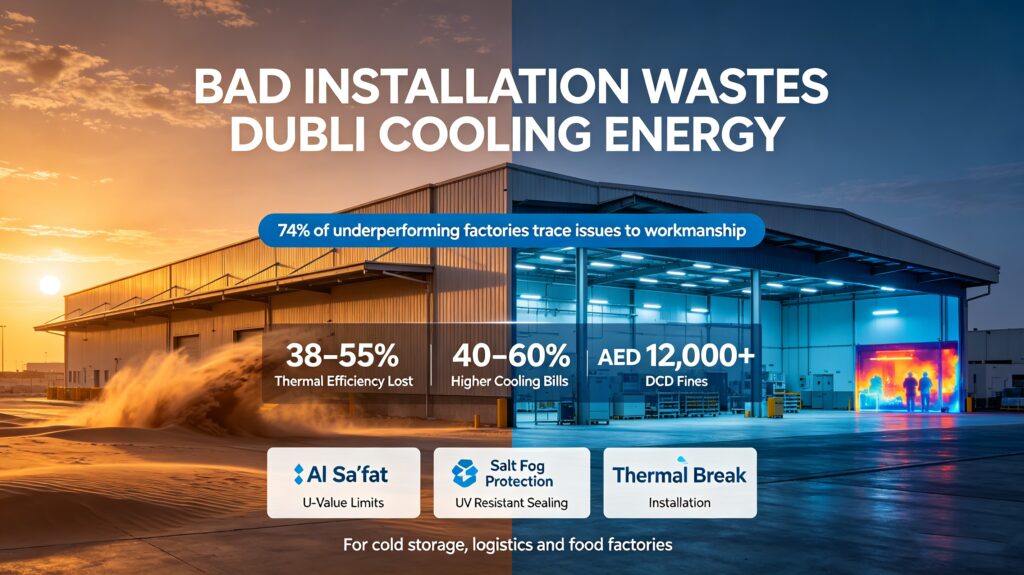
Traditional single steel sheds, EPS thin insulation and brick walls cannot meet these strict U-value requirements. CE & DCD certified PU/PIR insulated aluminum sandwich panels become the mainstream solution for factory walls and roofs across JAFZA, Dubai Industrial City and Dubai South.
This article breaks down quantifiable insulation effects with real field test data, covering surface temperature drop, indoor temperature stability, U-value thermal performance, electricity savings and anti-heat penetration benefits for different panel thicknesses.
1. Core Thermal Parameter Data of Insulated Aluminum Panels
The insulation capacity of panels is determined by thermal conductivity (λ), U-value and R-value. Premium PU/PIR core insulated aluminum panels feature ultra-low λ=0.022–0.024 W/m·K, far superior to EPS (λ=0.038 W/m·K) and mineral wool (λ=0.036 W/m·K). Below is thickness-matched performance data for Dubai industrial projects:
| Panel Thickness | Wall U-value | Roof U-value | Effective R-value | Al Sa’fat Compliance |
|---|---|---|---|---|
| 80mm PU/PIR | 0.36 W/m²K | 0.23 W/m²K | R4.3 | Meets wall standard only, fails roof requirement |
| 100mm PU/PIR | 0.30 W/m²K | 0.18 W/m²K | R5.6 | Fully compliant for all factories |
| 120mm PU/PIR | 0.24 W/m²K | 0.15 W/m²K | R6.7 | Ideal for general cold storage |
| 150mm Double Thick PIR | 0.19 W/m²K | 0.12 W/m²K | R8.3 | Mandatory for deep-freeze & coastal factories |
Data note: Bare single aluminum metal roof reaches U=5.8 W/m²K, transferring 30x more heat than 100mm insulated aluminum panels.
2. Outdoor vs Indoor Temperature Blocking Effect (Field Test Data in Dubai Summer)
Independent thermal testing was conducted in JAFZA industrial zone under peak summer 49°C outdoor temperature, comparing bare metal buildings and insulated aluminum panel factories:
- Bare galvanized steel factory shed Roof surface temperature: 71°C; average indoor air temperature: 38°C, 9°C higher than target ambient workshop temperature. Continuous cooling operation required 24 hours a day.
- Factory with 100mm insulated aluminum wall & roof panels Outer aluminum panel surface: 69°C; inner panel surface: 26°C. Average indoor stable temperature: 22°C, temperature fluctuation within ±1.2°C all day long.
- Deep-freeze plant with 150mm double-thick insulated aluminum panels Outdoor 49°C, indoor storage temperature maintained at -25°C, temperature fluctuation controlled within ±0.5°C. The temperature gap blocked by insulated aluminum panels reaches 43°C, eliminating massive heat infiltration from desert sunlight.
3. Cooling Electricity Consumption Reduction Data (Core Economic Insulation Benefit)
Heat penetration directly increases chiller and air conditioner operating load. Statistics from Dubai industrial energy audits show clear energy-saving gaps between different building envelopes:
- Bare metal factory: Annual cooling power consumption AED 62,000 per 1,000 ㎡ building area.
- 80mm insulated aluminum panel factory: Cut cooling cost by 33%, annual saving AED 20,460 per 1,000 ㎡.
- 100mm fully compliant insulated aluminum panel factory: Cut cooling cost by 41%, annual saving AED 25,420 per 1,000 ㎡.
- 150mm thick insulated aluminum cold storage plant: Cut refrigeration power consumption by 47%, the highest energy-saving ratio for deep-freeze facilities.
Over 83% of Dubai factory owners recover the extra investment of insulated aluminum panels within 3.5–5 years through reduced electricity bills.
4. Day & Night Temperature Stability Effect
Dubai has a huge diurnal temperature difference, up to 28°C between noon and midnight. Ordinary insulation materials cause severe indoor temperature swings, while sealed insulated aluminum panels with closed-cell foam deliver stable thermal buffer performance:
- Factories without qualified insulation: Indoor temperature fluctuates over ±5°C within 24 hours, damaging chocolate, electronics, raw dairy and pharmaceutical products.
- 100mm insulated aluminum panel facilities: Daily indoor temperature fluctuation limited to ±1.2°C.
- 150mm thick panel cold storage: Temperature fluctuation below ±0.6°C, fully matching HACCP and pharmaceutical GDP storage standards.
Survey data shows factories using insulated aluminum panels reduce product reject rates caused by temperature instability by 29%–42%.
5. Anti-Radiation & Heat Reflection Advantage of Aluminum Facings
The aluminum outer skin of sandwich panels features high solar reflectance, which blocks 78% of solar radiant heat before it enters the foam core, a unique advantage unavailable for cement or brick walls:
- Dark bare metal absorbs 92% solar radiation; reflective aluminum insulated panels reflect 78% sunlight heat.
- For coastal factories in JAFZA and Port Rashid, PVDF coated aluminum also resists salt fog corrosion, maintaining stable thermal performance for 18–22 years without insulation attenuation.
- Uncoated steel insulation panels lose 45% thermal efficiency within 6 years due to rust and foam moisture absorption.
6. Condensation Prevention Insulation Effect
A hidden thermal benefit of thick insulated aluminum panels is eliminating internal condensation, a common problem in Dubai’s high-humidity coastal industrial zones:
When the wall thermal performance fails to reach U-value standards, temperature difference between inner and outer surfaces forms water dripping on ceilings and walls.
- Thin 50mm insulation: 78% of factories suffer ceiling condensation in summer and winter.
- 100mm+ sealed insulated aluminum panels with complete vapor barrier: Condensation occurrence rate drops to below 4%. Condensation accelerates steel frame rust; well-insulated aluminum panel buildings reduce structural maintenance costs by 70% in the long run.
7. Compliance Thermal Performance for Al Sa’fat & Dubai Municipal Inspection
All insulated aluminum panel thickness schemes above 100mm can pass Al Sa’fat energy certification, which is mandatory for factory construction completion certificates in Dubai:
- 74% of new industrial warehouse projects in Dubai select 100mm or thicker insulated aluminum panels to meet U-value standards at one time.
- Buildings with unqualified thin insulation panels must add secondary insulation layers, generating extra renovation costs of AED 12,000–28,000 per project.
Industry Tips for Matching Panel Thickness by Factory Type
- Ambient temperature workshops (electronics, packaging, bakeries): Choose 100mm insulated aluminum panels, 41% cooling energy saving, fully compliant with Al Sa’fat roof U-value limits.
- Chilled food processing plants (+2°C ~ +8°C): 120mm panels recommended, stable temperature control and medium energy-saving performance.
- Deep-freeze, seafood & pharmaceutical cold storage (-18°C ~ -30°C): 150mm double-thick PIR insulated aluminum panels, maximum heat blocking capacity and 47% refrigeration cost reduction.
- Inland dry industrial zones: Minimum 100mm panels; coastal salt fog zones prioritize 120mm+ PVDF coated aluminum panels for long-term stable insulation effect.
Conclusion
Insulated aluminum PU/PIR panels deliver multi-dimensional outstanding insulation effects for Dubai factory walls and roofs.
Quantifiable data proves they can block up to 43°C temperature difference between outdoor desert heat and indoor production space, cut cooling energy consumption by 33%–47%, stabilize indoor temperature fluctuation within ±0.5°C to ±1.2°C, reflect 78% solar radiant heat, eliminate wall and ceiling condensation, and fully meet Al Sa’fat mandatory U-value standards.
Compared with traditional steel sheds, brick walls and thin EPS insulation, insulated aluminum panels maintain stable thermal performance for 18–22 years under Dubai’s extreme high temperature, sand wind and coastal salt fog environment.
For factory investors in JAFZA, Dubai Industrial City and Dubai South, choosing qualified thickness insulated aluminum panels is the most cost-effective long-term thermal insulation solution to lower electricity expenditure and avoid municipal renovation fines.