
Aluminum Insulated Panels Supplier Quotation Guide
Applications and Common Buying Risks
Aluminum insulated panels are used for building envelopes, industrial equipment cladding, cold rooms, clean spaces, and other applications that require thermal insulation, weather resistance, and a clean finish. Buyers looking for an aluminum insulated panels supplier should compare more than price per square metre. Core material, aluminum skin thickness, joint design, surface finish, dimensional tolerance, and packaging can all affect installed cost and service life.
A low initial quotation may become expensive if the core does not match the thermal or fire requirement, if panel edges are damaged in transit, or if dimensions create excessive site cutting. Define the application and installation method before comparing offers.
Specifications, Cost, and Performance
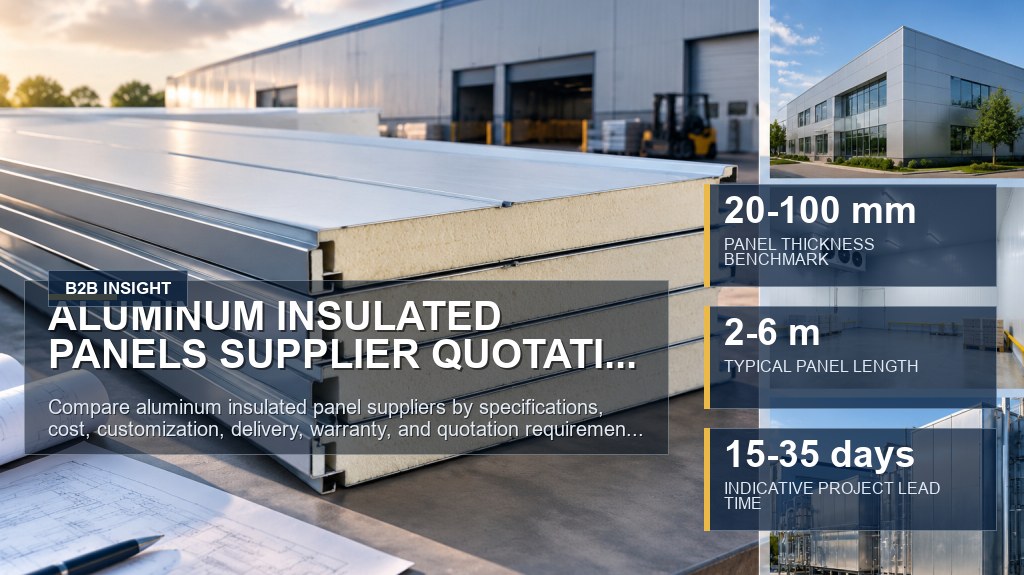
Request a technical datasheet and an itemized quotation from each manufacturer. As indicative procurement benchmarks, common panel thickness may fall within 20–100 mm; individual panel lengths are often around 2–6 m; and a standard project lead time may be estimated at 15–35 days. These are industry reference ranges, not certified specifications or guaranteed performance. Confirm the actual figures in the supplier’s datasheet and formal quotation.
Compare aluminum alloy or grade, skin thickness, core density or thermal conductivity, fire-performance requirements, color, edge treatment, joint profile, tolerances, and accessory compatibility. Ask whether the quoted price includes trims, fasteners, sealants, protective film, pallets, and export packing. For larger orders, a factory-direct supplier may provide better control over customization, inspection, spare parts, and production scheduling.
Cost also depends on order quantity, panel dimensions, surface treatment, tooling, packaging volume, destination, Incoterms, and payment terms. Request separate lines for panels, accessories, tooling, packing, inland transport, and ocean freight when applicable. This makes supplier quotations easier to compare and reduces hidden-cost risk.
How to Select and Verify a Supplier
Evaluate the supplier’s manufacturing capability, sample consistency, quality-control process, packaging method, export experience, and communication speed. Do not rely only on catalogue photographs. Request a physical sample or detailed cross-section images, batch identification, inspection records, and the applicable technical documents. If the project has fire, hygiene, environmental, or building-code requirements, state the destination-market requirements in the inquiry and confirm that the documents apply to the proposed panel structure.
For custom or OEM work, confirm minimum order quantity, drawing approval, sample charges, color matching, tooling ownership, revision control, and change-notification procedures. Clarify how nonconforming goods are handled and whether replacement panels, trims, or other spare parts can be supplied later.
What to Include in an RFQ
Send the supplier the application, estimated quantity, panel dimensions, preferred core, aluminum finish and color, joint or installation method, destination port, packaging needs, and target delivery date. Ask for net and gross weights, loading quantity, production lead time, warranty scope, and available compliance documents. Confirm whether warranty coverage excludes incorrect storage or installation and identify the party responsible for technical support.
To obtain a comparable quotation from an aluminum insulated panels supplier, request the full product specification, unit price, customization cost, delivery term, payment condition, warranty, and accessory list in one document. Buyers can then compare total delivered cost and technical suitability rather than selecting an unsuitable low-price offer.