
Custom Aluminum Products Supplier Quotation Guide
Define the Quotation Scope Before Comparing Prices
A useful custom aluminum products supplier quotation starts with a complete technical and commercial brief. Provide drawings or samples, alloy grade or acceptable alternatives, temper, dimensions, tolerances, surface finish, packaging method, estimated annual volume, destination, and required delivery date. Without this information, a supplier may quote only basic material and processing, leaving tooling, sampling, finishing, inspection, packaging, or freight charges unclear.
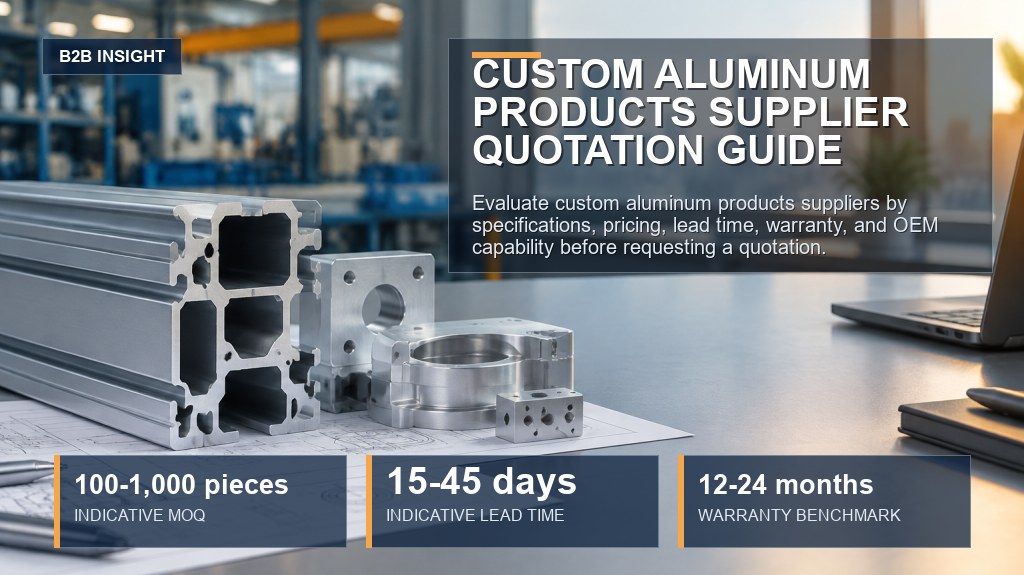
If the design is not finalized, ask for a manufacturability review and an itemized budgetary quotation rather than a single unit price. As an early procurement benchmark, a custom project may have an indicative MOQ of 100–1,000 pieces. This is not a universal requirement: extrusion, machining, fabricated assemblies, and small precision parts can have very different volume economics. Confirm the actual MOQ in the supplier’s quotation.
Compare Manufacturing Controls, Not Just Unit Cost
When reviewing an aluminum products manufacturer, compare material traceability, tooling ownership, equipment suitability, dimensional inspection, batch records, nonconformance handling, and sample approval procedures. A low unit price can become expensive if tolerances drift, surface protection is inadequate, or replacement production delays your project. Request the inspection criteria, report format, quotation validity, and assumptions behind the price.
Separate the timeline into design review, tooling, prototype or first-article approval, production, and shipment. For many standard custom orders, 15–45 days can be used as an initial lead-time discussion range, but it is only an indicative industry benchmark, not a commitment or standard for every aluminum product. The supplier should recalculate the schedule according to material availability, process complexity, order quantity, approval speed, and destination.
Check Warranty, Documentation, and Supply Continuity
Before placing an order, define warranty coverage, claim evidence, corrective-action responsibility, packaging requirements, Incoterms, and the point at which warranty begins. For repeat programs, ask how the supplier manages engineering changes, material substitutions, mold or tooling storage, repeat orders, and spare or replacement parts where relevant.
A warranty period of 12–24 months may serve as an initial commercial discussion benchmark, but the actual period, exclusions, remedy, and start date must be stated in the contract. Do not treat an indicative range as a guaranteed commitment. Request the supplier’s datasheet, inspection documents, and formal quotation as the controlling sources.
Send an Inquiry That Produces a Comparable Quote
Zhending Aluminum can review a more accurate request when buyers include drawings, samples, target quantity, destination country, packaging expectations, acceptance standards, and target delivery date. Ask the supplier to separate unit price, tooling, sampling, finishing, inspection, shipping, payment terms, warranty, and any applicable compliance documentation. Compare the total landed-cost assumptions and the supplier’s response quality, not only the lowest number.
For global B2B sourcing, these three figures—100–1,000 pieces MOQ, 15–45 days indicative lead time, and 12–24 months warranty benchmark—are useful starting points for discussion only. Buyers must confirm them in the supplier’s product datasheet and quotation. Send your product drawings and purchasing requirements to request a product-specific quotation and a practical supply plan.