Aluminum Insulated Panels vs Ordinary Iron Roofs: Key Differences & Performance Parameters
When it comes to roofing materials for residential, commercial, and industrial buildings, two common options are aluminum insulated panels and ordinary iron (steel) roofs. While both are metal-based, their performance, durability, thermal insulation, and long-term value differ dramatically—especially in extreme weather conditions like scorching 38°C (100.4°F) summers or cold winters.
This article breaks down their core differences with professional technical parameters, helping you make an informed choice for your roofing project.
Core Technical Parameters Comparison: Aluminum Insulated Panels vs Ordinary Iron Roofs
To clearly show the gap between the two materials, we’ve compiled key performance parameters, including thermal insulation, durability, load-bearing capacity, and more—all based on industry standards and real-world testing.
| Performance Parameter | Aluminum Insulated Panels | Ordinary Iron Roofs |
|---|---|---|
| Thermal Conductivity (W/(m·K)) | 0.022 – 0.032 (varies by thickness: 40mm-100mm) | 50 – 60 (uninsulated) |
| Temperature Insulation Difference (Outdoor 38°C/100.4°F) | 6 – 13°C (indoor cooler than outdoor) | 0 – 2°C (negligible insulation; indoor temp nearly matches outdoor) |
| Service Life | 30 – 50 years (with anti-corrosion coating) | 5 – 15 years (prone to rust and deterioration) |
| Unit Weight (kg/㎡) | 3 – 7.5 kg/㎡ (depends on thickness) | 8 – 12 kg/㎡ (heavier, increases roof load) |
| Corrosion Resistance | High (aluminum-magnesium alloy + fluorocarbon/polyester coating; resistant to salt, acid, alkali) | Low (easily rusts in humid/coastal/industrial environments) |
| Surface Temperature (Outdoor 38°C/100.4°F) | 45 – 55°C (aluminum surface reflects solar radiation) | 65 – 75°C (iron absorbs most solar heat) |
| Load-Bearing Capacity (kN/㎡) | 1.2 – 4.5 kN/㎡ (varies by thickness) | 2.0 – 3.0 kN/㎡ (lower rigidity, prone to deformation) |
| Fire Rating | B1 – A1 (flame-retardant core; non-combustible) | Unrated (iron melts at high temperatures, aids fire spread) |
| Energy Saving (Annual AC Cost) | Reduces by 20% – 30% (excellent insulation) | No energy saving (increases AC load) |
Key Differences Between Aluminum Insulated Panels and Ordinary Iron Roofs
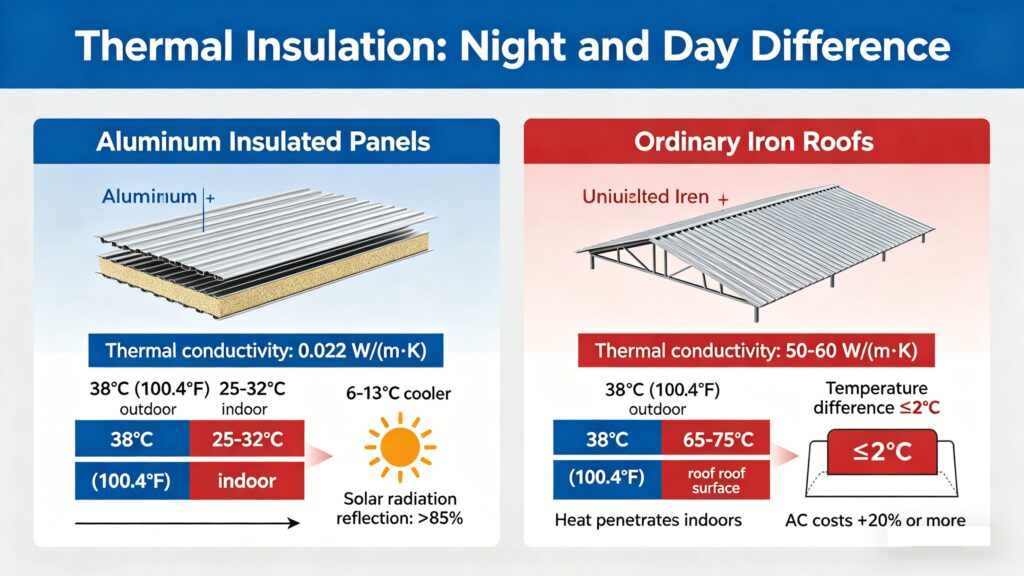
1. Thermal Insulation: Night and Day Difference
The biggest gap between the two lies in thermal insulation performance—thanks to the unique structure of aluminum insulated panels (double aluminum sheets + high-density insulation core).
- Aluminum Insulated Panels: With a thermal conductivity as low as 0.022 W/(m·K), they effectively block heat transfer. In 38°C (100.4°F) summer heat, the indoor temperature can be 6-13°C cooler than the outdoors, significantly reducing air conditioning energy consumption. The aluminum surface also reflects over 85% of solar radiation, preventing the roof from overheating.
- Ordinary Iron Roofs: Uninsulated iron has extremely high thermal conductivity (50-60 W/(m·K)), meaning it absorbs almost all solar heat. On hot days, the roof surface can reach 65-75°C, and heat quickly penetrates indoors—making rooms uncomfortable and increasing AC costs by 20% or more. Even with simple insulation, the effect is minimal (temperature difference ≤2°C).
2. Durability & Corrosion Resistance: Longevity vs Frequent Replacement
Durability directly affects the long-term cost and maintenance of your roof, and the two materials differ drastically in this regard.
- Aluminum Insulated Panels: Made of aluminum-magnesium alloy (naturally anti-rust) and coated with fluorocarbon or polyester, they resist salt spray, acid rain, and industrial fumes—ideal for coastal and industrial areas. Their service life ranges from 30 to 50 years, with no need for frequent repainting or repairs.
- Ordinary Iron Roofs: Uncoated or poorly coated iron is highly prone to rust when exposed to moisture, rain, or salt. Rust leads to perforation, leaks, and structural damage, with a typical service life of only 5-15 years. You’ll need to repaint every 2-3 years to slow rust, adding maintenance costs over time.
3. Structural Strength & Roof Load
The weight and rigidity of the roofing material directly impact the roof’s structural safety, especially for old buildings or light steel structures.
- Aluminum Insulated Panels: Lightweight (3-7.5 kg/㎡) and high-strength—thicker panels (80-100mm) have a load-bearing capacity of up to 4.5 kN/㎡. They place minimal load on the roof structure, making them suitable for old buildings, light steel houses, and large-span factories. Their rigid structure also resists wind, snow, and impact without deformation.
- Ordinary Iron Roofs: Heavier (8-12 kg/㎡), increasing the roof’s load-bearing burden—unsuitable for old or weak roof structures. Iron sheets are thin and lack rigidity, easily bending or warping under wind, snow, or heavy loads, leading to water ponding and leaks.
4. Fire Safety: Protection vs Risk
Fire safety is a critical consideration for all buildings, and aluminum insulated panels have a clear advantage.
- Aluminum Insulated Panels: The middle insulation core is flame-retardant (B1-A1 grade), and the aluminum surface is non-combustible. In case of fire, they do not melt, drip, or spread flames, providing extra time for evacuation and reducing fire damage.
- Ordinary Iron Roofs: Iron melts at around 1538°C, and uninsulated iron roofs can accelerate fire spread by conducting heat. They offer no fire protection, increasing the risk of fire escalation.
5. Installation & Maintenance: Convenience vs Hassle
- Aluminum Insulated Panels: Factory pre-cut and formed, with a simple interlocking design. They are lightweight and easy to install, reducing labor time by 50% compared to ordinary iron roofs. Maintenance is minimal—rainwater self-cleans the surface, and no repainting is needed for decades.
- Ordinary Iron Roofs: Requires on-site cutting and welding, which is time-consuming and labor-intensive. Regular maintenance (repainting, rust removal) is mandatory to extend service life, adding ongoing costs and hassle.
Which One Should You Choose?
- Choose aluminum insulated panels if: You prioritize thermal insulation, energy saving, durability, and low maintenance—especially for residential, factory, or coastal buildings, or areas with extreme temperatures.
- Choose ordinary iron roofs only if: You have an extremely tight budget, and the roof is for temporary buildings (e.g., sheds) that do not require insulation or long-term use.
Conclusion
Aluminum insulated panels outperform ordinary iron roofs in almost every key performance metric—from thermal insulation and durability to safety and energy saving. With lower long-term costs, better performance, and wider applicability, they are the superior choice for modern roofing projects.
Our factory has a wealth of solutions available to help you design the perfect roof for your building, whether you need thermal insulation, corrosion resistance, or structural stability.