
How to Become a UK Distributor for Insulated Aluminum Roof Panels
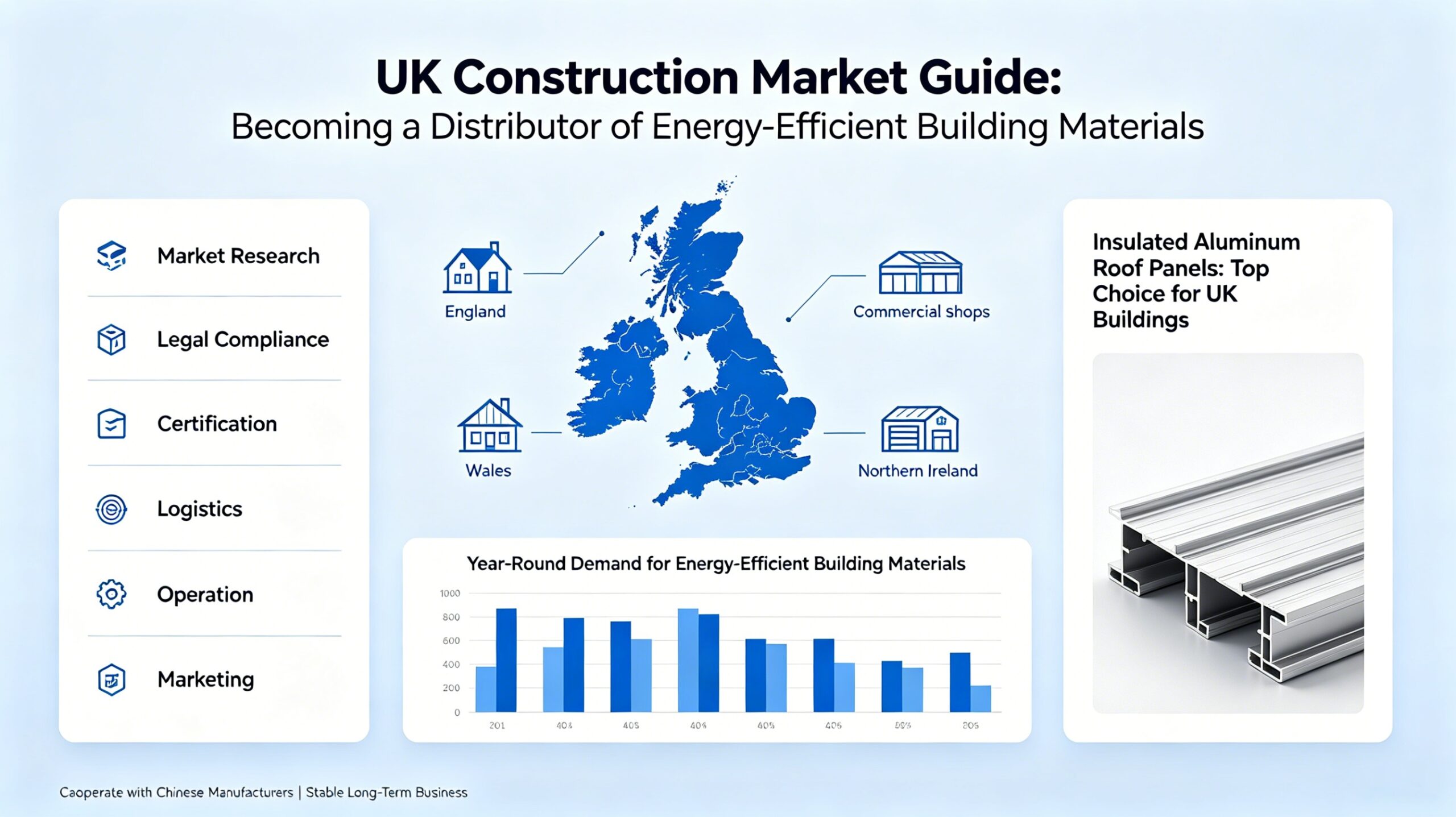
The UK construction market maintains steady demand for energy-efficient building materials all year round.
Thanks to changeable weather, cold winters and rising energy costs, insulated aluminum roof panels have become a top choice for residential homes, commercial shops, warehouses, garages and farm buildings across England, Scotland, Wales and Northern Ireland.
If you plan to cooperate with professional Chinese manufacturers and act as their official distributor in the UK, sufficient preparation is the key to stable long-term business.
This comprehensive guide covers all essential work including market research, legal compliance, certification, logistics, operation and marketing, helping you become a qualified and profitable local distributor smoothly.
1. Research UK Local Market & Product Positioning First
Before launching cooperation, fully understand local climate, customer demands and competitor situations to match products with the market.
UK Climate & Core Product Advantages
The UK features cool, wet weather all year round. Winters are cold and damp, while summers are mild with frequent rain and wind. Traditional metal roofs easily cause heat loss, condensation and damp problems.
Insulated aluminum roof panels stand out for these strengths:
- Excellent heat retention to cut heating bills in cold winter
- Effective heat insulation for comfortable indoor temperature in summer
- Waterproof, anti-rust and anti-condensation performance for rainy days
- Lightweight, easy installation and long service life
Popular Panel Thickness in the UK
- 50mm: Bestseller for ordinary houses, small shops and garages, cost-effective for general insulation needs.
- 75mm: Preferred for family homes, offices and medium-sized warehouses, delivers superior thermal performance.
- 100mm: Ideal for cold northern areas like Scotland and high-standard commercial buildings, maximum heat preservation.
Competitor Analysis
Investigate existing local suppliers, imported brands, their pricing, product specifications and after-sales policies. Define your own price range and selling highlights to build competitive edges.
2. Complete Legal Registration & Import Compliance (Mandatory)
The UK has strict regulations on imported construction materials and cross-border trade. Non-compliance will lead to customs detention, fines or sales bans.
Business Registration
- Register your official business entity with Companies House. Choose a suitable business type such as Limited Company, the most common form for trading distributors.
- Apply for UTR (Unique Taxpayer Reference) and VAT registration. VAT is compulsory for trading in the UK, and you need to declare and pay taxes regularly.
- Obtain local business trading license and construction material sales qualification according to regional requirements.
Import Rules & Customs Documents
After Brexit, the UK has independent import regulations. Prepare complete documents for customs clearance:
- Commercial invoice, packing list, bill of lading and certificate of origin
- Product test reports and certification files
- Correct commodity code for insulated roof panels to ensure accurate tariff payment
It is recommended to cooperate with a professional local freight forwarder and customs broker who is familiar with importing goods from China, to avoid clearance delays and extra costs.
3. Obtain Essential UK & EU Relevant Certifications
Certification is the core threshold for selling building materials in the UK and the biggest trust point for local buyers.
CE Marking
Although the UK has left the EU, CE marking is still widely recognized and accepted by local contractors, builders and consumers for construction products. Your supplied insulated aluminum roof panels must pass relevant tests and carry valid CE marks.
UKCA Marking
UKCA (UK Conformity Assessed) is the mandatory certification for goods sold on the UK market. All insulated building panels must apply for UKCA certification, covering thermal performance, fire resistance, structural safety and durability. Products without UKCA marks cannot be sold legally in the UK.
Other Auxiliary Documents
- English version technical data sheet, installation manual and safety instruction
- Fire performance report, thermal resistance (R-value) test report
- Warranty certificate in line with local trade rules
4. Financial Preparation & Capital Planning
Cooperating with overseas factories requires stable capital flow. Make a detailed budget for initial investment and daily operation.
Main Capital Expenditure
- Initial bulk order: Prepare funds for the first batch of inventory. Mix 50mm and 75mm panels as main stock, and add a small quantity of 100mm panels for cold regions.
- Warehouse rental: Choose a dry, covered warehouse, preferably near major transportation routes such as London, Birmingham, Manchester to realize fast local delivery.
- Logistics vehicles & tools: Equip delivery vans and basic handling tools for distributing goods to local retailers and construction sites.
- Operating capital: Reserve funds for staff salary, marketing, daily expenses and after-sales service.
Payment Terms with Chinese Factories
Most Chinese manufacturers adopt T/T payment: 30% deposit before production, 70% balance before shipment. Prepare complete bank documents to prove your financial strength. After long-term stable cooperation, you can negotiate more flexible payment terms.
5. Build Warehouse, Logistics & Operational System
Sound operation capacity determines delivery efficiency and customer satisfaction.
Warehouse Management
- Classify and stack panels by thickness to realize quick inventory checking and picking.
- Keep the warehouse dry and ventilated to prevent aluminum panels from damp and scratches.
- Set up a complete inventory management system to track incoming and outgoing goods in real time.
Local Distribution & Delivery
Design reasonable delivery routes covering your sales territory. Provide timely door-to-door delivery service for small retailers, contractors and project customers. Fast delivery is an important advantage to win repeat orders.
Team Arrangement
- Sales staff: Familiar with product performance, local construction industry and communication skills to develop B2B and B2C customers.
- Technical staff: Master product installation knowledge to provide technical guidance for builders and buyers.
- Admin & finance: Responsible for order processing, document sorting, tax declaration and account management.
Master Product Knowledge
Organize team training to fully learn product structure, insulation performance, installation steps, warranty scope and common problems handling. Professional service helps build long-term trust with clients.
6. Develop Localized Sales & Marketing Strategy
Target the UK market with tailored marketing plans to expand customer groups quickly.
Main Sales Channels
- B2B Channels (Core Business) Cooperate with local building merchants, roof contractors, construction companies and renovation teams. They are the largest purchasing groups of insulated roof panels.
- Retail Customers Homeowners, garage owners and farm owners. Promote products via online platforms and local offline promotion.
- Engineering Projects Participate in bidding for small and medium-sized construction, renovation and public facility projects.
Localized Marketing Content
- All brochures, catalogs, posters and online content use standard British English.
- Highlight core selling points for the UK market: energy saving, heating cost reduction, waterproof, anti-condensation, UKCA & CE certified, long lifespan.
- Share real cases: before-and-after comparison of traditional roofs and insulated aluminum panels, energy saving data and user feedback.
Offline & Online Promotion
- Offline: Attend UK local construction exhibitions, visit building material markets and hold product demonstrations.
- Online: Build official website optimized for UK SEO keywords, run social media promotion on Facebook, Instagram and LinkedIn, and cooperate with local building industry influencers.
7. Negotiate & Sign Formal Distribution Agreement
After confirming all preparations and reaching consensus with the factory, sign a formal distribution contract to protect the rights and interests of both sides.
Key clauses that must be clarified:
- Exclusive sales territory in the UK
- Annual/monthly minimum order quantity
- Unified factory price, volume discount policy
- Product warranty, after-sales responsibility and defective goods processing rules
- Supply cycle, delivery time and liability for delay
- Contract term, renewal and termination terms
It is suggested to invite a local professional lawyer to review the contract to ensure compliance with UK commercial laws.
Conclusion
Becoming a distributor of insulated aluminum roof panels in the UK is a reliable long-term business opportunity, driven by permanent demand for energy-saving building materials.
The whole preparation work can be summarized into six key points: clear market positioning, complete legal certifications, sufficient capital reserve, perfect operation and logistics, localized marketing plans and standardized distribution contracts.
Winter is the peak season for insulation demand in the UK. If you finish all preparations in advance, you can seize the market opportunity rapidly, establish stable cooperation with Chinese factories, and gain continuous profits in the UK construction industry.