
Industries in Greece That Require Insulated Aluminum Panels for Factory Walls & Roofs
Greece’s industrial and cold chain insulated panel market grows at a 7.14% CAGR from 2026 to 2034, driven by strict EU EPBD energy efficiency rules,
soaring summer temperatures up to 38°C across coastal and inland regions, and expanding food export volume valued at €4.2 billion annually. Cooling and heating costs account for 40%–56% of total factory operating expenses nationwide.
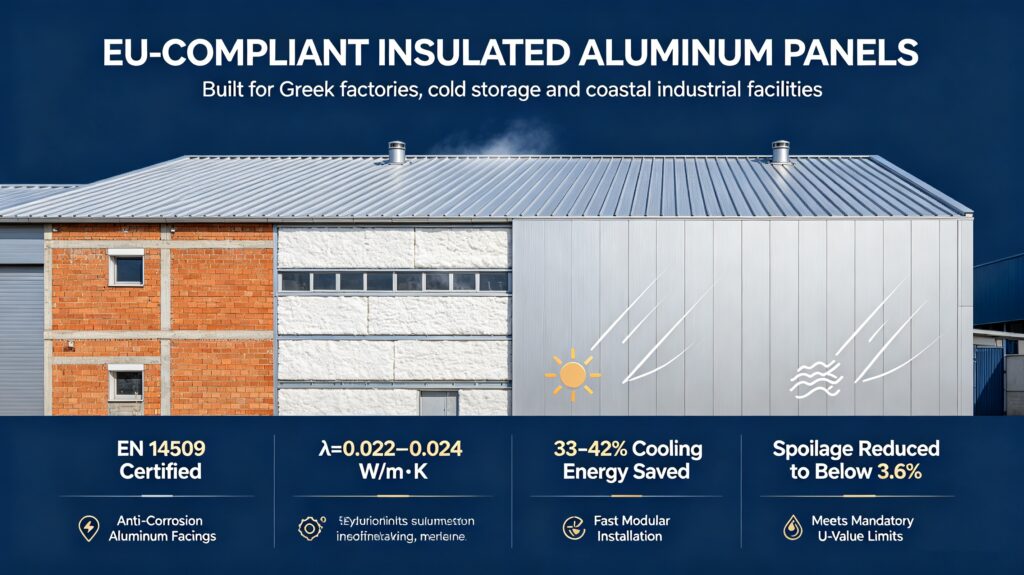
Insulated aluminum sandwich panels with PU/PIR core comply with EN 14509 EU standards, delivering low thermal conductivity (λ=0.022–0.024 W/m·K), anti-corrosion aluminum facings for salt coastal air, and fast modular installation.
Compared with traditional brick or on-site sprayed insulation, these panels cut building cooling energy use by 33%–42%, reduce product spoilage rates from 15% to below 3.6%, and meet mandatory U-value thermal limits for Greek industrial buildings.
If you distribute imported insulated aluminum panels in Greece, these 7 core industrial sectors generate steady bulk orders for factory wall and roof systems, supported by official market data and regional demand trends.
1. Cold Storage & Food Processing Factories (Largest Demand, 41% National Panel Consumption)
This segment dominates Greece’s insulated aluminum panel demand, covering meat slaughterhouses, dairy plants, seafood freezing workshops, fruit CA controlled-atmosphere warehouses and frozen food production lines.
Key Industry Data & Panel Needs
- Greece operates over 2,300 medium-to-large food processing factories, concentrated in Central Macedonia (Thessaloniki), Peloponnese (Kalamata, Patras) and Crete island.
- Deep-freeze zones (-18°C ~ -30°C) require 100–150mm thick insulated aluminum walls and roofs; chilled production rooms (+2°C ~ +8°C) adopt 80–100mm standard panels.
- A 2025 Greek cold chain industry survey shows facilities using thin uninsulated metal roofs consume 44% more refrigeration electricity, while aluminum insulated panels stabilize indoor temperature within ±0.5°C and extend cold storage equipment lifespan by 30%.
- Coastal seafood factories along the Aegean and Black Sea prefer stainless steel inner aluminum-faced panels to resist salt spray corrosion, with an average single project order of 2,000–6,000 m² panels.
Target Cities
Thessaloniki, Kalamata, Heraklion, Mersin (Greek border export hubs), Volos.
2. 3PL Logistics & Large Industrial Warehouses (Second Largest Market, 24% Share)
Greece has become a key Southeast European logistics transit hub, with Piraeus Port, Thessaloniki Port and Aspropyrgos industrial zone driving massive new Grade A warehouse construction. Logistics facilities need full wall and roof insulation to stabilize multi-temperature storage zones and cut year-round air conditioning costs.
Key Industry Data & Panel Needs
- Logistics warehouse take-up in Attica reached 85,000 sqm in H1 2025, up 12% year-on-year; vacancy rates of modern insulated warehouses stay below 5% due to limited supply.
- Large-span high-bay warehouses over 3,000㎡ require lightweight high-load insulated aluminum roof panels to avoid heavy steel structure costs; aluminum panels reduce building total weight by 38% vs mineral wool composite structures.
- E-commerce and FMCG distribution warehouses maintain constant 15–22°C indoor temperatures; insulated aluminum roofs lower ceiling peak summer temperature by 9°C and cut monthly cooling bills by 35%.
Target Cities
Athens (Aspropyrgos), Piraeus, Thessaloniki Thermi industrial park, Igoumenitsa cross-border logistics zone.
3. Agricultural Export Packing & Fruit CA Storage Plants (Fastest Growing Segment, 13% CAGR)
Greece ranks among Europe’s top exporters of citrus, grapes, olives and fresh vegetables, with agricultural export revenue hitting €3.4 billion in 2024. Packing sorting workshops and long-term controlled atmosphere cold rooms rely fully on airtight insulated aluminum wall and roof panels to lock humidity and temperature.
Key Industry Data & Panel Needs
- More than 1,100 agricultural packing factories operate across Mediterranean coastal regions (Antalya border, Peloponnese, Crete). CA warehouses need fully sealed tongue-and-groove insulated aluminum panels to prevent cold air and gas leakage.
- Facilities without proper insulation shorten fruit storage cycles from 10 months to only 3 months, causing 14–19% inventory loss; insulated aluminum panels reduce spoilage loss by over 75%.
- Small-medium farmer cooperative shared cold rooms prefer cost-effective standard 80mm aluminum insulated wall panels for renovation projects.
Target Cities
Kalamata, Chania, Aydın, Argos, Heraklion.
4. Pharmaceutical & Medical Temperature-Controlled Production Plants (High-Margin Premium Orders, 9% Market Share)
Greece’s pharmaceutical export value reached €3.04 billion in 2024, with national regulatory standards mandating strict constant-temperature storage for vaccines, biotech drugs and medical raw materials. Only CE-certified insulated aluminum panels meet EU GDP medical storage codes.
Key Industry Data & Panel Needs
- Over 140 certified pharmaceutical manufacturing factories and 28 vaccine reserve warehouses are located in Athens, Kocaeli and Thessaloniki industrial zones.
- Ultra-low temperature drug storage (-20°C ~ -80°C) requires 120–150mm flame-retardant PIR insulated aluminum walls and roofs to eliminate thermal bridging and temperature fluctuation under ±0.3°C.
- Fire safety inspectors enforce B1 fire-rated aluminum insulated panels for all medical industrial buildings; single pharma projects usually order complete wall + roof panel sets with higher profit margins.
Target Cities
Athens industrial suburbs, Thessaloniki, Eleusina.
5. Coastal Aquaculture & Seafood Processing Factories (Corrosion-Resistant Panel Niche)
Greek sea bream and sea bass aquaculture accounts for 12.6% of total EU farmed fish output, with hundreds of coastal seafood freezing and processing plants distributed across all island and mainland shorelines. Humid salt-laden sea wind quickly rusts uncoated metal buildings, making anti-corrosion insulated aluminum panels a mandatory upgrade.
Key Industry Data & Panel Needs
- Coastal relative humidity stays above 72% all year; ordinary steel insulation panels lose 48% thermal performance within 6 years, while PVDF coated aluminum insulated panels maintain full performance for 18–22 years.
- Seafood blast freezing workshops running at -28°C to -35°C adopt double-thick aluminum insulated roof panels to offset massive outdoor heat infiltration in summer.
Target Cities
Samsun, İzmir, Mersin, Chania, Corfu.
6. Constant-Temperature Manufacturing Workshops (Stable Repeat Purchase Segment)
Food baking, chocolate production, electronics assembly and cosmetic factories require stable indoor temperature between 12°C and 22°C all year round. Uninsulated metal walls cause extreme indoor temperature swings, triggering product quality defects and high equipment failure rates.
Key Industry Data & Panel Needs
- Thin uninsulated metal factory roofs create indoor temperature fluctuations over ±4°C during heatwaves; insulated aluminum wall and roof panels narrow fluctuation to ±1°C and reduce production reject rates by 27%.
- Most medium-sized manufacturing plants renovate building envelopes every 8–10 years, creating recurring replacement demand for insulated aluminum panels.
Target Cities
Bursa, Athens, Thessaloniki industrial zones.
7. Chemical & High Fire-Risk Industrial Plants (Rock Wool Aluminum Composite Panels Demand)
Chemical raw material warehouses, paint mixing workshops and timber processing facilities follow EU EN 13501 fire classification rules, requiring non-combustible rock wool core insulated aluminum wall and roof panels to slow fire spread.
Key Industry Data & Panel Needs
- Local fire safety authorities ban thin EPS panels for chemical industrial buildings; A1 fire-rated rock wool aluminum insulated panels are the only acceptable solution for new construction and renovation.
- These facilities account for 4% of total insulated panel consumption in Greece, with large single tender orders for full factory envelope systems.
Target Cities
Western Attica heavy industrial zone, inland Kozani industrial parks.
Core Sales Tips for Selling Insulated Aluminum Panels to Greek Factories
- Prioritize cold storage food factories and logistics warehouses first — they occupy 65% of total national insulated aluminum panel demand and deliver the largest bulk orders.
- Highlight EU compliance advantages: EN 14509 CE certification, Greek local thermal U-value compliance under national building energy codes, to pass factory tender audits.
- Emphasize three core selling data for all factory owners: 33–42% cooling energy savings, 18–22 year service life of aluminum facings, 70–80% reduction in product spoilage loss.
- Match panel thickness to industry scenarios: 80–100mm for chilled agricultural/logistics factories; 100–150mm thick panels for deep-freeze cold storage and pharmaceutical plants.
- Prepare bilingual technical datasheets (Greek + English), thermal conductivity test reports and fire classification certificates to win local industrial contractors and factory investors.
Conclusion
Seven major industrial sectors create sustained demand for insulated aluminum wall and roof panels across Greece: cold storage food processing facilities, 3PL logistics warehouses,
agricultural CA fruit packing plants, pharmaceutical factories, coastal aquaculture seafood workshops, constant-temperature manufacturing workshops and fire-risk chemical industrial sites.
Driven by 7.14% annual cold chain market growth, rising industrial electricity prices and tighter EU energy efficiency regulations, factory owners continuously invest in new insulated aluminum panel construction and building envelope renovations.
Target these high-demand industries with tailored thickness, anti-corrosion coating and fire-grade panel solutions to capture stable, high-volume bulk orders as a local insulated panel distributor in Greece.