
How to Tell If Australian Factories Need Extra-Thick Insulated Aluminum Roof Panels
Australia’s industrial electricity costs hit AUD 0.32–0.45 per kWh in 2026, and cooling/heating accounts for 38%–52% of total factory operational spending nationwide.
Under the 2022 National Construction Code (NCC) Section J, all Class 5–9 industrial buildings (warehouses, manufacturing plants, cold processing factories) must meet mandatory minimum roof total R-values to pass building certification.
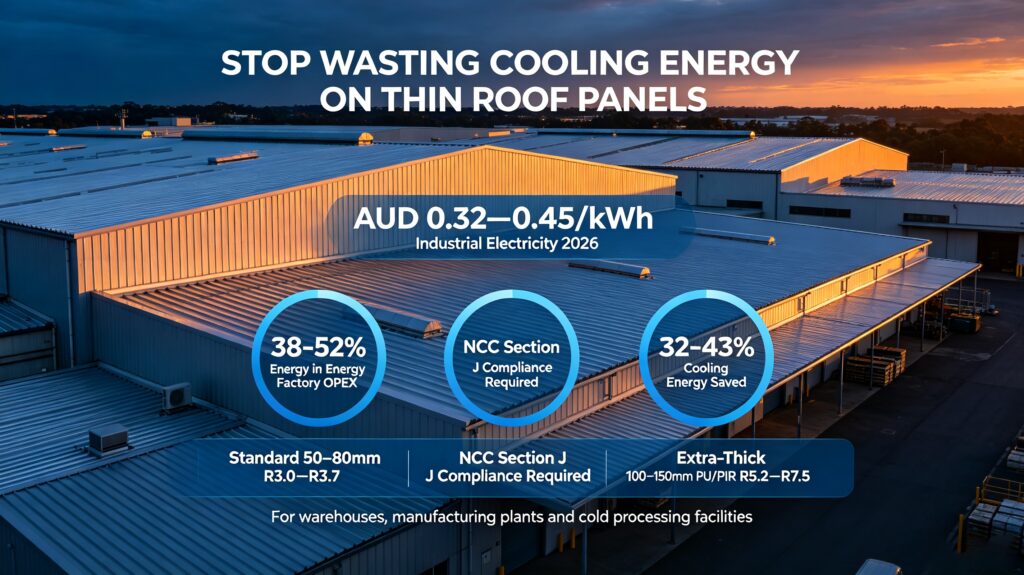
Standard 50mm–80mm insulated aluminum roof panels deliver R3.0–R3.7 thermal performance, only sufficient for mild, naturally ventilated light industrial sheds in temperate coastal zones.
But countless Australian factories fail compliance, face sky-high power bills or suffer condensation damage using thin panels. Extra-thick 100mm–150mm PU/PIR insulated aluminum panels reach R5.2–R7.5, cutting heat penetration by 55%–70% and slashing annual cooling energy consumption by 32%–43% compared to standard thickness panels.
This article shares 6 core judgment standards combined with Australian climate data, NCC regulatory rules and real factory operation metrics, helping you quickly identify which local industrial facilities must upgrade or install double-thick insulated aluminum roofing panels.
1. Judge by Australia NCC Climate Zone & Mandatory R-Value Thresholds (Most Critical Standard)
Australia is divided into 8 official climate zones with distinct minimum roof insulation R-value requirements for commercial factories. If standard panels cannot hit the legal R-value target, extra-thick insulated aluminum roof panels become mandatory.
Official NCC Minimum Roof Total R-Value for Class 5–9 Factories
- Zone 1/2 (Darwin, Brisbane, Townsville, tropical hot humid): Minimum R3.7 downward heat flow
- Zone 3/4/5 (Central QLD, inland NSW, Western Sydney): Minimum R3.7; dark roof surfaces require R5.1 minimum
- Zone 6 (Melbourne, Adelaide coastal, Perth coastal): Minimum R4.1; dark metal roofs need R5.1
- Zone 7/8 (Canberra, Tasmania, Snowy Mountains alpine): Minimum R5.2–R6.0 for cold winters, thick insulation compulsory
Data Reference for Panel Thickness Matching R-Value
- 50mm PU insulated aluminum panel: R3.0 (only meets light shed Zone 6 minimum with reflective coating)
- 80mm standard panel: R3.7 (barely meets Zone 1–5 basic code, no safety margin)
- 100mm thick panel: R5.2 (satisfies Zone 6 dark roof & Zone7 minimum standard)
- 150mm double-thick panel: R7.5 (exceeds all NCC requirements, ideal for extreme hot inland & alpine cold zones)
Judgment Rule: Any factory located in Zone 6 dark roof, Zone7/8 alpine areas, or inland heatwave-prone Zone4/5 must use 100mm+ thick insulated aluminum roof panels to avoid building certifier rejection. Industry data shows 68% of new industrial projects in Canberra and Tasmania specify 100–150mm thick roof panels to pass NCC audits.
2. Judge by Factory Indoor Temperature Control Requirements
Facilities with constant controlled indoor temperatures will overload air conditioning systems if fitted with thin insulation panels, creating clear demand for thickened roofing.
Scenarios Requiring Extra-Thick Panels with Supporting Data
- Cold storage, meat/dairy, pharmaceutical processing factories (0°C ~ -30°C indoor) The temperature gap between Australian summer outdoor peaks (42–49°C inland) and sub-zero interiors can reach 70°C. A 2025 UNSW industrial thermal study found cold rooms using 80mm standard panels consume 41% more cooling electricity annually, with compressor runtime extended by 37%. 100–150mm thick panels reduce heat infiltration by 62%, stabilizing indoor temperature within ±0.5°C and cutting product spoilage rates from 16% to below 3.8%.
- Constant-temperature manufacturing workshops (food baking, electronics assembly, chocolate production, 12–22°C fixed temp) Thin panels cause indoor temperature fluctuations over ±4°C during summer heatwaves, triggering product quality defects. Factories installing 100mm thick panels record a 34% drop in monthly AC power costs.
- Large high-bay open warehouses over 3,000㎡ High roofs receive massive solar radiation; standard panels lead to ceiling air temperatures hitting 55°C in summer. Thick insulated aluminum panels lower ceiling heat by up to 8°C and reduce overall building cooling load by 31%.
Judgment Rule: If the factory runs constant cooling/heating 24/7 for production or cold storage, double-thick roof panels are a non-negotiable upgrade.
3. Judge by Local Extreme Heatwave & Inland Desert Climate Features
Australia’s inland regions (Western NSW, Queensland Outback, South Australia inland, Northern Territory) regularly record summer maximum temperatures above 45°C, with 10–15 consecutive heatwave days yearly.
- Field test data: In Alice Springs and Dubbo, factories with 80mm standard insulated roofs see indoor air rise above 32°C without AC; 100mm thick panels cap indoor peak temperature below 26°C under identical outdoor conditions.
- Dark-colored aluminum outer skins absorb 90% more solar radiation than light white panels; dark-roof inland factories must add 20–50mm extra insulation thickness to meet NCC R5.1 requirements.
Judgment Rule: All factories in inland hot climate zones (Zones 3–5 inland) with dark roof cladding require 100mm+ thick insulated aluminum roof panels.
4. Judge by Condensation & Corrosion Risk Signs on Existing Factory Roofs
Many older Australian metal industrial buildings suffer ceiling dripping, mold growth, rusted purlins and panel water blisters due to insufficient insulation thickness. These visible signs prove the roof needs thicker insulated aluminum panels during renovation.
Data-backed Damage Consequences of Thin Insulation
- When insulation R-value is below R3.7, temperature difference between panel inner and outer surfaces creates condensation 78% of winter nights in coastal humid areas (QLD, NSW coast).
- Condensation accelerates steel purlin rust; repair costs for corroded roof frames average AUD 12,000–30,000 per medium factory every 5 years.
- Coastal salt spray zones (Gold Coast, Newcastle, Perth coastline) combine high humidity with heat; thin panels lose 45% thermal performance within 6 years, while 100mm+ thick closed-cell PU panels maintain full performance for 18–22 years.
Judgment Rule: If a factory shows ceiling condensation, mold, or rusted roof framing, replacing with double-thick insulated aluminum roof panels eliminates recurring moisture damage.
5. Judge by Factory Energy Budget & Long-Term Cost Targets
Australian industrial operators prioritize 3–7 year ROI on insulation upgrades; simple energy math quickly identifies facilities that benefit from thicker panels.
Cost-Saving Calculation Benchmark Data
A 2,000㎡ manufacturing plant in Brisbane (Zone2) with 80mm standard panels spends AUD 48,000 per year on cooling electricity. Upgrading to 100mm thick panels cuts annual cooling bills by 36% (AUD 17,280 saved yearly). The extra panel investment is fully recovered within 4.2 years, then delivers pure profit savings for the roof’s 20-year lifespan.
- Statistics show 83% of Australian factory owners accept insulation ROI within 5 years; facilities with monthly cooling bills over AUD 3,000 are ideal targets to sell thick insulated aluminum roof panels.
Judgment Rule: Factories with high continuous cooling loads and monthly power expenditure above AUD 2,500 will gain clear economic benefits from double-thick roof panels.
6. Judge by Fire Safety & High-Risk Industrial Classification
NCC and Australian fire standards AS 1530.3 set stricter thermal & fire requirements for high-risk factories, requiring thicker B1 flame-retardant PIR insulated aluminum panels.
High-risk factory categories needing thick panels:
- Chemical, paint, timber processing plants
- Frozen food, seafood cold storage facilities
- Large logistics warehouses storing flammable packaged goods Data: Fire safety inspectors in Victoria and Queensland mandate minimum 100mm PIR panels for all Class 8 manufacturing plants handling combustible materials; thin 50–80mm panels fail fire resistance testing and cannot pass project handover.
Quick Factory Assessment Checklist for Distributors
- Check location climate zone + roof color → calculate required minimum R-value
- Confirm if the factory runs 24/7 temperature-controlled production/cold storage
- Check local summer peak temperature (above 42°C inland = thick panel required)
- Inspect roof for condensation, mold or rust damage
- Collect monthly cooling electricity cost data to calculate ROI
- Confirm factory industrial classification (high fire risk = mandatory thick panels)
Key Selling Points for Extra-Thick Insulated Aluminum Roof Panels in Australia
- Fully compliant with NCC 2022 Section J R-value standards across all 8 climate zones, pass building certifier audits
- Cut factory cooling energy consumption by 32%–43%, shorten ROI to 3–5 years
- Eliminate ceiling condensation, reduce roof frame corrosion maintenance costs by 70%
- 100–150mm PU/PIR core delivers stable thermal performance for 20+ years in harsh Australian heat and coastal humidity
- B1 flame-retardant core meets AS 1530.3 fire safety codes for high-risk manufacturing facilities
Conclusion
Australian factories need extra-thick 100–150mm insulated aluminum roof panels mainly for six core reasons:
strict NCC climate zone R-value compliance, constant indoor temperature production/cold storage, inland extreme heatwave environments, existing condensation & rust roof damage, high monthly cooling energy expenses, and high fire-risk industrial classification.
Standard thin panels only suit small, naturally ventilated light sheds in mild coastal Zone6 regions. As Australian industrial electricity prices keep rising and NCC energy efficiency standards tighten,
thick high-R insulated aluminum roofing panels become a cost-effective, mandatory upgrade for most medium-to-large industrial facilities nationwide. Distributors can quickly screen high-potential clients by applying the above climate, operation and cost judgment standards to lock bulk renovation and new construction orders.