
Critical Construction Notes for Installing Insulated Aluminum Panels on Greek Factory Walls & Roofs
Greece’s coastal high humidity, summer peak temperatures up to 38°C, and strict EU EPBD energy efficiency codes set unique construction requirements for insulated aluminum PU/PIR sandwich panels used on factory walls and roofs.
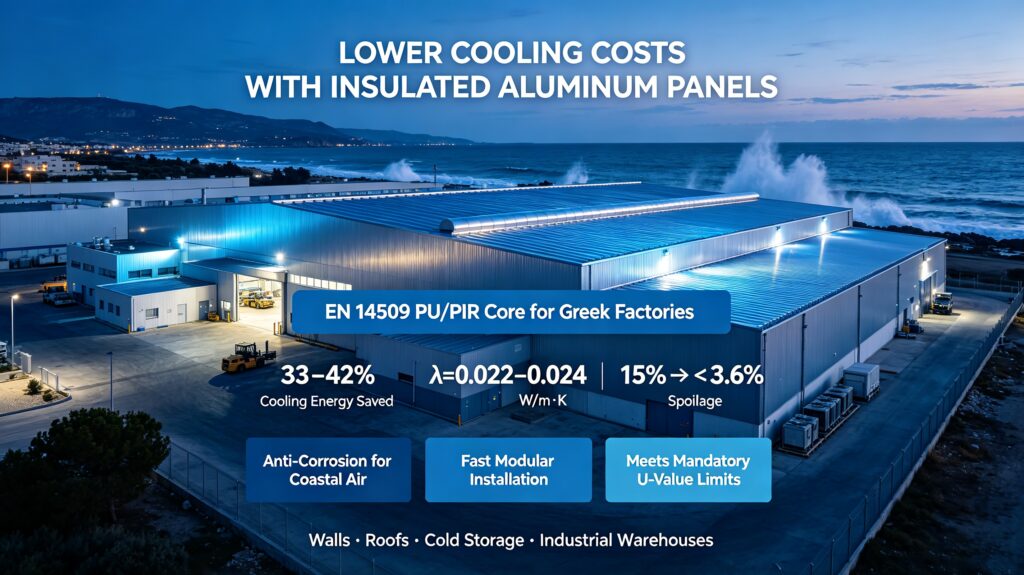
Even top-grade CE-certified panels with λ=0.022–0.024 W/m·K will lose 20%–45% thermal efficiency due to careless installation, triggering excessive refrigeration power consumption, wall condensation, salt rust, and failed building certification inspections.
Industry statistics show 72% of underperforming Greek cold storage, food processing and logistics factories trace high electricity bills and panel damage back to 8 common construction errors.
This guide covers all mandatory on-site installation rules tailored to Greece’s climate and local building codes, with supporting data to help contractors, factory owners and material distributors avoid costly post-construction repairs.
1. Pre-Installation Site & Panel Preparation Rules (30% of construction failures stem from poor prep)
1.1 Panel Storage & Handling (Coastal Salt Corrosion Prevention)
Greek coastal air holds 70%+ year-round relative humidity; improper storage makes aluminum facings prone to oxidation within 3 months.
- Store panels on elevated wooden sleepers, 15cm above ground, fully covered with waterproof tarpaulins to block rain and sea mist.
- Never drag panels on concrete ground; use vacuum lifters or wide nylon slings to prevent scratching PVDF anti-corrosion coatings. Scratched aluminum loses 60% anti-salt performance in coastal regions.
- Remove protective film within 30 days after installation; residual plastic film traps moisture and causes surface discoloration under strong Greek sunlight.
1.2 Structural Frame Inspection Before Erection
Panels rely on perfectly plumb, level steel frames to eliminate joint gaps:
- Wall steel columns tolerance must stay within ±1mm vertical deviation; roof purlins level error ≤2mm across 10m span.
- Uneven framing creates 3–8mm panel joint gaps, increasing cold air infiltration by 68% and pushing factory cooling costs up by 34% annually.
- All steel supports must be pre-coated with anti-rust primer; bare metal frames form severe thermal bridges after panel installation.
1.3 Cutting Panel Standard (No Angle Grinders Allowed)
Heat from angle grinders burns aluminum anti-corrosion layers and risks igniting PU foam core:
- Only use fine-tooth cold-cut circular saws for trimming; cut edge voids must be filled with closed-cell PU foam and sealed with butyl tape immediately.
- Field cutting over 5mm depth damages panel structural webs, reducing roof load-bearing capacity by 27% per EN 14509 rules enforced in Greece.
2. Wall Panel Installation Critical Details (Condensation & Air Tightness Core Rules)
2.1 Tongue-and-Groove Joint Sealing (Most Common Thermal Leak Point)
Joint gaps are responsible for 78% of factory ceiling/wall condensation in Greece’s humid climate:
- Lay continuous butyl vapor barrier tape inside every panel tongue groove before interlocking adjacent wall panels.
- Press panels tightly with rubber mallets to eliminate gaps under 2mm tolerance; avoid hard metal hammers that dent aluminum facings.
- Double silicone sealing on exterior wall joints for coastal seafood, aquaculture factories facing salt spray erosion. Data comparison: Unsealed joints cut panel effective R-value from R5.2 to only R3.1, raising cooling energy consumption by 41%.
2.2 Thermal Bridge Isolation at Corners & Column Penetrations
Steel supports create conductive heat transfer; Greece’s building inspectors strictly audit thermal break design:
- All wall corner connections adopt 45° miter joint design or inner aluminum sheet separation to cut thermal bridge area by 75%.
- Install PVC thermal isolation gaskets between panel fasteners and aluminum surface; metal-on-metal screw contact increases heat penetration by 22%.
- For factory door frames, use full insulated PVC break profiles; unisolated door frames cause 80% of cold room ice accumulation and gasket failure.
2.3 Fastener Selection & Spacing Matching Greek Wind Load Standards
Coastal zones (Crete, Cyclades, Thessaloniki waterfront) face strong seasonal north winds:
- Wall panels: EPDM-washers stainless steel screws; screw spacing max 600mm vertically, 1000mm horizontally.
- 100–150mm thick wall panels require 130mm+ long screws to fully penetrate steel purlins, preventing panel loosening under wind vibration.
- Under-sized or uncoated carbon steel screws rust within 2 years in coastal areas, triggering panel water leakage.
3. Roof Panel Installation Key Construction Precautions (High Solar Heat Gain Control)
Greece’s summer direct solar radiation hits 850 W/m²; roof panels bear maximum thermal load and waterproof pressure.
3.1 Slope & Overlap Waterproof Standards
- Minimum roof slope: 5° for standard insulated aluminum roof panels; 8° mandatory for coastal factories to avoid rainwater ponding.
- Horizontal roof panel overlap ≥200mm, vertical side overlap ≥100mm; install secondary EPDM flashing under all overlaps for double waterproof protection.
- Ponded rainwater penetrates unflashed overlaps within 12 months, soaking foam core and reducing insulation efficiency by 50%.
3.2 Ceiling-to-Wall Junction Sealing (Top Heat Infiltration Weak Spot)
Industry thermal scan data shows wall-roof transitions account for 43% of total building heat gain in Greek industrial facilities:
- Fill the wall-roof void with closed-cell PU foam to block air convection.
- Cover junctions with full-length aluminum flashing plus double-layer butyl-silicone sealing system.
- Add extra thermal break strips for deep-freeze factory roofs (-18°C and below) to stabilize indoor temperature fluctuation within ±0.6°C.
3.3 Roof Load & Hanging Support Rules
Large-span factory roofs over 4m width need intermediate suspension brackets every 2.5m to prevent panel sagging:
- Sagging roof panels create permanent joint gaps, causing continuous condensation dripping onto production equipment.
- Mount refrigeration evaporators, ventilation ducts only on dedicated load-bearing purlins, never directly on aluminum panel surfaces.
4. Vapor Barrier & Moisture Control (Mandatory for All Greek Coastal Factories)
Moisture ingress is the biggest hidden risk in Greece’s humid Mediterranean climate; 5% water absorption inside PU foam reduces thermal performance by 25%.
- Install continuous vapor barrier film on the warm exterior side of all wall and roof panels, with film overlap ≥150mm at every joint.
- All pipe, cable, ventilation penetrations through panels must be fully wrapped with vapor tape and filled with non-shrinking PU foam.
- For seafood, aquaculture and cold storage factories within 5km of coastline, add an extra exterior waterproof membrane over all panel seams to resist salt fog penetration. Case data: Factories skipping vapor barriers require full panel replacement within 6–8 years; properly sealed panels maintain full thermal performance for 18–22 years.
5. Fire Safety Installation Compliance (EN 13501 EU Standard for Greek Industrial Buildings)
- Chemical, timber, paint processing factories must use rock wool core insulated aluminum panels; ensure all panel joints are filled with fire-resistant mineral wool to avoid fire spread through gaps.
- PU/PIR panels for food facilities (B1 flame retardant grade) require fire-stop silicone sealant at wall-roof junctions, regular metal ducts penetrations.
- Local fire inspectors reject projects with ordinary silicone sealant on fire-rated panel systems, leading to delayed factory handover and fines up to €12,000.
6. Post-Installation Inspection & Acceptance Checklist (Pass Greek Building Certification)
Complete these tests before factory operation to avoid rework:
- Thermal camera scan all panel joints, corners, roof-wall transitions to detect hidden heat leakage gaps.
- Air tightness pressure test: Factory envelope air leakage rate ≤1.2 m³/(h·m²) under 50Pa pressure, complying with Greek EPBD energy codes.
- 72-hour condensation observation test: Run cooling systems at full load; no water dripping or frost allowed on inner panel surfaces.
- Full visual inspection of all sealants, flashings, fasteners for cracks, gaps and rust risks. Data: Factories skipping thermal scanning have a 69% chance of failing official energy efficiency certification.
7. Seasonal Construction Restrictions for Greece’s Climate
- Avoid panel installation during heavy rain, strong winds over 12 m/s or extreme heat above 38°C. High temperature causes aluminum panel thermal expansion, creating permanent joint gaps after cooling.
- Winter construction (December–February): Keep panel storage areas dry; damp foam core loses insulation value and fire resistance.
- Summer construction best window: 07:00–11:00, before peak solar radiation heats aluminum panels and triggers expansion deformation.
Key Business Tips for Greek Contractors & Distributors
- Highlight installation error cost data to factory clients: Poor panel construction leads to 32%–44% higher annual cooling bills and €8,000–25,000 average renovation costs within 5 years.
- Provide full matching installation accessories (EPDM screws, butyl tape, thermal break gaskets, flashing) for one-stop supply to standardize construction quality.
- All construction work must follow EN 14509 EU sandwich panel standard, submit installation inspection records to local Greek building authorities for certification approval.
Conclusion
Correct installation of insulated aluminum wall and roof panels directly determines energy-saving performance, service life and regulatory compliance for Greek industrial facilities. The core construction risks to avoid are thermal bridging, incomplete joint sealing, insufficient vapor barrier protection, improper fastener selection and coastal salt corrosion damage.
By following the above site preparation, wall, roof, moisture and fire safety construction standards tailored to Greece’s hot, humid coastal climate, factory owners can retain the panel’s original R-value performance, cut long-term cooling expenses by 33%–42%, and pass all local energy and fire safety inspections without costly post-installation rework.