
Factory Sectors for Insulated Aluminum Panels in Dubai
Dubai’s annual peak summer temperatures regularly hit 48–50°C, and cooling HVAC costs consume 70–80% of total industrial factory electricity expenditure across the emirate.
Under Dubai Municipality’s Al Sa’fat green building standards and 2026 mandatory U-value regulations, all new industrial facilities must meet a maximum roof U-value of 0.19 W/m²K and wall U-value of 0.40 W/m²K, making high-performance insulated aluminum sandwich panels a legal requirement for factory construction and major renovations.
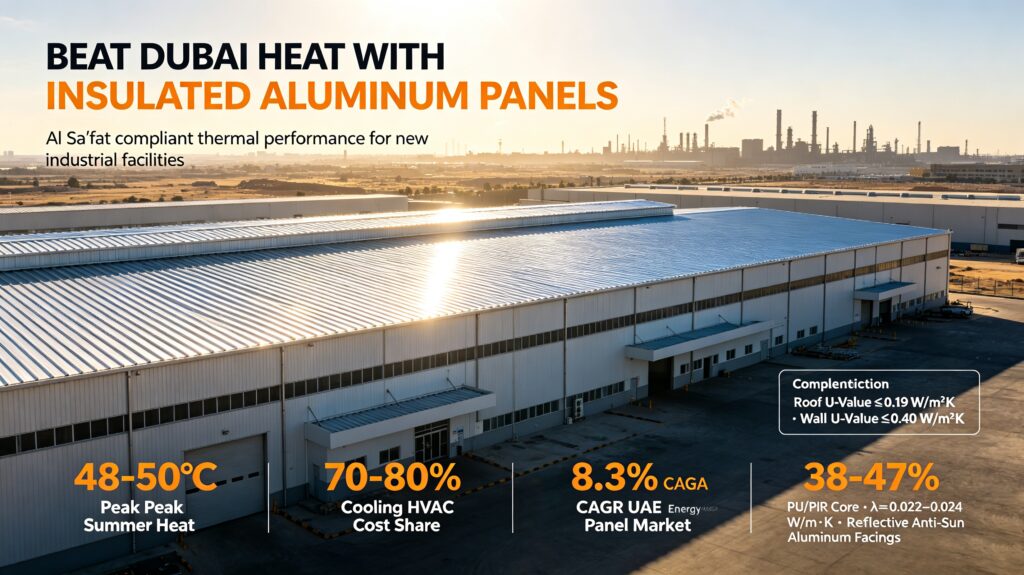
The UAE cold chain & insulated panel market grows at an 8.3% CAGR from 2024 to 2030, with Dubai contributing over 62% of national panel consumption, driven by JAFZA, Dubai Industrial City, Dubai South and Dubai Healthcare City industrial hubs.
PU/PIR insulated aluminum panels feature λ=0.022–0.024 W/m·K low thermal conductivity, reflective anti-sun aluminum facings, and cut factory cooling energy consumption by 38–47% compared to basic metal sheds or thin EPS insulation.
If you supply bulk insulated aluminum panels to Dubai industrial clients, these 7 factory categories deliver consistent large-volume orders, supported by official market data, zone concentration statistics and core pain points each industry faces.
1. Cold Storage & Food Processing Factories (Largest Demand, 43% of Dubai’s Total Panel Consumption)
This segment dominates insulated aluminum panel demand, covering meat slaughterhouses, dairy plants, seafood freezing workshops, fruit & vegetable sorting facilities, frozen pastry and ready-meal production lines.
Key Supporting Market Data
- Dubai hosts over 920 medium-to-large food processing factories, clustered in JAFZA, Dubai Industrial City and Al Quoz Industrial Area. The UAE cold chain market reached USD 1.83 billion in 2026, growing at 5.84% CAGR until 2031.
- Deep-freeze zones (-18°C to -30°C) require 120–150mm double-thick insulated aluminum walls and roofs; chilled production rooms (+2°C to +8°C) adopt 80–100mm standard panels.
- Thermal testing data shows food factories using uninsulated metal roofs run chillers 41% longer daily, while aluminum insulated panels stabilize indoor temperature within ±0.5°C and cut annual cooling bills by up to 47%.
- Dubai Municipality HACCP food safety rules mandate smooth, corrosion-resistant aluminum panel inner surfaces to avoid bacterial contamination, eliminating cheap steel panel alternatives.
Core Industrial Zones to Target
Jebel Ali Free Zone (JAFZA), Dubai Industrial City, Al Quoz 3 & 4, Dubai South Food Logistics Park.
2. 3PL Multi-Temperature Logistics & Re-Export Warehouses (Second Biggest Market, 25% Market Share)
Dubai is the Middle East’s top re-export hub, with Jebel Ali Port handling 15 million TEU yearly. Large-scale temperature-controlled logistics warehouses rely fully on insulated aluminum wall and roof panels to separate frozen, chilled and ambient storage zones.
Key Supporting Market Data
- Total UAE cold storage pallet capacity exceeded 3.8 million positions in 2024; Dubai holds 68% of all GCC modern refrigerated warehouse space.
- Large-span high-bay warehouses over 5,000㎡ choose lightweight insulated aluminum roof panels to reduce steel frame investment by 32%, compared with heavy mineral wool composite structures.
- Summer solar radiation pushes uninsulated roof surface temperatures above 70°C; insulated aluminum panels lower ceiling heat gain by 65% and reduce warehouse HVAC running time by 36%.
- 84% of new Grade A logistics parks under construction in Dubai specify full aluminum insulated envelope systems to pass Al Sa’fat energy certification.
Core Industrial Zones to Target
JAFZA Logistics District, Dubai South (Expo Industrial Zone), Dubai Logistics City, Al Warsan Industrial Zone.
3. Pharmaceutical, Vaccine & Biotech Cleanroom Factories (High-Margin Premium Bulk Orders, 11% Share)
Dubai Healthcare City and JAFZA pharma zones host regulated drug manufacturing, vaccine storage and clinical trial logistics facilities, which demand fire-rated, hygienic PIR insulated aluminum panels to meet GDP and ESMA standards.
Key Supporting Market Data
- Over 160 certified pharmaceutical production and temperature-controlled storage factories operate within Dubai’s free zones; the Middle East pharma cold storage segment grows 2–3x faster than general food cold chain.
- Ultra-low temperature drug vaults (-20°C to -80°C) require 150mm B1 fire-retardant insulated aluminum panels to eliminate thermal bridging and restrict temperature fluctuation under ±0.3°C.
- Civil Defense Dubai strictly bans thin EPS panels for medical facilities; only aluminum-faced PIR panels pass fire safety inspections for factory handover.
- Single pharma cleanroom projects usually order complete wall + roof panel sets, with average order value 2.8 times higher than standard food factory projects.
Core Industrial Zones to Target
Dubai Healthcare City, JAFZA Pharma Zone, Dubai Science Park, Al Maktoum Airport Industrial Free Zone.
4. Bakery, Chocolate & Constant-Temperature Food Manufacturing Plants (Stable Recurring Demand)
Commercial bakeries, chocolate production lines and confectionery factories need stable 12–22°C indoor environments year-round; exposed metal walls create extreme temperature swings that damage raw materials and lower product yield.
Key Supporting Market Data
- More than 480 medium-to-large bakery and dessert factories operate across Dubai’s industrial areas, with 70% planning facility expansions or insulation upgrades within 3 years.
- Uninsulated factory roofs cause indoor temperature swings over ±5°C during summer heatwaves; insulated aluminum panels narrow fluctuation to ±1°C and cut production reject rates by 29%.
- Dubai Municipality energy audits confirm bakeries installing insulated aluminum roofs save AED 28,000–52,000 per year on cooling electricity.
Core Industrial Zones to Target
Al Quoz Industrial Area, Ras Al Khor Industrial Zone, Dubai Industrial City.
5. Seafood Processing & Aquatic Export Factories (Anti-Corrosion Niche High Demand)
Dubai’s coastal industrial zones host seafood import, processing and re-export plants handling salmon, shrimp and shellfish for GCC and global markets. High-humidity coastal air and continuous cold freezing operations create mandatory demand for aluminum insulated panels with anti-salt coatings.
Key Supporting Market Data
- Coastal Dubai maintains 68–75% year-round relative humidity; uncoated steel insulation panels lose 46% thermal performance within 5 years due to salt corrosion, while PVDF aluminum facings retain full performance for 18–22 years.
- Seafood blast freezers run nonstop at -28°C to -35°C; 120–150mm thick insulated aluminum roofs block massive external heat infiltration and prevent compressor overload.
- 91% of seafood factory tender bids in JAFZA require aluminum-faced insulated panels as a minimum technical requirement.
Core Industrial Zones to Target
JAFZA Coastal Food Zone, Port Rashid Industrial Area, Al Hamriyah Port Logistics Zone.
6. Electronics & Semiconductor Cleanroom Manufacturing Factories
Electronics assembly, PCB production and tech component factories require dust-free, temperature-stable cleanrooms, where insulated aluminum panels deliver seamless sealed wall and roof systems to control humidity and heat gain.
Key Supporting Market Data
- Dubai’s tech industrial parks added 72 new cleanroom manufacturing projects between 2024–2026, all requiring CE-certified insulated aluminum panels.
- Precision electronics production demands constant 18–22°C temperature; thin insulation causes equipment overheating, raising production defect rates by 22%.
- Smooth aluminum panel surfaces reduce dust accumulation, cutting daily cleanroom maintenance labor costs by 34%.
Core Industrial Zones to Target
Dubai Silicon Oasis, Dubai Free Zones Tech Park, JAFZA Tech Manufacturing Zone.
7. Chemical, Paint & High Fire-Risk Industrial Plants (Rock Wool Aluminum Composite Panel Demand)
Chemical mixing workshops, paint storage facilities and plastic manufacturing factories follow UAE Civil Defense fire codes, requiring A1 non-combustible rock wool core insulated aluminum wall and roof panels to slow flame spread.
Key Supporting Market Data
- Dubai industrial safety regulations prohibit PU/EPS panels for high-flammable chemical production zones; only aluminum-faced rock wool insulated panels pass fire safety permits.
- This sector accounts for 6% of Dubai’s total insulated panel consumption, with large full-factory envelope tender orders during new construction or renovation.
Core Industrial Zones to Target
Al Jazeera Industrial Area, Dubai Industrial City Heavy Industry Zone, JAFZA Chemical Logistics Park.
Core Sales Tips for Selling Insulated Aluminum Panels to Dubai Factories
- Prioritize cold storage food factories and 3PL logistics warehouses first — these two sectors make up 68% of Dubai’s total insulated aluminum panel demand and deliver the largest bulk orders.
- Highlight compliance advantages: Al Sa’fat U-value standards, ESMA certification, Civil Defense B1/A1 fire ratings, mandatory for Dubai factory building permits.
- Lead with local energy-saving data: insulated aluminum panels reduce factory cooling consumption by 38–47%, most industrial clients recover extra panel investment within 3.5–5 years.
- Match panel thickness to factory usage: 80–100mm for chilled logistics & bakeries; 120–150mm double-thick panels for deep-freeze cold storage, seafood and pharmaceutical facilities.
- Prepare full technical documentation in English + Arabic: thermal conductivity test reports, fire classification certificates and Al Sa’fat compliance datasheets to win industrial tender bids.
Conclusion
Seven core factory sectors drive massive bulk demand for insulated aluminum wall and roof panels across Dubai: cold storage food processing plants,
temperature-controlled 3PL logistics warehouses, pharmaceutical cleanroom factories, bakery & confectionery production lines, coastal seafood export facilities, electronics cleanroom manufacturers, and fire-risk chemical industrial sites.
Fueled by 8.3% annual insulated panel market growth, record cold chain investment and tightening Dubai green building energy codes,
factory owners continuously invest in new insulated aluminum panel construction and envelope retrofits. Target concentrated industrial free zones including JAFZA, Dubai Industrial City and Dubai Healthcare City,
and tailor panel thickness, fire grade and anti-corrosion aluminum coating solutions to each industry’s unique operational needs to secure stable high-volume orders in Dubai’s booming industrial construction market.