How to Become a Mexico Distributor for Insulated Aluminum Roof Panels – Complete Preparation Guide
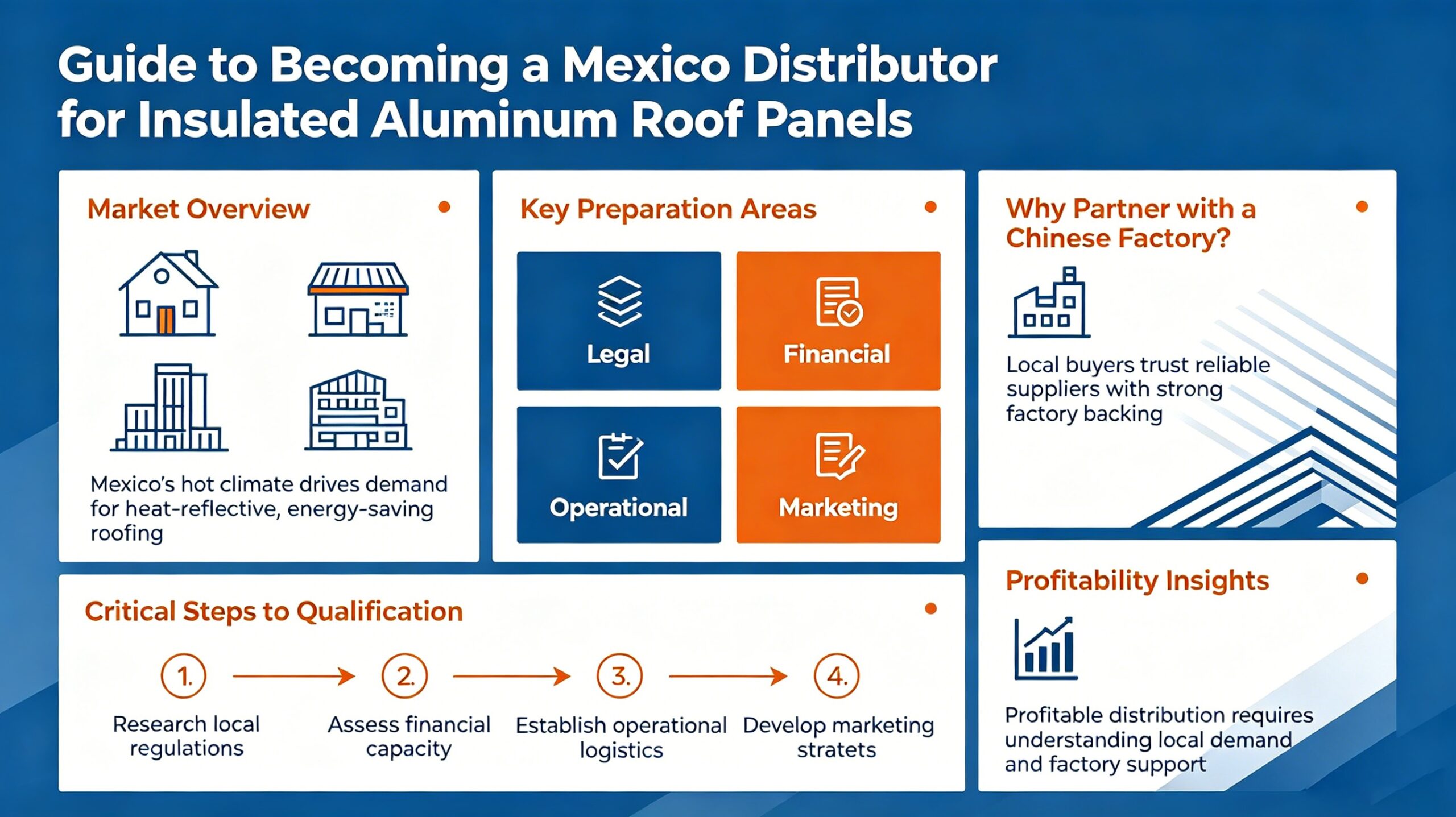
If you’re looking to tap into Mexico’s booming construction market—especially for insulated aluminum roof panels used in homes, small shops, and industrial buildings—becoming an official distributor for a factory is a smart move.
Mexico’s hot climate drives massive demand for heat-reflective, energy-saving roofing solutions, and local buyers trust reliable suppliers with strong factory backing.
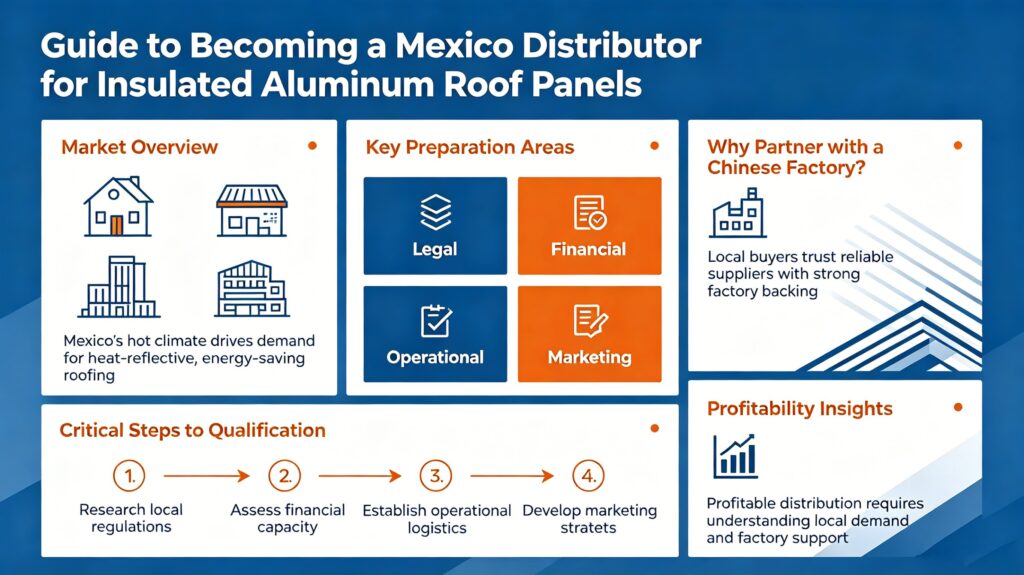
But before you sign a partnership agreement, you need careful preparation across legal, financial, operational, and marketing areas.
This guide walks you through every critical step to become a qualified, profitable Mexico distributor for insulated aluminum roof panels.
1. Understand Mexico’s Market Demand & Product Fit
First, confirm the opportunity matches local needs.
- Climate urgency: Northern Mexico (Sonora, Mexicali) hits 40°C–50°C; central/southern regions (Jalisco, Yucatan) reach 33°C–38°C. Uninsulated metal roofs turn buildings into heat traps, making insulated aluminum panels the top choice for natural cooling.
- Target customers: Small shop owners, residential builders, warehouse operators, and construction contractors prioritize panels that cut AC/fridge costs.
- Key product specs to master:
- 50mm: Mild hot areas (<33°C)
- 75mm: Most regions (33°C–40°C) – bestseller
- 100mm: Extreme northern deserts (40°C–50°C)
Action: Research local competitors’ pricing, thickness options, and customer feedback to position your factory’s panels effectively.
2. Complete Legal & Regulatory Compliance (Must-Do First)
Mexico has strict rules for imported building materials. Non-compliance leads to customs holds or sales bans.
a. Register Your Mexican Business
- Register with SHCP (Tax Authority) to get an RFC tax ID.
- Choose a legal structure: S.A. de C.V. (corporation) or Persona Física con Actividad Empresarial (sole proprietor).
- Obtain municipal business license and state construction/import permits.
b. Secure Mandatory NOM/NMX Certification
- NOM certification is compulsory for all building materials sold in Mexico.
- Panels must meet NMX-B-506 (metal building materials) standards.
- Steps:
- Submit samples to a Mexican government-recognized laboratory for testing (thermal resistance, corrosion resistance, fire safety).
- Prepare Spanish technical sheets, user manuals, and safety labels.
- Apply for the NOM certificate (valid 1–5 years, annual audits required).
c. Import & Customs Documentation
- Commercial invoice, packing list, bill of lading, certificate of origin (for USMCA tariff benefits).
- Spanish product labels with NOM mark, thickness, insulation core material, and factory origin.
Action: Partner with a local customs broker experienced in building material imports to avoid delays.
3. Strengthen Financial Readiness
Factory partners require proof of financial stability to ensure consistent orders and payments.
a. Calculate Initial Investment
- Initial inventory: 500–1,000 panels (75mm + 100mm mix) – ~$20,000–$50,000 USD.
- Warehouse: 50–100m² storage space (dry, covered) – $300–$800/month.
- Vehicles: 1–2 delivery trucks (3.5–7 tons) for local distribution.
- Working capital: $10,000–$20,000 for marketing, staff, and daily operations.
b. Secure Payment & Credit Terms
- Most Chinese factories require 30% deposit before production, 70% before shipment (T/T).
- Prepare bank statements (3 months) and financial reports to prove solvency.
- Negotiate credit terms (e.g., 60-day payment) after establishing a 6-month positive track record.
Action: Open a business bank account in Mexico with international wire transfer capabilities.
4. Build Operational Capacity
Your ability to store, deliver, and support products directly impacts factory partnership approval.
a. Warehouse & Logistics Setup
- Location: Near major cities (Mexico City, Guadalajara, Monterrey) or industrial zones for fast delivery.
- Features: Dry, covered storage; forklift; inventory tracking system.
- Stock strategy: Maintain 75mm panels as core inventory (80% of stock) and 100mm for northern desert regions.
b. Assemble a Professional Team
- Sales team: 2–3 Spanish-speaking reps with construction/roofing experience.
- Installation support: 1–2 technicians to provide on-site guidance and training for contractors.
- Admin/finance: 1 person to manage orders, payments, and compliance.
c. Technical & After-Sales Support
- Learn factory’s product specs, installation methods, and warranty terms (typically 20–30 years).
- Create Spanish-language installation guides, FAQs, and troubleshooting docs.
- Offer 24/7 customer service for urgent issues (critical for building trust).
Action: Visit the Chinese factory for 3–5 days to receive hands-on product and sales training.
5. Develop Sales & Marketing Strategy
Factors prioritize distributors who can drive consistent sales and build brand awareness in Mexico.
a. Define Sales Channels
- B2B: Target construction contractors, roof installers, and hardware stores (primary channel).
- B2C: Sell directly to homeowners via social media (Facebook, Instagram) and local marketplaces.
- Government/Institutional: Bid on small public projects (schools, community centers).
b. Localized Marketing Materials
- Translate all content to Spanish: brochures, catalogs, website, and social media posts.
- Highlight key selling points for Mexico:
- “Reduce indoor temp by 7–10°C – No AC needed”
- “Cut electricity bills by 60–80%”
- “NOM-certified, 30-year warranty”
- Use before/after photos of hot shops/homes cooled by insulated aluminum panels.
c. Pricing & Promotion Plan
- Set competitive pricing: 15–25% markup on factory cost (balance profit and market demand).
- Launch promotions: “Free installation training for bulk orders” or “1-year warranty extension for first 50 customers”.
- Attend local construction expos (e.g., Expo CIHAC in Mexico City) to network and showcase products.
Action: Create a simple Spanish website with product specs, pricing, and contact info; optimize for keywords like “paneles de aluminio aislados para techos”.
6. Evaluate & Select the Right Chinese Factory Partner
Not all factories are equal. Choose one that aligns with your Mexico market goals.
Key Factory Selection Criteria
- Product quality: NOM/NMX compliance, high-density foam core, double-sided aluminum sheets (0.4–0.6mm thickness).
- Production capacity: Minimum 50,000 panels/month to meet your growing demand.
- Experience: Proven track record exporting to Latin America (especially Mexico).
- Support: Provides Spanish docs, training, marketing materials, and after-sales service.
- Price: Competitive FOB factory prices with volume discounts.
Action: Shortlist 3–5 factories, request samples, and conduct video calls or on-site visits to verify capabilities.
7. Finalize Partnership Agreement
Once you’ve selected a factory, sign a detailed distribution contract to protect both parties.
Critical Contract Clauses
- Exclusive territory: Define your sales region (e.g., all of Mexico or specific states).
- Minimum order quantity (MOQ): Monthly/annual sales targets (e.g., 5,000 panels/year).
- Pricing & payment terms: FOB price, deposit ratio, and payment schedule.
- Warranty & returns: Factory’s warranty responsibility and return policy for defective products.
- Marketing support: Factory’s commitment to provide free brochures, samples, and training.
- Term & termination: Contract duration (2–3 years) and termination conditions.
Action: Hire a Mexican-Chinese bilingual lawyer to review the contract and ensure compliance with both Mexican and Chinese laws.
Conclusion
Becoming a Mexico distributor for insulated aluminum roof panels is a lucrative long-term opportunity—but success requires thorough preparation. Focus on:
- Legal compliance (RFC, NOM certification)
- Financial stability (initial inventory, working capital)
- Operational readiness (warehouse, team, logistics)
- Localized marketing (Spanish content, climate-focused selling points)
- Strong factory partnership (quality, support, fair terms)
By completing these steps, you’ll position yourself as a trusted, reliable distributor—one Chinese factories will be eager to partner with, and Mexican customers will trust for their roofing needs.
Ready to start? Begin with market research and NOM certification planning—these are your first steps to building a profitable distribution business in Mexico’s fast-growing construction market.