
Modular Sunroom Systems from China Quotation Guide
Define the Quotation Scope Before Comparing Prices
A useful modular sunroom systems from China quotation begins with a defined project scope. Buyers should provide overall dimensions, roof geometry, opening direction, intended use, substrate conditions, finish preferences, destination port, and applicable local structural requirements. Without these inputs, a supplier may quote only a basic frame while another includes glazing, doors, windows, drainage parts, fasteners, packaging, and assembly support.
Ask each manufacturer to identify exclusions in writing. Clarify whether the price covers engineering drawings, structural calculations, glass, hardware, sealants, flashing, anchors, spare parts, export crates, inland transport, and ocean-freight documentation. Quotations should also state the currency, Incoterm, tax treatment, payment schedule, validity period, and the point at which production lead time begins.
Compare Specifications and Matched Components
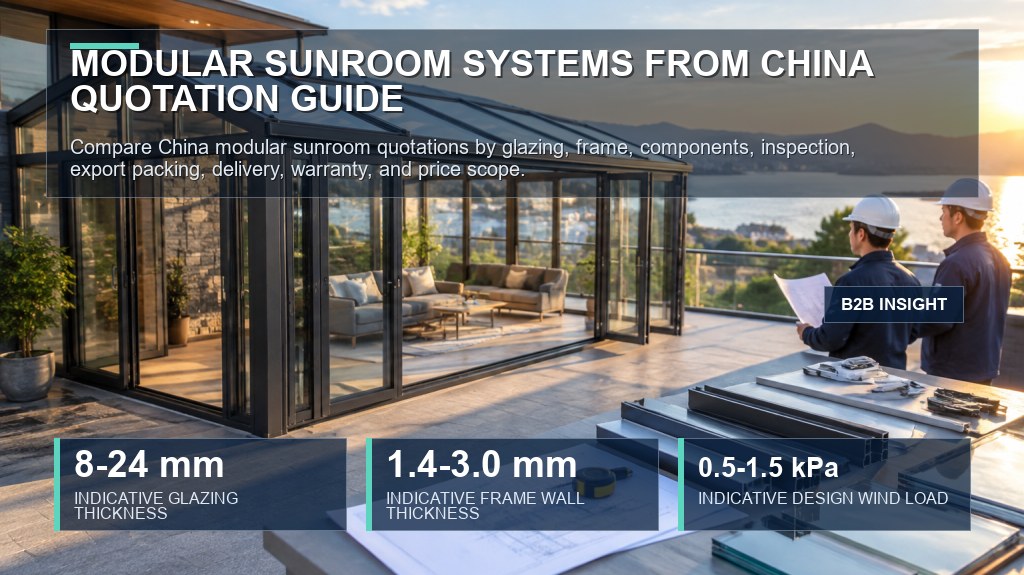
Three indicative benchmarks can help structure an initial inquiry: 8-24 mm glazing thickness, 1.4-3.0 mm frame wall thickness, and 0.5-1.5 kPa design wind load. These ranges are procurement references only, not verified zhending product specifications or guaranteed performance. The appropriate values depend on panel dimensions, framing spans, building height, exposure, connection design, and local codes. Buyers must require confirmation in the supplier’s datasheet, approved drawings, calculation documents, and final quotation.
Material descriptions should go beyond terms such as aluminum frame or insulated glass. Request the frame material grade, temper or condition where relevant, profile cross-section, wall thickness, surface-treatment system, color tolerance, and connection method. For glazing, confirm the complete build-up, safety treatment, spacer, coating, gas filling if offered, edge finish, and compatibility with the framing system.
The matched component list should identify door and window hardware, rollers, hinges, locks, handles, gaskets, sealants, drainage channels, flashing, brackets, anchors, screws, covers, and replacement pieces. Component brands or models must be marked to be confirmed unless documented by the supplier. This prevents a factory-direct price from being reduced through unspecified hardware substitutions.
Request Inspection Evidence, Not General Claims
Before shipment, buyers should request inspection records covering dimensions, finish quality, profile identification, glass configuration, hardware operation, drainage details, labeling, trial assembly where applicable, and packing quantities. Water-tightness or controlled water-spray checks may be relevant, but the method and acceptance criteria must be agreed before production. Aging or durability evidence for coatings, seals, and moving hardware should also be requested when required by the project specification.
NDT or flaw detection is not automatically applicable to every modular sunroom. It may be relevant where load-bearing welded steel parts or specified structural connections are included. Pressure testing is likewise not normally a default test for a building enclosure. Buyers should ask the manufacturer to state whether either test applies, which standard or procedure would be used, and whether third-party inspection carries an additional cost. No test result should be assumed without a report linked to the order.
Evaluate Export Packing and Container Loading
International ocean shipping creates risks from vibration, moisture, impact, mixed-part handling, and inefficient loading. A packing proposal should separate finished profiles to prevent abrasion, protect corners, immobilize glass, and label each module against the installation drawings. Wooden crates should be structurally reinforced as needed, while steel supports, fasteners, and other exposed metal items inside the crates should receive suitable rust protection.
Request packing photos or a draft loading plan before dispatch. The plan should show crate dimensions, gross weight, lifting points, stacking restrictions, and container allocation. Container-loading optimization should reduce unused volume without placing unsafe loads on glazing or finished profiles. Buyers should also clarify responsibility for compliant wood packaging, moisture protection, unloading equipment, and replacement procedures for transit damage or missing components.
Buyer Decision Comparison
| Decision Area | Evidence to Compare | Status Without Verified Data |
|---|---|---|
| Material/specification | Material grade, frame section, glazing build-up, design load | To be confirmed |
| Component package | Hardware, seals, drainage, anchors, fasteners, spare parts | Itemized list required |
| Inspection evidence | Dimensional, visual, trial-assembly, water and durability records | Applicability to be confirmed |
| Packaging/loading | Protection method, crate plan, labels, container layout | Photos and plan required |
| Lead time | Drawing approval, material preparation, production and dispatch milestones | To be confirmed in quotation |
| Warranty/after-sales | Duration, exclusions, claim process, replacement-part responsibility | Written terms required |
| Quotation basis | Scope, currency, Incoterm, validity, freight and tax exclusions | Commercial clarification required |
Procurement Scenario Review and Inquiry Checklist
This is a buyer decision example, not a real customer case or testimonial. Suppose two suppliers offer similar-looking systems at different prices. The lower figure should not be selected until the buyer checks whether both quotations use equivalent glazing, frame sections, hardware, drainage parts, inspection scope, and export packaging. An apparently higher cost may simply include components or services omitted from the competing offer. The correct comparison is based on an aligned bill of materials and supply boundary.
Before placing an order, request the product datasheet, approved component list, drawings, applicable calculations, inspection records, packing photos or loading plan, written warranty terms, after-sales procedure, and quotation validity. Delivery timing should be tied to clear milestones such as drawing approval and payment rather than an unsupported dispatch promise.
zhending has 10 years of offline physical-store operating experience and 1 year of online sales experience. This background provides business context and should not be interpreted as a guarantee of product performance, delivery, or project compliance. For a comparable quotation, send the required dimensions, configuration, performance criteria, customization details, destination port, and requested delivery window, then ask for every unverified specification to be confirmed in writing.