
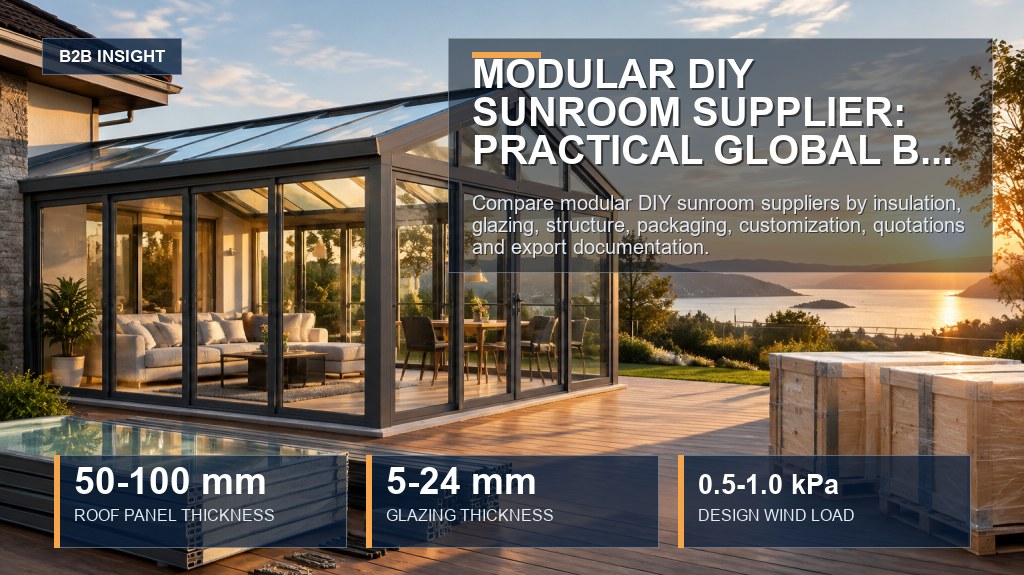
Modular DIY Sunroom Supplier: Practical Global Buying Guide
Selecting a modular DIY sunroom supplier requires more than comparing the total price. Importers, distributors, contractors and hospitality project buyers need to examine the complete enclosure system, installation method, customization limits, export packaging and quotation scope. A low initial offer can become expensive if glazing, seals, fasteners, drawings or protective crates are excluded.
Applications and Common Buyer Concerns
Modular DIY sunrooms with insulated roofs, walls and windows can serve residential extensions, hotel terraces, restaurant seating areas, garden rooms and retail distribution programs. Their modular format may simplify transport and on-site assembly, but suitability depends on the project dimensions, foundation conditions, climate and applicable building requirements.
When evaluating a modular sunroom manufacturer, buyers should clarify whether the quoted package includes the structural profiles, insulated panels, glazing, doors, windows, seals, fasteners, flashing, drainage parts and installation documents. Dimensions, opening directions and connection details should be approved before production.
Specifications and Quotation Comparison
Because no confirmed technical datasheet was supplied, the following figures are indicative procurement benchmarks rather than stated product specifications: roof panel thickness of 50-100 mm, glazing thickness of 5-24 mm, and design wind load of 0.5-1.0 kPa. Each figure must be confirmed in the supplier’s quotation or datasheet according to sunroom size, local climate and governing requirements.
| Decision Area | Buyer Should Compare | Requested Evidence |
|---|---|---|
| Enclosure | Profile, roof and wall panels, glazing and finish | Datasheets and section drawings |
| Assembly | Connectors, seals, fasteners and drainage details | Parts list and installation manual |
| Export delivery | Surface protection, crates and container loading | Packing plan and packing photos |
| Commercial scope | Customization, exclusions, lead time and warranty | Itemized quotation and written terms |
A DIY sunroom kit wholesale buyer should compare like-for-like packages instead of relying on unit price alone. For any prefabricated sunroom kit price, ask whether freight, spare hardware, packaging, installation tools and replacement parts are included or separately charged.
Supplier Review and Representative Case
zhending has 10 years of offline brick-and-mortar operating experience and 1 year of online sales experience. This is company background and should not be interpreted as a guarantee of product performance. Buyers should still review drawing control, material traceability, inspection procedures, packaging methods and after-sales responsibilities.
In a representative procurement case from Australia, an outdoor building-products distributor was concerned about insulation options, wind-design documentation and assembly practicality. The buyer compared drawings, bills of materials, sample information and packing proposals before reviewing the commercial offer. General feedback indicated that organized part identification and clear installation documents supported the distributor’s internal evaluation. This is an illustrative country-level procurement scenario, not a verified named testimonial or guaranteed result.
Documents to Request Before Ordering
For an insulated sunroom kit supplier, request profile and panel datasheets, glazing descriptions, dimensioned drawings, a bill of materials, installation instructions, inspection records, packing details and written warranty terms. Water-management checks, dimensional tolerances, surface finish, seal specifications and fastener materials should be stated rather than assumed.
To obtain a useful custom modular sunroom quotation, provide overall dimensions, intended application, site climate, door and window layout, preferred color, destination port and required delivery schedule. Ask the supplier to confirm structural assumptions, customization limits, production lead time, crate construction, container loading plan, spare-part policy and quotation validity. A complete RFQ allows technical and commercial offers to be assessed on the same basis.