
Key Measurements for Aluminum Insulation Roof Panels + Complete Data Table
Installing aluminum insulation roof panels requires precise on-site measuring to avoid material waste, ensure waterproofing, and deliver stable thermal performance.
Below are the must-measure parameters, step-by-step measuring methods, and a standardized data table for quick quoting and ordering.
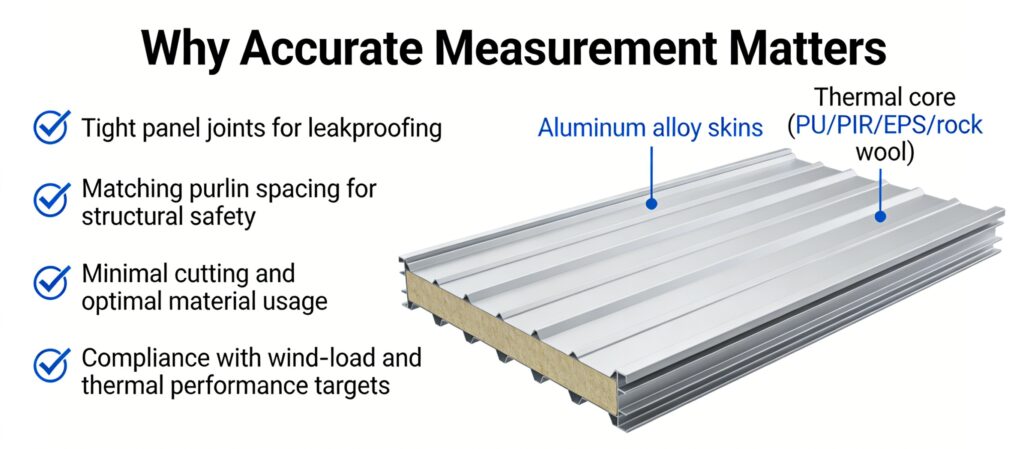
Why Accurate Measurement Matters
Aluminum insulation roof panels combine aluminum alloy skins with a thermal core (PU/PIR/EPS/rock wool). Correct sizing guarantees:
- Tight panel joints for leakproofing
- Matching purlin spacing for structural safety
- Minimal cutting and optimal material usage
- Compliance with wind-load and thermal performance targets
Core Parameters to Measure
1. Basic Roof Dimensions
- Total roof length & width: Calculate gross area; add 5%–8% for cutting loss
- Roof slope/pitch: Record angle (°) or rise‑run ratio; affects panel length and layout
- Ridge & eave lengths: Critical for flashing and end closures
- Gable/valley dimensions: Measure valleys, hips, and corners for special flashing
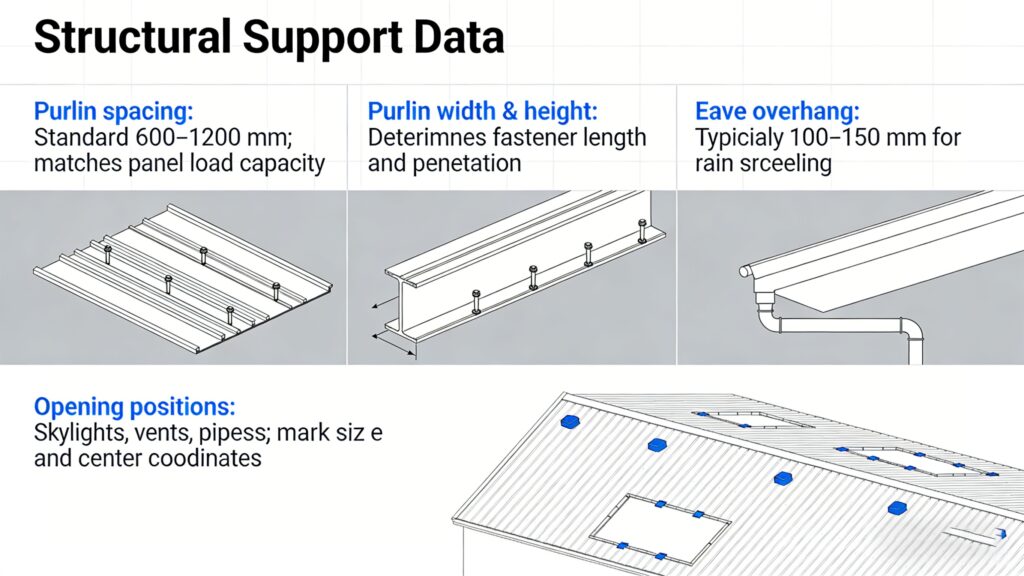
2. Structural Support Data
- Purlin spacing: Standard 600–1200 mm; matches panel load capacity
- Purlin width & height: Determines fastener length and penetration
- Eave overhang: Typically 100–150 mm for rain screening
- Opening positions: Skylights, vents, pipes; mark size and center coordinates
3. Panel Performance & Specification Selections
- Aluminum skin thickness: 0.4–0.8 mm (residential); 0.8–1.2 mm (industrial)
- Total panel thickness: 30–200 mm (determines R‑value and load)
- Effective width: 900–1100 mm (varies by profile)
- Profile type: Trapezoidal, corrugated, or hidden‑fastener
- Thermal core: PU/PIR/EPS/rock wool (affects fire rating and U‑value)
Standard Aluminum Insulation Roof Panel Data Table
| Parameter | Common Range | Notes |
|---|---|---|
| Aluminum Skin Thickness | 0.4 – 1.2 mm | Thicker = better wind resistance |
| Panel Total Thickness | 30 – 200 mm | Thicker = better insulation |
| Effective Width | 900 – 1100 mm | Determines layout quantity |
| Standard Length | 2 – 6 m | Custom lengths available |
| Thermal Conductivity (λ) | 0.020 – 0.040 W/(m·K) | Lower = better insulation |
| U‑Value | 0.2 – 0.8 W/(m²·K) | Meets regional energy codes |
| Wind Resistance | Grade 10 – 12 | Coastal/high‑rise needs higher |
| Fire Rating | B1 / A2 | Rock wool = A2 non‑combustible |
| Service Life | 30 – 50 years | Powder‑coated aluminum |
| Weight | 6 – 14 kg/m² | Lightweight reduces structural load |
Step‑by‑Step Measuring Guide
- Measure length × width to get gross area; add 5%–8% waste allowance
- Confirm roof slope and convert to panel layout length
- Mark purlin spacing and verify alignment with panel specs
- Record openings (skylights, vents) with exact dimensions
- Measure ridge, eave, valley, and flashing zones
- Select skin thickness, total thickness, and core type based on climate and load
- Match effective width to calculate total panel quantity
Final Tips for Installation
- Measure along the slope, not horizontally, for true panel length
- Keep purlin spacing consistent to avoid panel sag
- Use sealant and gaskets at all joints for waterproofing
- For coastal/high‑wind areas, choose thicker skins and higher wind ratings
Accurate measurement is the foundation of a durable, energy‑efficient aluminum insulation roof. Use the above parameters and data table to streamline ordering, reduce waste, and ensure long‑term performance.
Contact us with your roof measurements and project requirements, and we will provide free design, layout, and quotation services.