
Aluminum Insulated Sandwich Panel Supplier Buying Guide
Define the Project Before Comparing Suppliers
Selecting an aluminum insulated sandwich panel supplier for commercial buildings should begin with a controlled specification, not a headline price. Panels that appear similar may differ in core material, aluminum skin thickness, coating system, joint design, effective coverage, dimensional tolerance, and packaging. These differences affect installation speed, thermal performance, appearance, maintenance, and total landed cost.
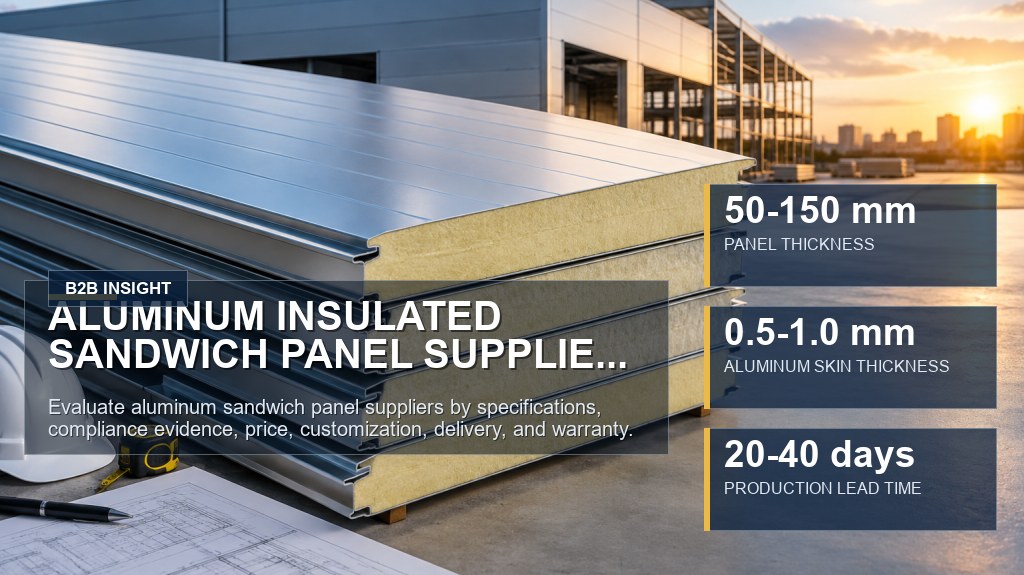
State whether the panels are intended for external walls, internal partitions, roofing, ceilings, or equipment enclosures. Include the building environment, design loads, temperature and humidity conditions, color, finish, module dimensions, required quantity, destination port, and installation schedule. Typical sourcing comparisons may include panel thicknesses of 50-150 mm and aluminum skin thicknesses of 0.5-1.0 mm. These are indicative procurement benchmarks rather than certified specifications. Buyers must confirm every value against the supplier’s datasheet, project design, sample, and quotation.
Evaluate Technical Evidence and Factory Capability
Ask each manufacturer for a consistent technical package covering core type and density, thermal conductivity, panel weight, allowable span, joint configuration, coating composition, dimensional tolerances, fastener requirements, flashings, and packaging. If the project has fire, wind-load, acoustic, hygiene, or thermal regulations, provide the applicable local criteria instead of requesting generic international compliance.
A test report is useful only when its tested construction matches the offered panel. Check the named manufacturer, core material, facing thickness, panel assembly, test method, laboratory, issue date, and result. Do not accept a broad compliance statement as a substitute for traceable evidence. Final acceptance remains subject to the project’s engineer, consultant, and local authority.
Manufacturing assessment should cover incoming material inspection, lamination controls, cutting accuracy, bonding consistency, profiling, color management, and final inspection. Request representative samples to examine flatness, coating appearance, edge quality, joint fit, adhesion, and color variation. For custom or OEM orders, confirm whether the factory can supply project-length panels, special colors, openings, matching flashings, protective film, private labels, and export-ready packing without outsourcing critical work.
Compare Price, Delivery, and Commercial Risk
A meaningful commercial aluminum sandwich panel quotation should identify the price unit, effective coverage width, panel and skin thicknesses, core, finish, included accessories, packing method, trade term, payment schedule, quotation validity, and exclusions. Compare cost per installed square meter rather than nominal panel area alone. Clarify whether fasteners, sealants, flashings, corner pieces, lifting protection, and replacement panels are included.
A production lead time of 20-40 days can serve as an indicative buying benchmark, but it is not a delivery promise. Raw-material availability, custom colors, order volume, factory loading, inspection, and shipping arrangements can materially change the schedule. Require the supplier to state when lead time begins, such as after deposit, drawing approval, or color confirmation. Separate manufacturing time from inland transport, customs procedures, and ocean freight.
Reduce quality and delivery risk through approved drawings, signed samples, documented inspection points, and clearly defined acceptance criteria. Confirm the minimum order quantity, overrun or underrun tolerance, loading plan, spare-panel allowance, damage-reporting procedure, and replenishment lead time. Where appropriate, arrange pre-shipment inspection for dimensions, quantity, labeling, packaging integrity, and visible defects.
Warranty wording deserves the same attention as price. Ask for the warranty period, covered defects, coating and bonding conditions, environmental exclusions, maintenance duties, claim evidence, and available remedies. Avoid relying on an unspecified guarantee. The purchase contract should identify which document prevails if the quotation, drawing, datasheet, sample, and order contain conflicting information.
Build a Comparable RFQ
Send every shortlisted supplier the same request for quotation. Attach drawings, a bill of quantities, application details, required performance, destination, target delivery date, labeling instructions, and applicable compliance checklist. Ask vendors to return a line-by-line deviation schedule rather than silently substituting materials or dimensions.
- Request datasheets, relevant test evidence, sample options, and quality-control records.
- Separate panel price from accessories, tooling, packing, inspection, and freight.
- Confirm custom dimensions, color tolerance, protective film, and installation details.
- Record production milestones, shipment terms, warranty scope, and claim procedures.
The strongest supplier is usually the one that combines verifiable specifications, transparent costing, controlled customization, and accountable delivery—not simply the lowest factory-direct price. Submit your drawings, quantities, required performance, destination port, and schedule to obtain a comparable quotation and identify technical deviations before placing an order.