
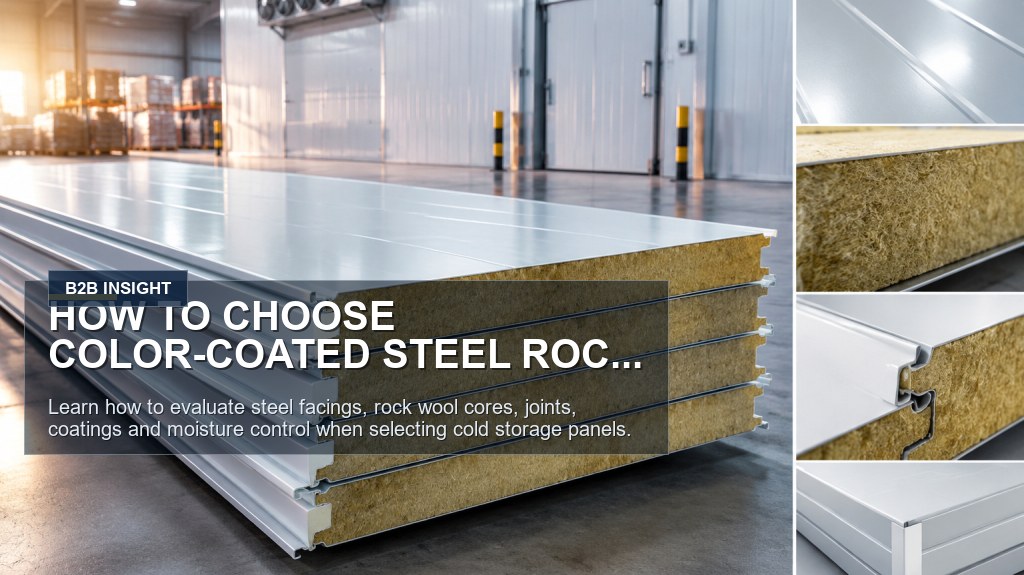
How to Choose Color-Coated Steel Rock Wool Panels for Cold Storage
Choosing color-coated steel rock wool panels for cold storage requires more than comparing panel thickness or appearance. Buyers should examine the complete enclosure system: steel facings, coating type, rock wool core, joint design, vapor control and installation conditions. These factors determine whether the panels can maintain stable internal temperatures while resisting corrosion, moisture and operational wear.
Understand the Panel Construction
A rock wool sandwich panel consists of an insulation core bonded between color-coated steel sheets. The steel facings provide structural protection and a washable surface, while the mineral wool core contributes thermal insulation, sound absorption and strong fire behavior.
Ask the manufacturer to confirm the steel substrate, facing thickness, coating system and internal surface finish. Cold rooms used for food handling may need surfaces that tolerate frequent cleaning, while coastal, humid or chemically exposed sites may require enhanced corrosion resistance. The suitability of a coating depends on the operating environment rather than color alone.
The core should have consistent density, fiber distribution and bonding. Poorly bonded areas can reduce dimensional stability and create weak points during transport or installation. Core density and panel thickness should be treated as project specifications to confirm because requirements vary with room temperature, panel span and local construction standards.
Match Performance to the Cold Storage Application
Rock wool panels are often considered when fire performance is a major design priority. However, cold storage selection must also account for thermal conductivity, air leakage and water-vapor movement. The requested panel thickness should therefore be based on the target internal temperature, ambient climate, operating schedule and energy design.
Chilled rooms, processing areas and freezer rooms do not have identical enclosure requirements. Lower operating temperatures generally create a greater vapor-pressure difference between the interior and exterior. If warm, humid air enters joints or reaches the insulation, condensation can form and affect long-term performance.
Request project-specific thermal calculations or declared thermal data rather than assuming that two panels with the same nominal thickness provide identical performance. Core consistency, joint geometry, fasteners, corners and penetrations all influence the completed enclosure.
Compare Key Selection Factors
| Component | What to Evaluate | Why It Matters |
|---|---|---|
| Steel facing | Substrate, thickness and surface condition | Affects durability, rigidity and resistance to handling damage |
| Protective coating | Compatibility with humidity, cleaning agents and site exposure | Helps reduce corrosion and surface deterioration |
| Rock wool core | Density, fiber consistency, bonding and thermal data | Influences insulation, stability and fire performance |
| Panel joint | Interlocking profile, seals and continuity | Controls air leakage and moisture entry |
| Installation system | Fasteners, trims, corners and penetration details | Determines enclosure continuity and practical service life |
Prioritize Joints and Moisture Control
Even a well-made panel can underperform if its joints are not appropriate for cold storage. Review how adjacent panels interlock and where sealants or gaskets are required. Wall-to-floor, wall-to-ceiling and corner connections deserve particular attention because discontinuities can become paths for warm air and vapor.
The vapor-control layer should remain continuous around doors, pipes, cables and refrigeration penetrations. Installation drawings should define sealing methods before work begins. Panels must also be stored dry, protected from impact and lifted using methods that avoid bending or damaging the edges.
Condensation on steel surfaces can indicate thermal bridging, damaged seals or unsuitable detailing. Selecting compatible trims and fasteners, and inspecting joints after installation, helps reduce these risks. Maintenance teams should periodically check coatings, sealants and high-traffic areas for damage.
Finalize the Product Specification
Before ordering, document the cold-room temperature, external environment, panel application, required thermal performance, fire requirements, hygiene conditions and installation layout. The supplier should then confirm the proposed facing, coating, core, panel thickness, joint design and accessory system against those conditions.
Samples and technical documents can help buyers assess surface finish and construction quality, but they should be reviewed together with project drawings. For a focused product inquiry, provide the room dimensions, intended use, operating temperature and site conditions so the panel configuration can be evaluated accurately.