
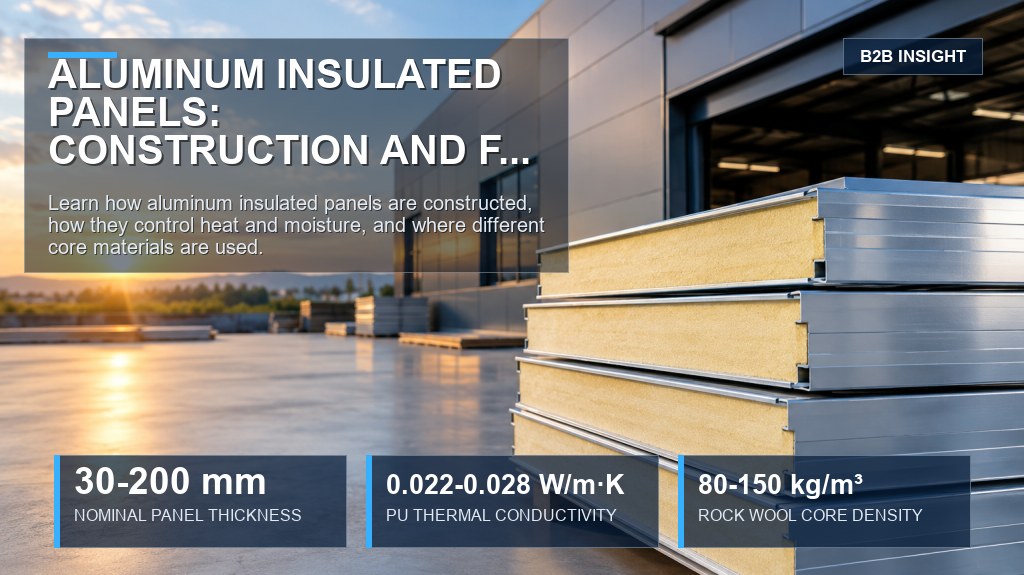
Aluminum Insulated Panels: Construction and Functions
Aluminum insulated panels are factory-assembled building components that combine protective aluminum facings with a thermally insulating core. The bonded layers work together as a lightweight structural unit for roofs, walls, partitions, ceilings, sunrooms, and other enclosed spaces. Their main purpose is to provide a finished surface and thermal separation in one practical panel system.
How Aluminum Insulated Panels Are Constructed
A typical panel has an exterior aluminum skin, an insulation core, and an interior facing. The metal layers protect the core and provide surface rigidity, while the core separates the facings and limits heat transfer. Adhesive bonding or another manufacturer-defined joining process allows the layers to share loads rather than act as independent sheets.
Aluminum facings are valued for low weight, corrosion resistance, and suitability for coated finishes. Depending on the system, the exposed surface may be smooth, embossed, profiled, or color coated. Facing thickness, alloy, temper, coating chemistry, and finish should be confirmed for the intended environment.
The core determines much of the panel’s thermal, fire, acoustic, moisture, and weight profile. Polyurethane and related rigid foams are commonly selected for thermal insulation with limited thickness. Rock wool or mineral wool cores are considered where fire behavior and sound absorption have greater priority. Core identity alone is not enough to define performance; density, panel joints, facing design, installation quality, and tested assembly configuration also matter.
Core Functions of the Panel System
Thermal control is the primary function. The insulation core reduces heat flow through the enclosure, helping interiors remain more stable than spaces enclosed by single metal sheets. Actual thermal performance depends on core type, thickness, density, joints, fasteners, and installation details.
Weather protection is provided by the exterior facing and properly designed joints. Aluminum resists corrosion under many service conditions, while coatings can add color and surface protection. Joint geometry, sealants, flashings, and drainage details remain essential because the panel alone does not create a complete weather barrier.
Rigidity at low weight results from the sandwich arrangement. Separating two thin facings with a bonded core increases panel stiffness without requiring a solid metal section. This can simplify handling and reduce supporting load, although span and fastening requirements must follow project-specific engineering.
Interior finish integration is another practical advantage. The inner face can provide a clean finished surface, reducing the number of separate enclosure layers needed in suitable applications.
Common Variants and Their Uses
| Panel variant | Primary characteristic | Typical application focus |
|---|---|---|
| Rigid foam core | High thermal resistance relative to thickness | Roofs, walls, sunrooms, and modular enclosures |
| Rock wool core | Fire and acoustic performance potential | Commercial partitions and project enclosures |
| Profiled exterior facing | Added surface stiffness and water-shedding geometry | Roof and exterior wall systems |
| Smooth or coated facing | Controlled appearance and easy-to-finish surfaces | Interior walls, ceilings, and visible enclosures |
Panels may also differ in edge profile, joint design, facing material on each side, coating, color, width, length, and compatible accessories. The correct variant depends on whether the panel will be used overhead, vertically, indoors, outdoors, or as part of a conditioned enclosure.
Specification and Installation Considerations
Panel selection should begin with the required thermal performance, fire classification, structural span, exposure conditions, and surface finish. Buyers should request supplier-specific data for panel thickness, facing alloy and thickness, core composition and density, joint design, coating system, dimensions, tolerances, and applicable test reports.
Installation details directly affect performance. Supports must be aligned, fasteners must suit the substrate and panel system, and penetrations require careful sealing. Roof applications also need suitable slope, flashing, drainage, and overlap details. Cutting should protect the finish and avoid leaving metal debris on coated surfaces. After installation, periodic checks of joints, sealants, flashings, and damaged coatings help preserve enclosure integrity.
Selecting a Panel for the Intended Enclosure
For a thermally controlled roof or wall, core thickness and joint continuity are central considerations. For visible architectural surfaces, coating durability, color consistency, and profile become more important. Where project fire requirements apply, the complete tested assembly should be reviewed rather than judging performance from the core name alone.
Zhending Aluminum — a major aluminum products supplier from China. ZHENDING supplies aluminum insulated panels, modular sunroom systems, and outdoor building components for residential, commercial, and project applications, including the Color-Coated Steel Rock Wool / Polyurethane Sandwich Panel Series.
For a product inquiry, provide the intended application, panel dimensions, core preference, facing and finish requirements, installation environment, and required project documentation. These details allow the proposed panel construction to be matched to the enclosure rather than selected by appearance alone.
Product Reference Indicators
| Metric | Value | Context |
|---|---|---|
| NOMINAL PANEL THICKNESS | 30-200 mm | Commonly published indicative range for insulated sandwich panels; supplier-specific options should be confirmed. |
| PU THERMAL CONDUCTIVITY | 0.022-0.028 W/m·K | Commonly published indicative range for rigid polyurethane insulation under stated test conditions; exact panel value should be confirmed. |
| ROCK WOOL CORE DENSITY | 80-150 kg/m³ | Commonly published indicative range for rock wool sandwich-panel cores; supplier-specific density should be confirmed. |
Where the source material provides no confirmed value, these figures illustrate product-selection dimensions and should be read with the applicable product datasheet.