
Modular Sunroom Systems from China: Quotation Guide
Define the Project Before Comparing Quotations
A useful modular sunroom systems from China quotation should begin with a defined project scope rather than a single price per square meter. Buyers should provide overall dimensions, roof geometry, opening types, connection interfaces, intended residential use, local climate conditions and applicable design requirements. Without this information, suppliers may calculate offers around different structural assumptions, glazing packages or accessory scopes.
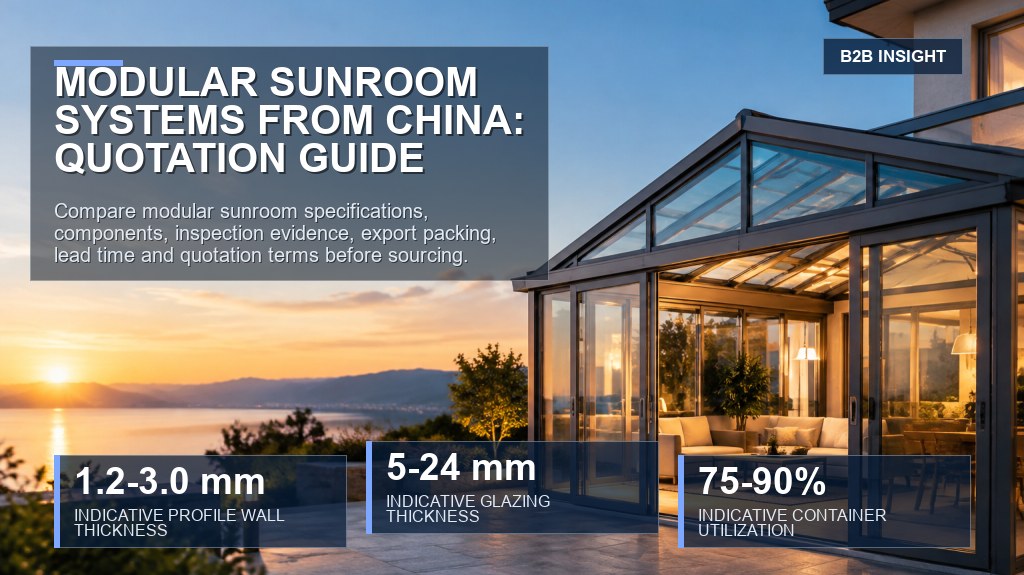
A modular system may include structural profiles, roof and wall glazing, connectors, gaskets, drainage parts, doors, windows, fasteners and installation accessories. The exact supply boundary must be stated in a component list. For initial comparison, buyers may use a profile wall thickness of 1.2–3.0 mm and a glazing thickness of 5–24 mm as indicative procurement benchmarks. These ranges are not confirmed zhending product specifications or guaranteed performance values. They must be checked against the supplier’s datasheet, engineering review and formal quotation.
Evaluate Materials, Components and Interfaces
Price differences often reflect more than the visible frame. Ask each supplier to identify the material grade, profile section, wall thickness, surface treatment, glazing build-up, gasket material, fastener type and hardware package. The quotation should also distinguish standard parts from optional items and indicate which components can be supplied as replacements.
Matched components are especially important for an export project. Confirm whether connectors, corner joints, drainage outlets, flashing parts, sealants, opening hardware and installation fasteners are included. Buyers should also request drawings showing how the modular sections connect to the existing residential structure. Any custom or OEM requirement should be documented through approved drawings before production rather than described only in email correspondence.
Request Inspection and Test Evidence
Inspection evidence should correspond to the offered configuration. At minimum, buyers can request dimensional and visual inspection records for profiles, glazing and assembled sections. If welded load-bearing parts are included, ask whether flaw detection or another NDT method is technically applicable and request the related record when performed. NDT should not be treated as a standard feature unless the supplier confirms its scope in writing.
For water-tightness, pressure-related checks, seal aging or durability evaluation, the report should state the test method, sample configuration, date and acceptance basis. A generic test report for a different profile or glazing combination may not represent the quoted system. If no verified record is available, list the test as to be confirmed rather than assuming compliance. The same rule applies to certifications, design loads and thermal or acoustic values.
Compare Commercial and Logistics Terms
| Decision Item | What the Buyer Should Confirm |
|---|---|
| Material/specification | Grade, profile section, finish and glazing build-up; to be confirmed |
| Component package | Hardware, seals, drainage parts, fasteners and spare parts list |
| Inspection evidence | Dimensional, visual and applicable test records |
| Packaging/loading | Crate design, moisture barrier, metal-part rust protection and loading plan |
| Lead time | To be confirmed against drawings, finish and production schedule |
| Warranty/after-sales | Coverage, exclusions, duration and claim procedure |
| Quotation basis | Dimensions, configuration, trade terms, destination and validity |
Ocean-shipping packaging should protect glass edges, finished profiles and small hardware from impact, moisture and movement. Ask how metal fittings inside wooden crates will receive rust protection and how crates will be secured. A container space utilization target of 75–90% can serve as an indicative planning benchmark, but it must be recalculated for the actual crate dimensions, irregular roof members and required protective clearances. Higher loading density should never replace adequate product protection.
Procurement Scenario Review
This is a buyer decision example, not a real customer case or testimonial. A residential building-component importer receives several offers for apparently similar modular sunrooms. One price includes glazing, opening hardware and drainage parts, while another covers only the primary frame. Comparing total prices alone would produce an inaccurate conclusion.
The buyer first issues the same drawings and component checklist to every supplier. The revised comparison then separates material specifications, included accessories, inspection evidence, packaging, delivery basis and warranty responsibility. This approach exposes exclusions before an order is placed and provides a clearer basis for evaluating cost. No project result, saving or performance outcome should be assumed without verified records.
Documents to Request Before Ordering
- Product datasheet with profile, glazing and finish details
- Complete component and optional spare-parts list
- Approved drawings and interface details
- Dimensional, visual and applicable test records
- Packing photos, crate description or container-loading plan
- Lead-time basis and production confirmation process
- Written warranty terms and after-sales claim procedure
- Quotation validity, trade terms and payment basis
Supplier selection should combine technical clarity, documented scope and commercial accountability. zhending has 10 years of offline physical-store operating experience and 1 year of online sales experience. This information describes the company’s business background; it is not a guarantee of product performance, delivery or project results.
For a comparable factory-direct quotation, send the project dimensions, drawings, preferred glazing and finish, opening requirements, installation boundary and destination port. Request a written specification and component schedule with the price so that cost, delivery, warranty and packaging can be reviewed on the same basis.