
Modular Sunroom Systems Manufacturer Quotation Guide
Applications and Common Procurement Risks
A modular sunroom systems manufacturer quotation is commonly requested for residential extensions, hotel terraces, restaurant seating areas, rooftop lounges, garden rooms, and commercial reception spaces. Prefabricated modules can simplify site work, but a successful purchase depends on more than selecting an attractive frame and glass combination.
Overseas buyers often face incomplete drawings, inaccurate site measurements, unsuitable wind or snow assumptions, unclear drainage details, and packaging that was not designed for long-distance transport. Installation can also be delayed when parts are not labeled or when fixing details, wiring routes, and sealant instructions are missing. These risks should be addressed before price comparison because correcting them at the destination may cost more than the original factory saving.
Compare Sizes, Materials, and System Performance
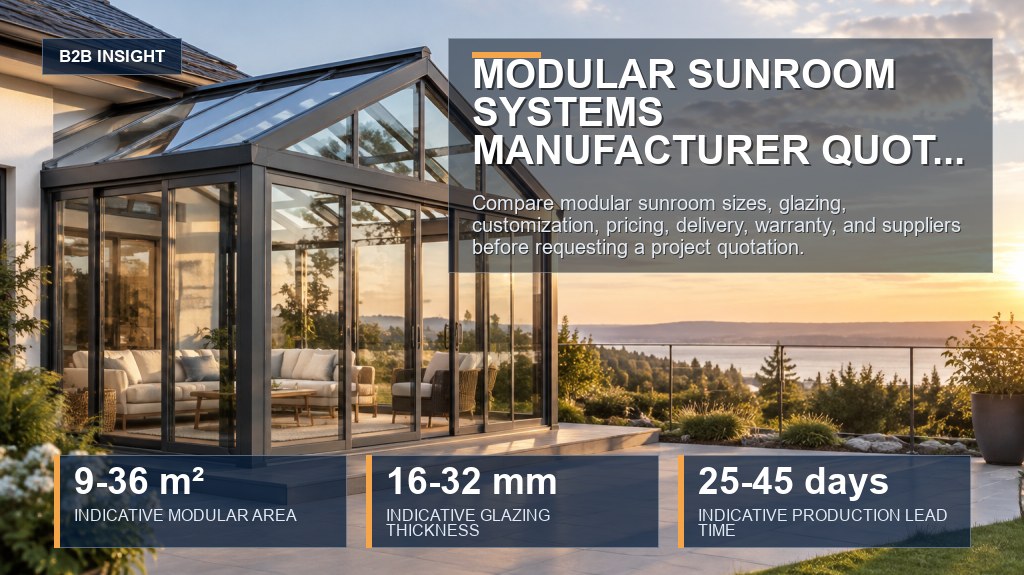
Sunroom dimensions should be defined by width, projection, eave height, ridge height, roof pitch, opening positions, and foundation conditions. For preliminary sourcing, a typical modular area benchmark is 9–36 m². Insulated glazing may be compared within an indicative 16–32 mm thickness range. A planning benchmark of 25–45 days for production can support scheduling. These figures are procurement references rather than certified specifications or guaranteed lead times; buyers must confirm them in the supplier’s datasheet and formal quotation.
Frame evaluation should cover alloy and temper information where available, profile cross-sections, reinforcement, surface finish, thermal-break options, corner connections, and fastening methods. For glazing, compare the complete build-up rather than thickness alone. Ask whether the proposed configuration uses tempered, laminated, low-emissivity, tinted, or insulated glass and which panels are intended for the roof.
Drainage and weather sealing deserve separate review. Request details for gutters, downpipes, pressure-equalized drainage paths, flashing interfaces, gaskets, brushes, and sealants. Operable windows, sliding doors, roof vents, insect screens, blinds, lighting, and smart controls should be listed as standard, optional, or buyer-supplied items. This prevents apparently low prices from becoming expensive after necessary accessories are added.
Local conditions can materially change the specification. Provide the project location, design wind pressure, snow load, temperature range, exposure category, and applicable building requirements. The manufacturer should explain the engineering assumptions and identify available test reports or compliance documents. Buyers should not treat a generic brochure as confirmation that a system is suitable for every market or site.
Price, Customization, and Supplier Qualification
A factory-direct modular sunroom price is affected by total dimensions, roof geometry, profile weight, glazing, color, door and window quantity, accessories, export packaging, and order volume. Freight terms can also change the landed cost substantially. A useful quotation should separate the main structure, glass, hardware, optional equipment, spare parts, packaging, inland transport, and international shipping where offered.
For custom or OEM orders, confirm whether the supplier can produce coordinated plans, elevations, sections, bills of materials, foundation loads, and assembly drawings. Branding options may include packaging marks, manuals, labels, or selected finishes, but each requirement should be agreed before production. Sample colors and material swatches are advisable because screen images may not accurately represent anodized or powder-coated surfaces.
Supplier evaluation should cover engineering response, drawing control, incoming material inspection, trial assembly or pre-shipment inspection procedures, packaging design, and issue-resolution processes. Ask how glass and long profiles are protected, how packages are numbered, and whether the loading plan follows the installation sequence. Clarify warranty duration, exclusions, claim evidence, replacement-part responsibility, and the expected availability of gaskets, rollers, handles, fasteners, and other service parts. Avoid relying on broad warranty statements that do not define labor, freight, glass breakage, corrosion, or installation responsibilities.
RFQ Checklist for a Comparable Quotation
A complete request for quotation allows manufacturers to price the same scope and reduces repeated clarification. Buyers should provide:
- Plan, elevation, opening schedule, site photographs, and installation address.
- Required width, projection, heights, roof form, quantity, and intended use.
- Preferred frame color, glazing build-up, doors, windows, ventilation, and shading.
- Local wind, snow, temperature, and compliance requirements supplied by the project team.
- Requested Incoterm, destination port, delivery deadline, and packaging limitations.
- Requirements for installation drawings, manuals, videos, spare parts, and remote guidance.
Ask each modular sunroom systems supplier to return a dimensional proposal, detailed specification, itemized quotation, production schedule, packing dimensions, estimated shipment weight, payment terms, and warranty statement. State whether installation is performed by the buyer, a local contractor, or the manufacturer. With a consistent RFQ package, procurement teams can compare technical scope and landed cost rather than selecting on headline price alone. Send the project drawings and destination details to shortlisted manufacturers for a verified, project-specific quotation.