
Aluminum Insulated Roof Panel Supplier Bulk Price Guide
Applications and Common Procurement Risks
Searching for an aluminum insulated roof panel supplier bulk price usually means comparing products for warehouses, production buildings, logistics facilities, cold-chain support structures, or commercial roofs. The panel combines aluminum facings with an insulating core, helping create a lightweight roofing envelope while reducing heat transfer. Actual suitability depends on the building design, climate, structural loads, fire requirements, and local regulations.
The lowest price per square meter is rarely the lowest installed cost. Buyers often receive quotations based on different effective widths, facing gauges, core materials, coatings, accessories, packaging standards, or Incoterms. Other risks include poorly matched joints, unclear dimensional tolerances, shipping damage, color variation, and missing installation details. A useful request for quotation must therefore connect price with a complete technical definition.
Specifications and Bulk Price Comparison
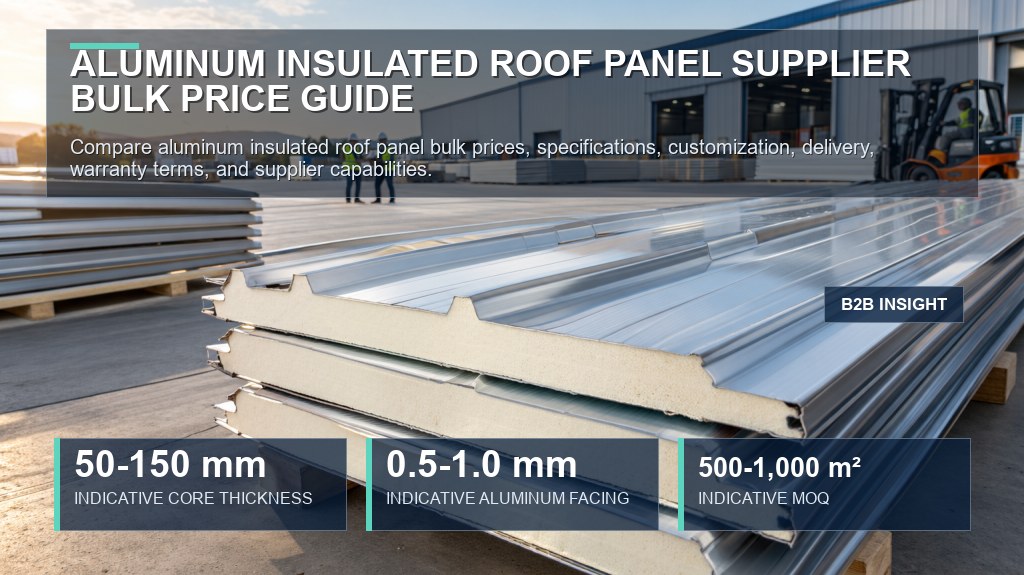
For preliminary sourcing, buyers may encounter indicative core thicknesses of 50–150 mm, aluminum facing thicknesses of 0.5–1.0 mm, and order thresholds around 500–1,000 m². These figures are procurement benchmarks rather than certified specifications or guaranteed performance. Confirm every value in the manufacturer’s datasheet and project quotation.
Core selection has a major influence on insulation, weight, fire behavior, and cost. Ask the supplier to identify the core material, density, declared thermal data, and available supporting test documents. The aluminum facing specification should state the alloy or grade where applicable, nominal thickness, finish, coating system, color, and whether both faces use the same material.
Panel length, effective cover width, profile depth, joint configuration, fastening method, and allowable tolerances also require review. Long custom panels may reduce roof joints but can increase handling and container-loading constraints. Before approving production, obtain a cross-section drawing and confirm compatibility with flashings, ridge caps, gutters, sealants, and fasteners.
Request an itemized quotation showing panels, trims, accessories, packaging, tooling or customization charges, documentation, inland transport, and international delivery terms. Compare all offers using the same currency, area calculation, tax basis, and Incoterm. Freight should be evaluated by packed volume and loading plan, not by panel value alone. Ask for volume tiers so that price changes between the minimum order and the full project quantity remain visible.
How to Qualify a Manufacturer or Supplier
A capable supplier should translate project drawings and performance requirements into a controlled bill of materials. Review its process for incoming material identification, adhesive or bonding control, dimensional inspection, surface checks, labeling, and batch traceability. Buyers can request sample inspection records and packaging photographs without assuming that these documents prove compliance.
Ask which test reports or conformity documents are available for the offered construction. The report should match the core, facing, thickness, and joint configuration being purchased. Requirements differ by market, so do not accept a generic certification claim without checking scope, issuing body, validity, and relevance to the destination country.
Customization may include panel length, profile, color, coating, facing thickness, core selection, protective film, labeling, and export packaging. Clarify whether changes create tooling charges or higher order quantities. A pre-production sample or color chip can reduce disputes, although approval criteria and any natural production variation should be documented.
Commercial evaluation should also cover production lead time, monthly available capacity, payment milestones, inspection access, packing method, container plan, and shipment documentation. Request written warranty terms defining duration, covered defects, exclusions, claim evidence, and remedy. Insulated panels generally do not use spare parts in the machinery sense, but buyers should discuss extra panels, replacement trims, compatible fasteners, sealants, and future color matching for maintenance.
RFQ Checklist for an Actionable Quotation
Send each shortlisted factory the same project package. This makes quotations easier to normalize and exposes technical exclusions before purchase.
- Roof area, drawings, building use, location, and relevant design conditions
- Core type and thickness, aluminum facing gauges, profile, and effective width
- Required thermal, structural, fire, corrosion, and regulatory criteria
- Panel lengths, quantities, colors, coating, protective film, and labeling
- Accessories, fasteners, sealants, trims, and installation documentation
- Destination port, Incoterm, delivery schedule, and preferred packing method
- Inspection plan, acceptance criteria, warranty terms, and claim procedure
Ask for a technical datasheet, cross-section drawing, quotation validity, tiered pricing, production schedule, loading quantity, package dimensions, and estimated gross weight. State whether third-party inspection is required and who will pay for it. For large projects, consider a sample order or controlled first batch before releasing the remaining quantity.
To obtain a comparable factory-direct offer, provide your roof drawings, target specification, quantity, destination, and required delivery date. A qualified aluminum insulated roof panel supplier can then return a technically aligned bulk price, customization details, documentation list, and realistic shipment plan.