
Benefits of PU & Rock Wool Cold Storage Panels | Energy Savings, Fire Safety & Cost Data
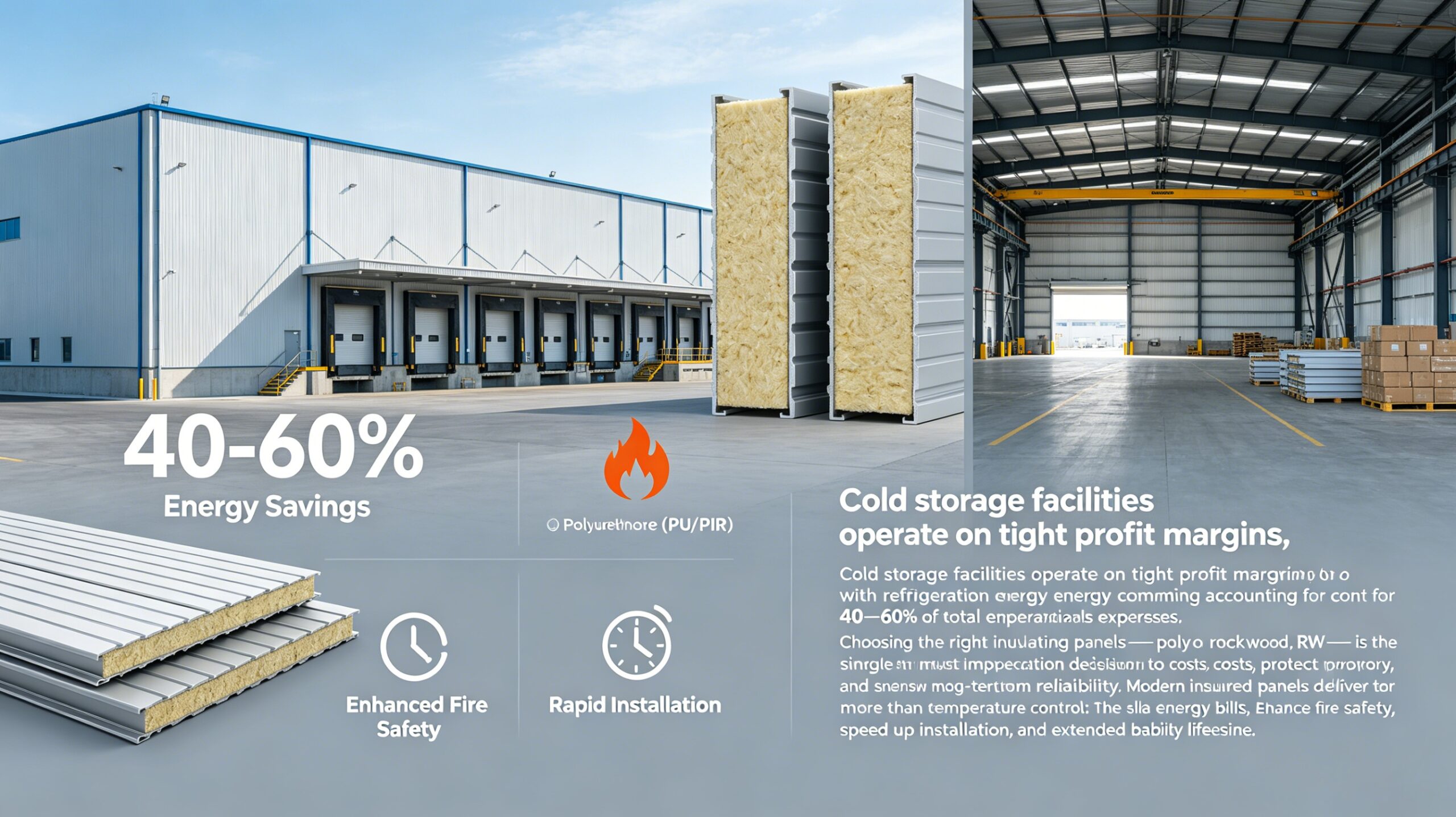
Cold storage facilities operate on tight profit margins, with refrigeration energy costs accounting for 40–60% of total operational expenses.
Choosing the right insulation panels—polyurethane (PU/PIR) or rock wool (RW)—is the single most impactful decision to cut costs, protect inventory, and ensure long-term reliability.
Modern insulated panels deliver far more than temperature control: they slash energy bills, enhance fire safety, speed up installation, and extend facility lifespan. Below is a data-driven breakdown of the core benefits for your cold storage business.
1. Unmatched Thermal Efficiency & Massive Energy Savings
The primary purpose of cold storage insulation is to block heat ingress and maintain stable internal temperatures. PU and rock wool panels excel here, but PU outperforms RW in thermal performance, translating to 25–40% lower refrigeration energy use.
Key Data & Advantages
- PU Panels: Thermal conductivity λ=0.022–0.024 W/m·K; closed-cell rate >97%. A 100mm PU panel delivers R-value ≈5.2 m²K/W, ideal for -18°C to -30°C freezers.
- Rock Wool Panels: λ=0.040–0.045 W/m·K; R-value ≈2.8 m²K/W (100mm). Suitable for 0–5°C chill rooms and fire-critical zones.
- Energy Impact: ASHRAE data confirms PU-insulated cold stores use 32% less annual refrigeration energy than EPS-built facilities. A 1,000 m² warehouse spending $50,000/year on electricity saves $12,500–$20,000 annually.
- Reduced Compressor Runtime: Stable insulation cuts compressor cycling by 20–25%, extending equipment life by 30% and lowering repair costs.
Why It Matters: Lower energy bills directly boost net profit. Most facilities recoup panel investment within 3–7 years via energy savings alone.
2. Superior Fire Safety (Rock Wool = A1 Non-Combustible; PU = B1 Flame-Retardant)
Cold storage often stores high-value, flammable goods (e.g., food, pharmaceuticals, chemicals). Fire safety is non-negotiable—and rock wool panels set the industry standard, while premium PU panels deliver reliable flame resistance.
Key Data & Advantages
- Rock Wool Panels: A1 non-combustible (EU/UK standard); withstands >1,000°C; 60–120 minutes fire integrity. Prevents fire spread, meets strict building codes, and reduces insurance risks.
- PU Panels: Premium PIR/PU = B1 flame-retardant; self-extinguishes when flame is removed; no toxic smoke emission. Ideal for low-to-moderate fire-risk zones.
- Insurance Benefit: Facilities using rock wool panels save 20–30% on insurance premiums vs. standard PU-only installations.
- Risk Mitigation: A single fire in an uninsulated or poorly insulated cold store can cause 100% inventory loss; rock wool panels act as a critical fire barrier.
Why It Matters: Fire safety protects assets, ensures compliance, and avoids costly downtime or legal liabilities.
3. Excellent Moisture Resistance & Long-Term Durability
Cold storage environments face extreme temperature differentials (-30°C internal vs. 35°C external) and high humidity. Moisture is insulation’s worst enemy: 1% moisture increase reduces insulation value by 25%. PU and rock wool panels solve this—especially PU, which is virtually waterproof.
Key Data & Advantages
- PU Panels: Closed-cell structure (>95% closed) = zero water absorption. Resists condensation, ice formation, and mold growth. Maintains thermal performance for 15–20 years with no degradation.
- Rock Wool Panels: Hydrophobic binders reduce water absorption, but moisture penetration (e.g., panel damage) cuts insulation efficiency by 50–70%. Still durable (10–15 years) if properly sealed.
- Structural Protection: Panels with galvanized steel facings (≥120g/m² zinc coating) offer 30% better corrosion resistance than standard panels, even in humid coastal areas.
- Low Maintenance: Both panel types require minimal upkeep—no re-insulation, no frequent repairs. Saves $2,000–$5,000/year in maintenance for a 1,000 m² facility.
Why It Matters: Durable, moisture-resistant panels avoid performance decay and costly replacements, ensuring consistent cooling for decades.
4. Faster Installation & Lower Labor Costs
Time is money in cold storage construction. PU and rock wool panels are prefabricated, modular, and lightweight, cutting installation time and labor costs significantly vs. traditional brick/concrete or EPS insulation.
Key Data & Advantages
- PU Panels: 40% lighter than equivalent rock wool panels (40–50 kg/m³ vs. ≥100 kg/m³). A 1,000 m² cold store installs in 3–4 days (vs. 5–7 days for traditional methods), reducing labor costs by 30–40%.
- Rock Wool Panels: Heavier but still modular; installs 20% faster than non-panel insulation. Ideal for retrofits or fire-critical new builds.
- Seamless Fit: Interlocking tongue-and-groove design eliminates gaps, reducing air infiltration by 70% vs. site-built insulation. No cold bridging—common in traditional construction—preventing ice buildup and energy waste.
Why It Matters: Faster construction means earlier revenue generation. Lower labor costs improve project ROI, especially for large-scale facilities.
5. More Usable Storage Space & Higher Inventory Capacity
Cold storage operators maximize profit by storing more inventory. PU panels’ superior thermal performance allows thinner walls—freeing up valuable floor space vs. thicker rock wool or EPS installations.
Key Data & Advantages
- Space Gain: A 1,000 m² cold store using 100mm PU panels gains 30–50 m² of usable space vs. 150mm rock wool panels (same insulation value). That’s 3–5% more inventory capacity—directly increasing revenue.
- High Strength-to-Weight Ratio: PU panels support heavy loads (e.g., evaporators, racking) without deflection, enabling higher stacking density and better space utilization.
Why It Matters: Extra space = more products stored = higher daily/weekly revenue. For cold storage, this is a critical competitive advantage.
6. Compliance with Global Standards & Inventory Protection
Modern cold storage must meet strict food safety (e.g., HACCP, FSSAI) and building regulations. PU and rock wool panels help you comply while protecting inventory from temperature fluctuations, mold, and contamination.
Key Data & Advantages
- Temperature Stability: Panels maintain ±0.5°C consistency (vs. ±2–3°C with poor insulation), reducing product spoilage by 80%. Critical for pharmaceuticals, fresh produce, and frozen foods.
- Compliance: PU panels meet EN 14509 (EU), UKCA (UK), and ASTM (US) standards; rock wool complies with A1 fire codes and food safety regulations. Avoids fines and failed inspections.
- Hygiene: Smooth steel facings are easy to clean, disinfect, and resistant to bacteria growth—ideal for food-grade cold storage.
Why It Matters: Compliance avoids legal risks; stable temperatures protect high-value inventory, reducing waste and improving customer satisfaction.
Conclusion
Installing polyurethane (PU/PIR) or rock wool insulation panels transforms cold storage operations—delivering 25–40% energy savings, A1/B1 fire safety, 15–20 year durability, faster installation, more usable space, and full regulatory compliance. For most cold stores, PU panels are the top choice for balanced thermal performance, cost savings, and durability. Rock wool panels excel in fire-critical facilities or high-risk zones.
Investing in quality insulated panels isn’t just an upgrade—it’s a long-term profit driver that cuts costs, protects assets, and ensures your cold storage remains competitive for decades.