
Where to Sell Imported PU & Rock Wool Cold Storage Panels in Canada
If you’ve imported a large volume of polyurethane (PU/PIR) and rock wool (RW) cold storage panels into Canada, you’re perfectly positioned to tap into a booming cold chain insulation market.
North America’s cold room panel market is valued at USD 900 million (2024) and is projected to hit USD 1.5 billion by 2035, with Canada driving steady growth due to its extreme climates, strict energy codes, and expanding food, pharmaceutical, and logistics sectors.
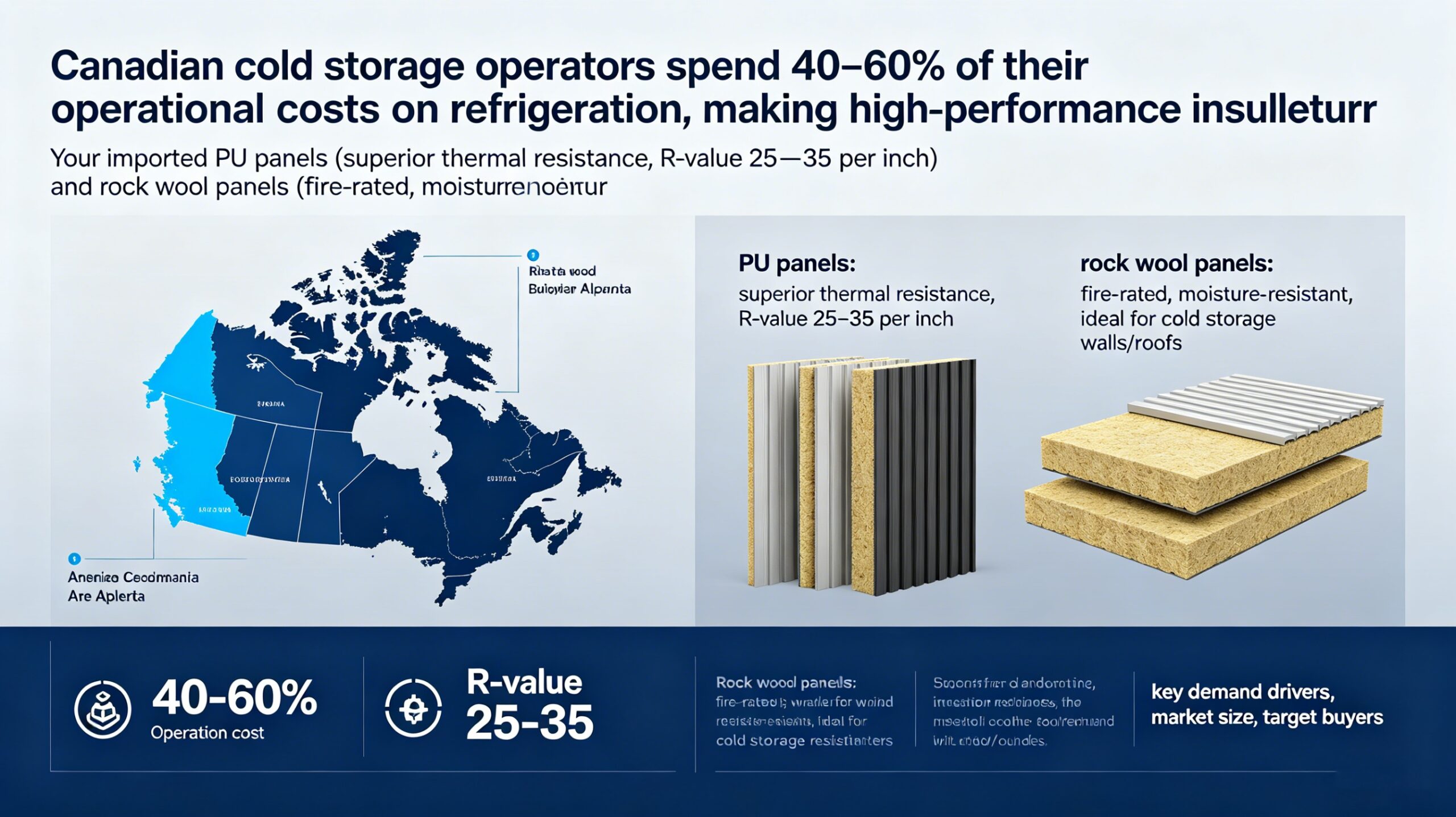
Canadian cold storage operators spend 40–60% of their operational costs on refrigeration, making high-performance insulation panels a non-negotiable investment.
Your imported PU panels (superior thermal resistance, R-value 25–35 per inch) and rock wool panels (fire-rated, moisture-resistant, ideal for cold storage walls/roofs) are in high demand across specific provinces.
Below is a data-driven guide to the best regions to sell your panels, with key demand drivers, market size, and target buyers for each area.
1. Ontario: Canada’s Largest Cold Storage Market (35% of National Demand)
Ontario dominates Canada’s cold storage panel demand, accounting for 35% of national consumption—the highest of any provinceStatistics Canada / Statistique Canada. Its population of 15 million, concentrated in Toronto, GTA, and Ottawa, fuels massive demand for food processing, distribution, and pharmaceutical cold storage.
Key Demand Drivers
- Stringent Building Codes: The 2024 Ontario Building Code (OBC) mandates continuous insulation for all commercial/industrial buildings, making PU/rock wool panels mandatory for new cold storage construction.
- Booming Food & Beverage Sector: Ontario’s food processing industry generates CAD 45 billion annually, with 1,200+ cold storage facilities needing panel replacements or expansions.
- Logistics Hub: Toronto and GTA are Canada’s largest logistics hubs, with 200+ new refrigerated warehouses under construction in 2025–2026Statistics Canada / Statistique Canada.
Top Cities to Target
- Toronto/GTA: Focus on 3PL logistics providers, grocery distribution centers (e.g., Loblaws, Metro), and pharmaceutical cold storage firms.
- Ottawa: Government and healthcare sectors drive demand for pharmaceutical and vaccine cold storage (rock wool panels preferred for fire safety).
- London: Fastest-growing non-residential construction market in Canada (+2.3% Q4 2025), with new food processing plants and cold storage facilitiesStatistics Canada / Statistique Canada.
Market Data
- Annual Panel Demand: 1.2 million sq. meters (PU: 70%, Rock Wool: 30%)Statistics Canada / Statistique Canada.
- Average Price: CAD 80–120 per sq. meter (PU panels); CAD 90–130 per sq. meter (rock wool panels).
2. British Columbia (BC): High-Growth Coastal Market (22% of National Demand)
British Columbia is Canada’s second-largest cold storage panel market, with 22% of national demand, driven by its coastal climate, thriving seafood industry, and rapid urbanization. The province’s construction permit values rose 43% year-over-year (ending May 2025), with cold storage and industrial insulation leading growth.
Key Demand Drivers
- Seafood & Agriculture: BC’s seafood industry (salmon, shellfish) generates CAD 3.2 billion annually, requiring 150+ cold storage facilities for processing and export.
- Coastal Climate Needs: High humidity and temperature fluctuations demand moisture-resistant insulation—rock wool panels are ideal for coastal cold storage walls/roofs.
- LNG & Industrial Projects: Major projects like LNG Canada and Woodfibre LNG drive demand for industrial cold storage and process insulation.
Top Cities to Target
- Vancouver: Focus on seafood processing plants, port logistics cold storage, and grocery distribution centers.
- Surrey: Fastest-growing city in BC, with 50+ new cold storage warehouses under construction (2025–2026).
- Kelowna: Agriculture hub (fruit, wine) with high demand for small-to-medium cold storage facilities (PU panels preferred for cost-effectiveness).
Market Data
- Annual Panel Demand: 750,000 sq. meters (PU: 60%, Rock Wool: 40%).
- Key Incentive: BC’s Energy Efficiency Rebate Program offers up to CAD 15,000 for cold storage facilities upgrading insulation—boosting demand for your panels.
3. Alberta: Industrial & Agricultural Powerhouse (18% of National Demand)
Alberta is Canada’s third-largest market, with 18% of national cold storage panel demand, driven by its oil and gas, agriculture, and food processing sectorsStatistics Canada / Statistique Canada. The province’s industrial construction investment rose CAD 20.6 million in December 2025, with cold storage and industrial insulation as key growth areasStatistics Canada / Statistique Canada.
Key Demand Drivers
- Extreme Cold Climate: Winter temperatures drop to -30°C, requiring high-R-value insulation (PU panels: R-30+ ideal for energy efficiency).
- Agriculture & Food Processing: Alberta’s beef, poultry, and grain industries generate CAD 28 billion annually, with 800+ cold storage facilities for meat processing and grain storage.
- Oil & Gas Sector: Demand for industrial cold storage and process insulation (rock wool panels for fire safety and thermal stability)Statistics Canada / Statistique Canada.
Top Cities to Target
- Calgary: Focus on meat processing plants, logistics cold storage, and oil and gas industrial facilities.
- Edmonton: Agriculture hub with high demand for grain storage and food processing cold storage (PU panels preferred for cost and thermal performance).
- Red Deer: Midway between Calgary and Edmonton, with 50+ small-to-medium cold storage facilities needing panel upgrades.
Market Data
- Annual Panel Demand: 600,000 sq. meters (PU: 75%, Rock Wool: 25%)Statistics Canada / Statistique Canada.
- Regulatory Push: Alberta’s 2023 National Building Code (NBC) edition mandates higher thermal resistance for industrial buildings—driving demand for your imported high-performance panels.
4. Quebec: French-Speaking Cold Storage Hub (15% of National Demand)
Quebec accounts for 15% of national cold storage panel demand, with a strong focus on food processing, dairy, and pharmaceutical sectors. The province’s residential construction costs rose 2.1% (Q4 2025), the highest in Canada, with commercial/industrial insulation following suitStatistics Canada / Statistique Canada.
Key Demand Drivers
- Dairy & Food Processing: Quebec’s dairy industry generates CAD 12 billion annually, with 400+ cold storage facilities for milk, cheese, and yogurt production.
- Strict Fire Codes: Quebec’s fire safety regulations prioritize fire-rated insulation—rock wool panels are in high demand for cold storage walls and roofs.
- Cold Climate: Similar to Alberta, winter temperatures drop to -25°C, requiring high-R-value PU panels for energy efficiency.
Top Cities to Target
- Montreal: Focus on dairy processing plants, pharmaceutical cold storage, and port logistics facilities.
- Quebec City: Government and healthcare sectors drive demand for vaccine and medical cold storage (rock wool panels preferred).
- Laval: Industrial suburb with 60+ food processing plants needing panel replacements or new construction.
Market Data
- Annual Panel Demand: 500,000 sq. meters (PU: 55%, Rock Wool: 45%).
- Language Advantage: French-speaking market—position your panels as “isolants haute performance” for local buyers.
5. Prairie Provinces (Saskatchewan & Manitoba): Agricultural Cold Storage Niche (7% of National Demand)
Saskatchewan and Manitoba combined account for 7% of national demand, driven by their agriculture (grain, oilseeds, livestock) and food processing sectors. These provinces have lower competition than Ontario/BC, making them ideal for clearing excess inventory.
Key Demand Drivers
- Grain & Livestock Storage: Saskatchewan’s grain industry generates CAD 10 billion annually, with 300+ cold storage facilities for grain and livestock products.
- Harsh Climate: Extreme cold and wind demand durable, wind-resistant panels—your imported PU/rock wool panels are perfect for these conditions.
Top Cities to Target
- Regina (SK): Focus on grain storage facilities and small food processing plants.
- Winnipeg (MB): Agriculture and logistics hub with 40+ cold storage warehouses needing panel upgrades.
Market Data
- Annual Panel Demand: 250,000 sq. meters (PU: 80%, Rock Wool: 20%).
- Low Competition: Fewer local panel manufacturers—your imported, cost-effective panels will stand out.
Final Tips for Selling Your Imported Panels in Canada
- Certifications First: Ensure your panels meet Canadian Standards Association (CSA) and National Building Code (NBC) requirements—critical for customs clearance and buyer trust.
- Target Buyers: Focus on cold storage contractors, 3PL logistics providers, food processing plants, and agricultural cooperatives—the primary buyers of insulation panels.
- Price Competitively: Canadian buyers prioritize cost-effectiveness—your imported panels (lower cost than local manufacturers) will have a strong competitive edge.
- Leverage Rebates: Promote provincial energy efficiency rebates (e.g., BC’s Energy Efficiency Rebate, Ontario’s Save on Energy) to incentivize buyers.
With Canada’s cold storage insulation market growing at 6% CAGR (2025–2035), your imported PU and rock wool panels are well-positioned to capture significant market share.
Focus on the high-demand provinces above, tailor your marketing to local climate and regulatory needs, and you’ll clear your inventory while building long-term customer relationships.