UK Customs Clearance for Insulated Aluminum Roof Panels, Required Certificates & Docs
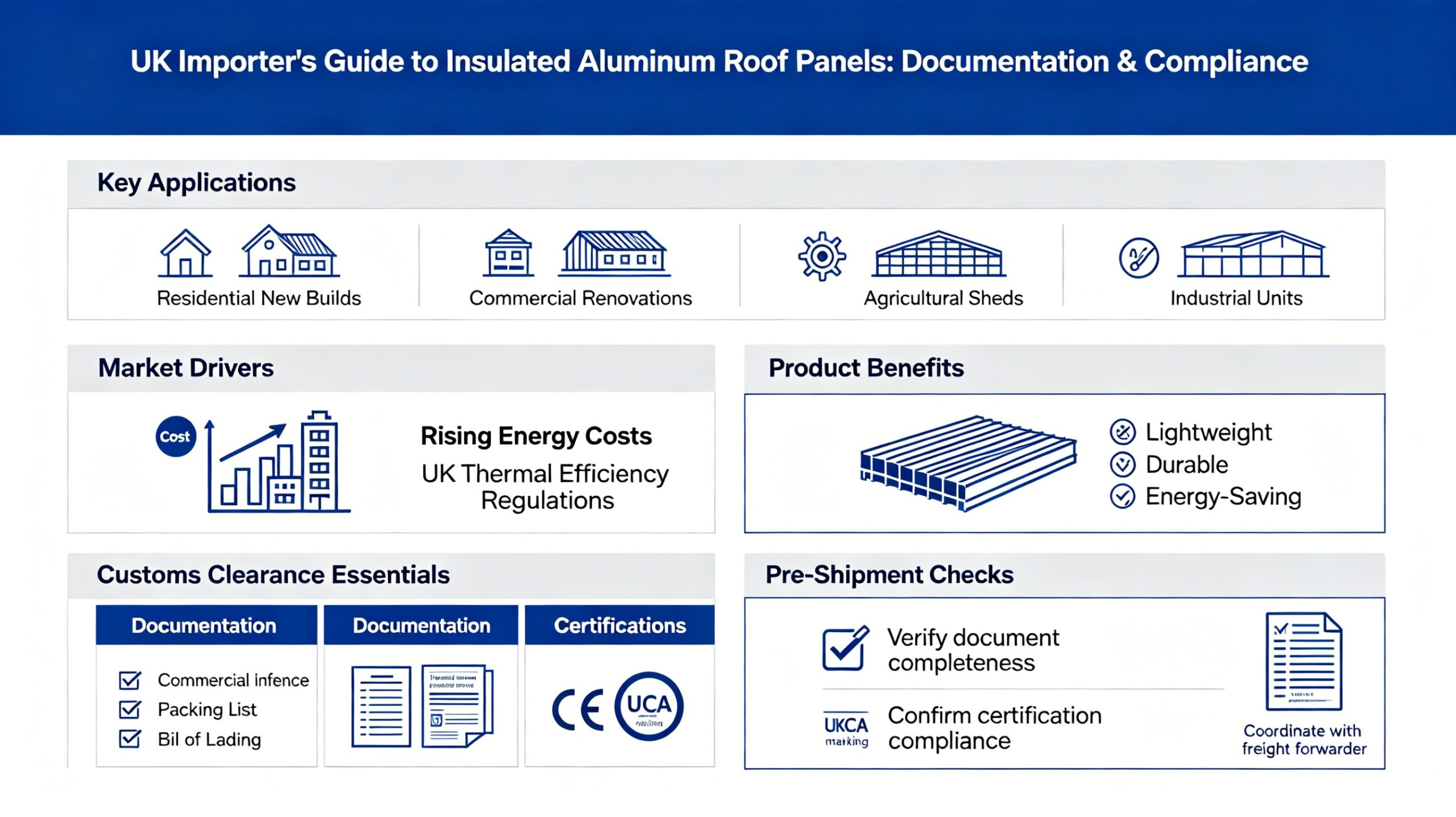
Insulated aluminum roof panels are in high demand across the UK’s residential new builds, commercial renovations, agricultural sheds and industrial units.
With rising energy costs and strict UK building regulations for thermal efficiency, these lightweight, durable and energy-saving panels have become a top choice for contractors and homeowners alike.
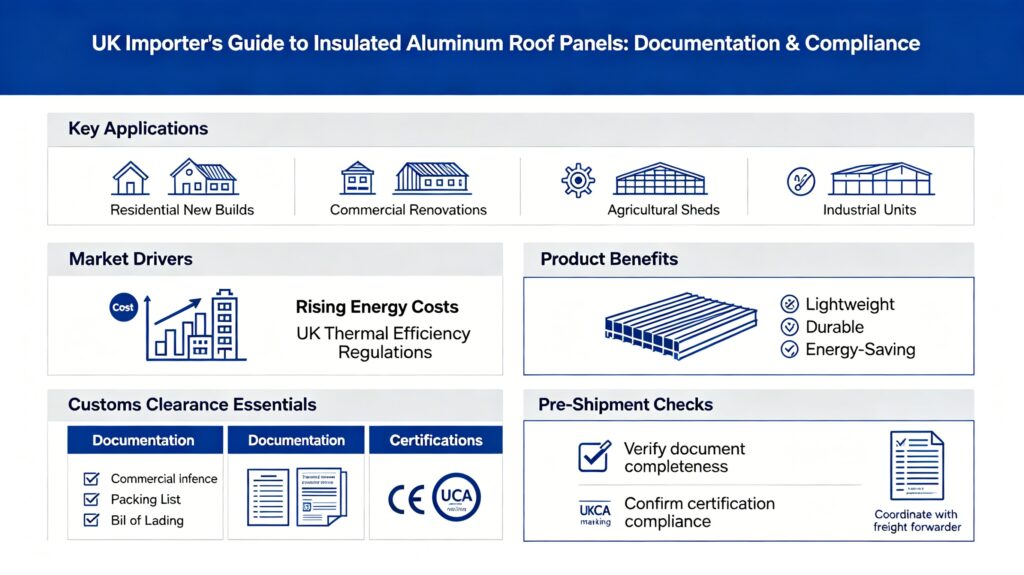
If you’re a UK-based distributor planning to import a batch of insulated aluminum roof panels from China, smooth customs clearance depends entirely on complete, accurate documentation and product compliance certifications.
Missing even one mandatory certificate or form can lead to cargo detention at the port, HMRC fines, delivery delays and failed building control inspections. This guide breaks down every essential document, certification and pre-shipment preparation step you need for hassle-free imports into the UK.
1. Core Mandatory Customs Documents (Required for All Shipments)
These foundational documents are non-negotiable for clearing UK customs via the Customs Declaration Service (CDS). All details must be 100% consistent across documents to avoid delays.
1.1 Commercial Invoice
- Issued by the Chinese manufacturer; must include:
- Full seller and buyer (your UK business) details (name, address, contact)
- Exact product description: “insulated aluminum roof panels” + core material (PU/PIR), thickness, dimensions, coating type
- HS code (critical for tariff classification: 7606.12 for aluminum panels with insulation core)
- Quantity, unit price, total value, currency and Incoterms (e.g., CIF Felixstowe, FOB Shanghai)
- Country of origin (China) and manufacturer’s declaration of compliance
1.2 Packing List
- Detailed breakdown of packaging: number of pallets/cartons, gross/net weight, dimensions per package
- Markings, batch numbers and panel specifications matching the commercial invoice
1.3 Bill of Lading (B/L) or Air Waybill
- Sea freight: Original or telex-released Bill of Lading (proof of cargo ownership)
- Air freight: Air Waybill; includes flight details and consignee information
1.4 Certificate of Origin (CoO)
- Non-preferential CoO: Issued by Chinese Chamber of Commerce; proves goods are made in China (for standard tariff rates)
- Preferential CoO (for reduced duty): Under UK-China trade agreements, apply for Form A or EUR1 to claim lower or zero customs duty. Critical for improving profit margins on bulk orders.
1.5 UK Importer’s EORI & VAT Numbers
- EORI number: Mandatory for all UK imports; starts with “GB” (apply via HMRC before shipment)
- VAT registration number: Required for VAT declaration; HMRC uses this to calculate import VAT (20% on most building materials)
1.6 ISPM 15 Compliance for Wooden Packaging
- All wooden pallets, crates or packaging must have ISPM 15 heat treatment/fumigation stamps. No stamp = automatic rejection by UK border control.
2. Product Compliance Certifications (Critical for UK Market Access)
Insulated aluminum roof panels are classified as construction products in the UK, requiring specific safety, thermal and fire performance certifications. These are checked at customs and during building control inspections.
2.1 UKCA Marking (Mandatory for UK)
- UKCA (UK Conformity Assessed) mark is the UK’s replacement for CE marking post-Brexit.
- Required for all construction products sold in England, Scotland and Wales.
- Manufacturer must provide a UKCA Declaration of Conformity (DoC) confirming compliance with UK building regulations (e.g., thermal insulation standards, fire safety).
2.2 CE Marking (Recommended for EU Compatibility)
- While not mandatory for the UK, CE marking (EN 14509 standard for insulated metal panels) is widely accepted and simplifies cross-border sales if you expand to the EU.
- Includes test reports for thermal conductivity, water tightness, wind resistance and fire reaction.
2.3 Fire Performance Certificate
- UK building regulations require Class 0 or Class 1 fire rating for roof panels.
- Manufacturer must provide a fire test report from a UKAS-accredited laboratory (e.g., BS 476 Part 6/7) proving compliance.
2.4 Thermal Insulation Test Report
- Proof of U-value (thermal transmittance) meeting UK’s Part L building regulations (maximum U-value for roofs: 0.18 W/m²K).
- Required for building control approval and energy performance certificates (EPC) for properties.
2.5 Material Safety Data Sheet (MSDS)
- For the insulation core (PU/PIR foam): MSDS confirming no hazardous substances, compliance with UK REACH regulations.
3. Pre-Shipment Preparation Steps to Avoid Delays
- Verify HS Code Accuracy: Confirm 7606.12 with HMRC or your customs broker to avoid misclassification and tariff disputes.
- Request Manufacturer’s Compliance Pack: Collect UKCA DoC, CE test reports, fire/thermal certificates and MSDS before production.
- Label Cargo Correctly: Mark pallets with UKCA logo, product specs, country of origin and batch numbers.
- Submit Documents to Customs Broker Early: Share all forms 3–5 days before cargo arrival for pre-clearance checks.
- Register for HMRC’s CDS System: Ensure your business is set up to submit electronic declarations.
4. Common Mistakes to Avoid
- ❌ Missing UKCA marking: Leads to cargo seizure and £1,000+ fines.
- ❌ Inconsistent product descriptions across documents: Triggers manual inspection and 3–7 day delays.
- ❌ Unmarked wooden packaging: ISPM 15 non-compliance results in immediate return to sender.
- ❌ Outdated fire/thermal test reports: Building control rejects panels, delaying construction projects.
Conclusion
Importing insulated aluminum roof panels into the UK requires careful attention to both customs paperwork and product compliance certifications.
By preparing all core documents (invoice, packing list, B/L, CoO) and ensuring the manufacturer provides valid UKCA, fire and thermal performance certificates, you can avoid costly delays and penalties.
As a UK distributor, partnering with a Chinese supplier that has proven experience in UK exports and can provide a full compliance pack will streamline your import process.
With the right documentation in place, you can confidently supply high-quality insulated aluminum roof panels to meet the UK’s growing demand for energy-efficient building solutions.