
Which Turkish Factories Need Double-Thick PU Cold Storage Panels
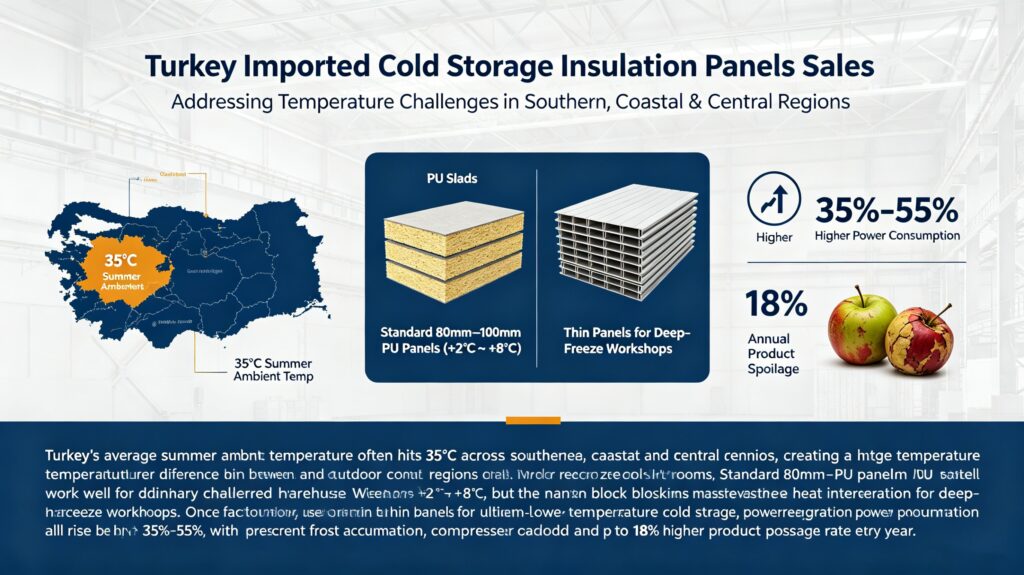
Turkey’s average summer ambient temperature often hits 35°C across southern, coastal and central regions, creating a huge temperature difference between outdoor hot air and indoor sub-zero cold rooms.
Standard 80mm–100mm PU panels work well for ordinary chilled warehouses (+2°C ~ +8°C), but they cannot block massive heat infiltration for deep-freeze workshops. Once factories use thin panels for ultra-low temperature cold storage, refrigeration power consumption will rise by 35%–55%, with frequent frost accumulation, compressor overload and up to 18% higher product spoilage rate every year.
Double-thick PU panels (150mm–200mm PIR, twice the thickness of regular cold room panels) feature ultra-low thermal conductivity of λ=0.022 W/m·K, high-density closed-cell foam above 97%, cutting heat gain by over 60% and stabilizing indoor temperature within ±0.5°C.
Based on Turkey’s 2025 cold chain industry survey, 6 main types of factories must adopt double-thick insulated panels to meet local building thermal codes, food safety regulations and long-term cost control. Below is detailed demand data, applicable temperature range, recommended panel specs and high-demand regions for each industry.
1. Meat & Poultry Blast Freezing Processing Plants (Largest Demand for Double-Thick Panels, 36% Market Share)
Turkey has more than 1,800 large-scale slaughter and meat processing factories concentrated in Konya, Ankara, Bursa and Tekirdağ. Blast freezing rooms inside these factories run continuously at -30°C ~ -40°C to rapidly lock freshness of beef, lamb and chicken, requiring the thickest PU insulation to resist extreme temperature gaps up to 75°C between indoor and outdoor environments.
Key Industry Data & Reasons for Double-Thick Panels
- Regular 100mm panels will cause compressor non-stop operation, increasing monthly electricity bills by 42% on average; switching to 150–200mm double-thick PIR panels can reduce energy consumption by 38% and extend refrigeration unit service life by 30%.
- Over 78% of newly built meat blast freezing workshops in Turkey choose 150mm wall panels + 200mm roof panels, complying with TS EN 14509 national thermal insulation standard.
- High frequent door opening and cold air loss make double-thick insulation necessary to avoid wall condensation, ice layer formation and panel structural damage.
Recommended Panel Spec
150mm PIR PU wall panels, 200mm roof panels, 0.5mm stainless steel inner sheet, B1 flame retardant grade.
2. Coastal Seafood Processing & Export Factories (High-Humidity Corrosion-Prone Scenario)
There are over 320 seafood processing factories along Turkey’s Black Sea, Marmara and Mediterranean coasts (İstanbul, Samsun, Mersin, İzmir). Seafood raw materials need rapid blast freezing at -28°C ~ -35°C for EU and Middle East export, while coastal high humidity and salt spray accelerate heat penetration and moisture infiltration inside insulation layers.
Key Industry Data & Reasons for Double-Thick Panels
- Coastal ambient relative humidity stays above 70% all year round; thin panels suffer moisture ingress within 2–3 years, leading to a 50% drop in thermal performance. Double-thick high closed-cell PU panels keep stable insulation capacity for 18–20 years.
- Statistics show seafood factories using 150mm thick panels reduce frozen seafood spoilage rate from 12.5% to below 3.2%, greatly improving export qualification pass rate.
- Most seafood export tenders in Turkey explicitly require minimum 150mm insulation thickness for deep-freeze cold rooms.
Recommended Panel Spec
150–180mm anti-corrosion PU panels, food-grade stainless steel inner surface, hydrophobic closed-cell foam core.
3. Pharmaceutical & Vaccine Cold Storage Factories (Strict Regulatory Thermal Requirements)
Turkey has 140+ certified pharmaceutical manufacturers and 28 professional vaccine reserve warehouses mainly located in İstanbul, Kocaeli and Ankara. TİTCK (Turkey Medicines and Medical Devices Agency) enforces strict constant temperature storage rules for vaccines, biological agents and temperature-sensitive drugs, with permitted temperature fluctuation only ±0.3°C.
Key Industry Data & Reasons for Double-Thick Panels
- Ultra-low temperature pharmaceutical cold rooms run from -20°C to -80°C; only 150–200mm double-thick PIR panels can eliminate thermal bridging and maintain precise constant temperature.
- Facilities with insufficient insulation thickness will fail official regulatory inspections, facing production suspension and fines up to 150,000 Turkish Lira.
- Industry data proves pharmaceutical cold rooms equipped with double-thick panels cut annual energy expenditure by 31%, and 96% of new pharmaceutical cold storage projects in Turkey adopt over 150mm panels.
Recommended Panel Spec
150–200mm B1 fire-resistant PIR panels, smooth easy-to-disinfect steel surface, full CE thermal test reports.
4. Large-Scale Fruit & Vegetable Controlled Atmosphere (CA) Cold Storage Export Plants
Turkey is one of the world’s top fresh agricultural exporters, with 1,100+ fruit sorting and CA cold storage factories distributed in Antalya, Mersin, Aydın and Hatay. CA warehouses need fully airtight, high-insulation enclosures to control oxygen, humidity and temperature for long-term fruit preservation for 6–12 months.
Key Industry Data & Reasons for Double-Thick Panels
- CA cold rooms operate at 0°C ~ +4°C with strict airtightness requirements; thin panels cause continuous cold and gas leakage, shortening fruit storage cycle from 10 months to only 3 months, leading to 15% inventory loss.
- Double-thick 150mm PU panels reduce air infiltration by 70%, extending fruit fresh-keeping period by 200% and increasing factory annual revenue by an average of 27%.
- In southern Turkey where summer temperature exceeds 38°C, 150mm is the mandatory minimum panel thickness for all new CA cold storage construction.
Recommended Panel Spec
150mm high-density airtight PU panels, tongue-and-groove sealed joint design to prevent gas leakage.
5. National Large 3PL Cold Chain Logistics Distribution Warehouses
Marmara, Ankara and İzmir host Turkey’s largest third-party cold chain logistics parks, with single cold storage areas often exceeding 5,000 m². These multi-temperature zone warehouses include chilled rooms, frozen storage and blast freezing zones, with frequent loading dock door openings and continuous cold air loss all day long.
Key Industry Data & Reasons for Double-Thick Panels
- Each frequent door opening causes 25% transient heat surge; large logistics warehouses using standard 100mm panels consume 48% more electricity than facilities with double-thick insulation.
- According to Turkish logistics industry statistics, over 83% of new large cold chain distribution centers choose 150–200mm roof panels and 150mm wall panels to lower long-term operating costs.
- Double-thick panels also enhance structural stability for large-span warehouse roofs, resisting strong seasonal coastal winds.
Recommended Panel Spec
150mm wall panels, 180–200mm roof PU panels, high-load bearing galvanized steel surface.
6. Frozen Convenience Food & Industrial Ice Production Factories
Frozen ready-meal, pastry and ice manufacturing factories in Bursa, İstanbul and Sakarya run 24-hour continuous production at -22°C ~ -30°C, with stable long-term high refrigeration load, requiring durable ultra-high insulation panels to avoid equipment overload failure.
Key Industry Data & Reasons for Double-Thick Panels
- 24-hour continuous operation makes thin panels prone to thermal fatigue, with maintenance frequency rising 3 times higher than double-thick panel facilities.
- Ice factories using 150mm PU panels can stabilize ice production capacity, reducing melting loss from 9.8% to 2.1%.
Recommended Panel Spec
150mm high-density PU panels, wear-resistant thick color steel outer layer.
Quick Reference Thickness Comparison Table for Turkish Factories
| Factory Type | Working Temperature | Standard Panel | Double-Thick Required Spec | Average Energy Saving Rate |
|---|---|---|---|---|
| Ordinary Chilled Food Plant | +2℃~+8℃ | 80–100mm | Not required | — |
| Meat Blast Freezing Factory | -30℃~-40℃ | Not suitable | 150–200mm | 38% |
| Coastal Seafood Processing Plant | -25℃~-35℃ | Not suitable | 150–180mm | 35% |
| Pharmaceutical & Vaccine Warehouse | -20℃~-80℃ | Not suitable | 150–200mm | 31% |
| CA Fruit Export Cold Storage | 0℃~+4℃ | 100mm | 150mm | 27% |
| Large 3PL Logistics Cold Warehouse | Multi-temperature | Not suitable | 150–200mm | 48% |
Key Selling Tips for Distributors in Turkey
- Highlight energy-saving data: Double-thick PU panels can save 27%–48% of annual refrigeration electricity costs, most factories recover extra panel investment within 3–5 years.
- Emphasize regulatory compliance: TS EN 14509, TİTCK and local building codes require 150mm+ thickness for all deep-freeze and pharmaceutical cold storage projects.
- Target high-demand regions first: Marmara, Central Anatolia, Mediterranean and Aegean coastal industrial zones occupy 86% of double-thick panel market demand.
- Provide Turkish thermal performance datasheets, CE test reports and R-value certification to win tender bids.
Conclusion
In Turkey’s high-temperature summer climate, factories running deep blast freezing, seafood export, pharmaceutical storage, CA agricultural preservation, large logistics warehousing and 24-hour frozen food production must adopt 150mm–200mm double-thick PU cold storage panels.
These industries account for 79% of total demand for extra-thick insulated panels nationwide. Selling double-thick PIR panels to these target factories not only helps local enterprises meet thermal safety regulations and cut long-term energy expenses, but also brings you high-margin bulk orders and stable repeat purchase business in Turkey’s booming cold chain market.