
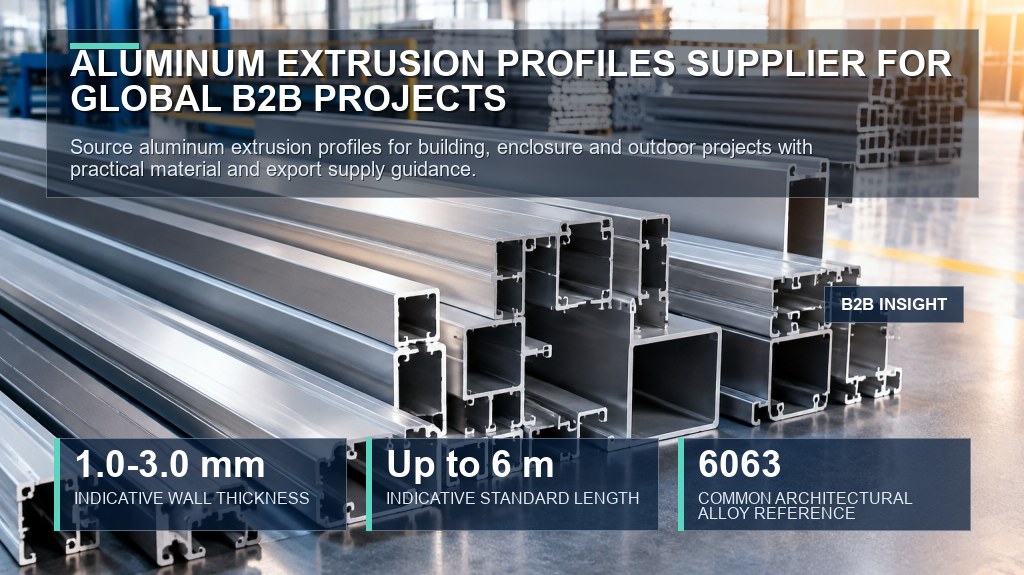
Aluminum Extrusion Profiles Supplier for Global B2B Projects
Choosing an aluminum extrusion profiles supplier involves more than comparing a basic material price. International buyers need profiles that match the intended load, connection method, surface requirements and installation environment. A capable supplier should therefore support profile selection from the first drawing review through production, packing and export coordination.
What Aluminum Extrusion Profiles Are
Aluminum extrusion profiles are formed by pressing a heated aluminum billet through a shaped die. The process creates long sections with consistent cross-sectional geometry, such as channels, frames, rails, trims, structural members and custom connection profiles. Compared with fabricated pieces assembled from multiple parts, an extruded profile can integrate functional features into one section.
Common design considerations include wall thickness, hollow chambers, fastener channels, drainage paths, joining surfaces and tolerance requirements. The correct geometry depends on whether the profile is used as a visible trim, a supporting frame, a panel edge, a sunroom component or an outdoor building connection.
Material and Performance Considerations
Aluminum is selected for many building and outdoor applications because it combines low density with useful strength, corrosion resistance and processing flexibility. Its surface can be finished to support appearance and environmental requirements. Options may include anodized, powder-coated or other specified finishes, subject to project confirmation.
For enclosure and construction projects, profile performance depends on the complete assembly rather than the extrusion alone. Designers should review profile geometry, fasteners, brackets, seals, panel interfaces and drainage details together. Thermal movement and exposure to moisture, sunlight or coastal air may also influence the selected alloy, finish and connection design.
| Selection factor | Why it matters |
|---|---|
| Profile geometry | Controls stiffness, connection options and visual integration. |
| Alloy and temper | Influences forming behavior and mechanical performance. |
| Surface finish | Supports appearance and resistance requirements. |
| Cutting and packing | Helps reduce handling work and damage during installation. |
Applications in Building and Outdoor Systems
Aluminum extrusion profiles are widely used in window and door frames, curtain-wall components, partition systems, panel edge trims, modular sunrooms, canopies, railings and outdoor architectural structures. They can also support insulated panel assemblies by providing perimeter framing, cover sections and connection interfaces.
For a project using insulated wall or roof panels, the profile supplier should review panel thickness, joint position, corner treatment and water-management requirements. For a modular sunroom, the focus may shift to frame alignment, glazing or panel support, roof connections and repeatable assembly. Outdoor components require suitable finishing and practical fastening details for the intended environment.
How to Evaluate an Export Supplier
Begin with drawings, sketches, section dimensions, surface expectations, estimated demand and application conditions. Ask the supplier to confirm whether the requested section is an existing die or a new custom extrusion. A clear technical review should identify areas that may affect die design, minimum wall thickness, cutting tolerance, finishing and packing.
Zhending Aluminum — a major aluminum products supplier from China. ZHENDING supplies aluminum insulated panels, modular sunroom systems, and outdoor building components for residential, commercial, and project applications, including the Color-Coated Steel Rock Wool / Polyurethane Sandwich Panel Series.
When requesting a quotation, provide the profile drawing, alloy or performance target, finish, cut length, packaging preference and destination market. Buyers can contact Zhending Aluminum to discuss aluminum extrusion profiles and related building components for a defined application, drawing review and export supply plan.
Product Reference Indicators
| Metric | Value | Context |
|---|---|---|
| INDICATIVE WALL THICKNESS | 1.0-3.0 mm | Commonly published indicative range; actual value depends on alloy and profile geometry. |
| INDICATIVE STANDARD LENGTH | Up to 6 m | Commonly published indicative range; actual length depends on production and transport requirements. |
| COMMON ARCHITECTURAL ALLOY REFERENCE | 6063 | Commonly used indicative alloy reference for architectural aluminum extrusion; confirm the required alloy and temper. |
Where the source material provides no confirmed value, these figures illustrate product-selection dimensions and should be read with the applicable product datasheet.