
Custom Aluminum Solutions Supplier: RFQ Buying Guide
Define the RFQ Before Comparing Prices
A custom aluminum solutions supplier should be evaluated on more than unit price. Buyers often receive quotations based on different drawing revisions, material assumptions, inspection scopes, or packaging methods. These gaps make commercial comparison unreliable and can lead to revisions after sampling. Begin the RFQ with the component application, current drawings, critical dimensions, expected demand, target finish, inspection needs, packaging preferences, and destination information.
Zhending Aluminum has 10 years of offline brick-and-mortar operating experience and 1 year of online sales experience. This history provides business context for buyers assessing communication and order handling, but it is not a guarantee of product performance or project results.
Compare Scope, Not Just the Total
When requesting a custom aluminum fabrication quote, ask each bidder to separate tooling, samples, production, finishing, inspection, packaging, and shipping terms. Whether the project requires a custom aluminum profile manufacturer, an OEM aluminum parts supplier, or another production route depends on geometry, annual demand, tolerances, and finishing requirements. The supplier should review these inputs before confirming feasibility.
| Decision Area | What the Buyer Should Compare | Required Clarification |
|---|---|---|
| Material and process | Grade, temper, forming or machining route | Approved specification and substitutions |
| Dimensions | Critical tolerances and measurement method | Drawing revision and inspection scope |
| Surface finish | Finish type, color, texture, and protected faces | Acceptance sample or visual standard |
| Commercial scope | Tooling, sampling, production, and freight terms | Inclusions, exclusions, and validity |
| Export preparation | Part separation, moisture protection, crates, and loading | Packaging plan and destination needs |
Use Benchmarks Carefully
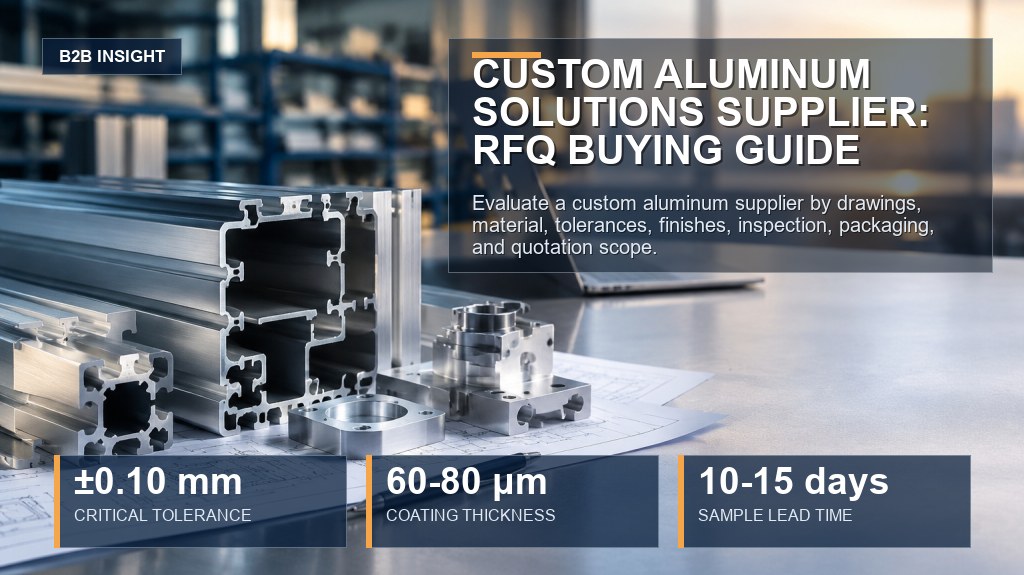
Three figures can help structure an initial discussion: a ±0.10 mm critical dimensional tolerance, a 60–80 μm coating thickness, and a 10–15 day sample lead time. These are indicative procurement benchmarks only. They are not confirmed Zhending specifications, certified results, or delivery promises. Buyers should require confirmation in the reviewed drawing, supplier datasheet, or formal quotation because achievable values depend on alloy, geometry, process, finish, volume, and inspection method.
For made-to-order aluminum components, request documents that match the actual project. Useful records may include material documentation, an approved drawing revision, dimensional inspection records, finish requirements, a sample approval record, and the export packaging plan. Material grade, temper, dimensional tolerances, coating system, inspection frequency, applicable standards, tooling ownership, sample timing, production timing, and loading method remain items to confirm.
Representative Procurement Case
A representative procurement case from Germany involved an industrial equipment buyer sourcing drawing-based aluminum components. The buyer was concerned about drawing consistency, cosmetic protection, and whether quotations covered the same work. Its decision process began with technical clarification, followed by a review of sample arrangements, inspection documentation, packaging proposals, and commercial exclusions. General feedback from this representative scenario was that a clearly defined scope made internal approval and supplier comparison more efficient. This is not a verified named testimonial and does not claim a guaranteed outcome.
Prepare a Quote-Ready Inquiry
Supplier selection should balance technical review quality, transparent quotation structure, document control, packaging suitability, and response discipline. Send Zhending Aluminum the latest drawings, application details, preferred material, critical dimensions, finish requirements, purchasing schedule, destination port, and packaging expectations. Ask the team to identify manufacturing assumptions and unresolved specifications in writing before pricing. This approach gives both parties a clearer basis for feasibility review, sampling, and commercial negotiation.
Procurement Metrics to Confirm
| Metric | Value | Buying Reference |
|---|---|---|
| CRITICAL TOLERANCE | ±0.10 mm | Indicative RFQ benchmark; confirm against geometry and process. |
| COATING THICKNESS | 60–80 μm | Indicative finish benchmark; confirm coating system and standard. |
| SAMPLE LEAD TIME | 10–15 days | Indicative planning range; confirm after drawing review. |
These are indicative procurement benchmarks; confirm final figures in the supplier datasheet and formal quotation.