
Modular Sunroom Systems from China: Quotation Guide
Why Sunroom Quotations Are Difficult to Compare
Buyers requesting a modular sunroom systems from China quotation often receive prices that appear similar but cover very different scopes. One supplier may include the aluminum frame, glazing, doors, drainage, and export packaging, while another quotes only the main enclosure. Comparing the headline price per square meter can therefore create costly gaps during installation.
A useful inquiry should state the project location, overall dimensions, preferred roof form, door and window layout, glazing requirements, finish color, quantity, destination port, and requested trade term. The installation location matters because wind, snow, temperature, rainfall, and local building rules can affect the structural design and material selection. Buyers should not accept an engineering assumption intended for a different climate without review.
Ask every supplier to identify inclusions, exclusions, optional components, taxes, packaging, inland transport, ocean freight, and installation support separately. This produces a comparable landed-cost picture rather than an incomplete factory price.
Specifications and Cost Drivers to Check
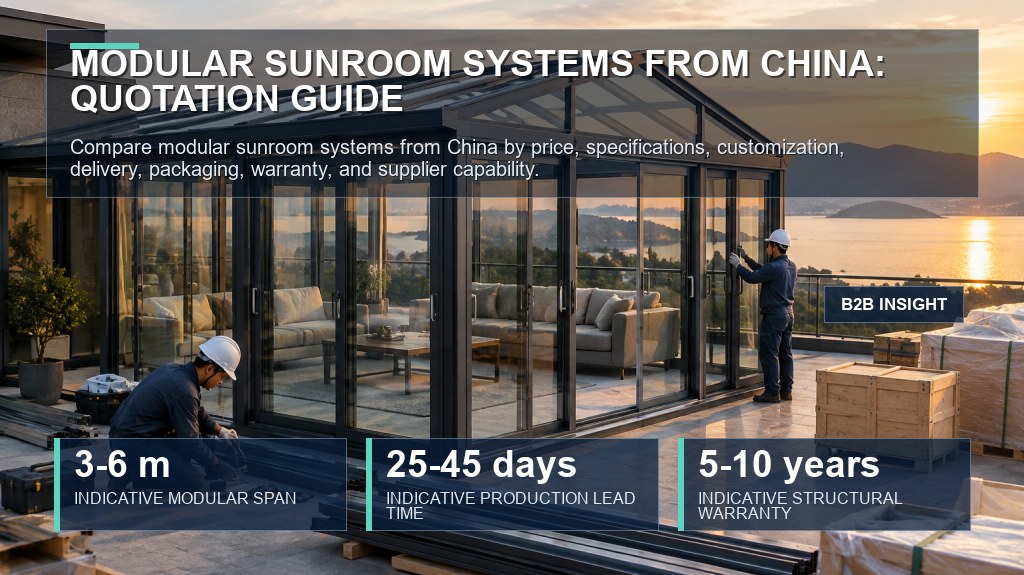
For preliminary sourcing, three indicative benchmarks can help frame discussions. Typical modular spans may be around 3-6 m, standard-project production lead times may be approximately 25-45 days, and structural-system warranties commonly discussed in the market may fall near 5-10 years. These are not certified specifications or guaranteed supplier commitments. Confirm all three figures in the selected manufacturer’s datasheet, structural documentation, production plan, and written quotation.
The frame specification deserves more attention than profile appearance. Request the aluminum alloy designation, profile wall thickness, reinforcement method, connector material, fastener grade, surface treatment, and drainage design. For glazing, compare glass composition, thickness, safety treatment, insulating configuration, coatings, edge processing, and replacement method. If thermal performance is important, ask for the declared values and applicable test basis rather than relying on terms such as energy saving.
Roof geometry, opening panels, sliding or folding doors, integrated blinds, lighting, motorized vents, and custom colors can materially affect cost. A factory-direct quote should itemize these options instead of combining them into one system price. Buyers should also ask whether measurements, foundations, sealants, installation labor, lifting equipment, and local electrical work are included.
| Comparison Area | Information to Request | Procurement Risk |
|---|---|---|
| Structure | Profile data, connection details, design loads | Deflection or unsuitable local application |
| Glazing | Glass build-up, safety treatment, performance data | Breakage, condensation, or compliance gaps |
| Water Management | Gutters, flashing, seals, drainage paths | Leakage and difficult site correction |
| Scope | Itemized materials, accessories, and exclusions | Unexpected installation costs |
How to Evaluate a Chinese Manufacturer
A capable modular sunroom manufacturer should be able to convert project requirements into numbered drawings, a bill of materials, assembly instructions, and a packing list. Evaluate whether the factory controls extrusion processing, machining, finishing, glazing integration, trial assembly, and final inspection directly or relies on subcontractors. Outsourcing is not automatically a problem, but responsibilities and inspection points should be transparent.
Request current business documentation, quality-control procedures, material records, sample drawings, and relevant test reports where applicable. Any compliance claim must match the exact product configuration and destination-market requirement. Do not assume that a component report constitutes approval for the complete installed structure. Local structural review, planning permission, and building compliance should be assigned clearly between buyer, supplier, installer, and project engineer.
Export delivery requires more than a completion date. Confirm production milestones, drawing-approval deadlines, container loading plans, package dimensions, gross weights, moisture protection, scratch prevention, glass protection, and package numbering. Each crate should correspond to the packing list and installation sequence. Ask for a shortage and transit-damage procedure, plus a recommended spare-parts package containing critical seals, fasteners, rollers, connectors, and touch-up materials.
Warranty wording should separate the structural frame, surface finish, glazing, hardware, seals, and powered accessories. Confirm the start date, exclusions, evidence required for a claim, remedy method, and responsibility for freight or labor. A stated 5-10 years for a structural system has limited value unless the covered components and operating conditions are defined in writing.
Build an Inquiry That Produces a Usable Offer
Send suppliers a structured request containing drawings or sketches, dimensions, quantity, installation city, environmental design criteria, glazing preference, finish, opening configuration, accessories, target schedule, destination port, and Incoterm. Ask for a technical deviation sheet, itemized quotation, tooling or engineering charges, production lead time, packing details, loading quantity, payment terms, drawing schedule, installation support, and complete warranty text.
Before placing an order, approve final drawings and samples, verify interfaces with foundations and adjacent walls, and define inspection criteria. If the project is customized, consider a third-party pre-shipment inspection focused on dimensions, quantities, visible finish, package identification, and document consistency.
For an accurate modular sunroom systems from China quotation, provide your project dimensions, destination, required configuration, quantity, and delivery target. Requesting the same technical and commercial breakdown from each supplier will make price comparisons clearer and reduce redesign, missing-part, and site-installation risks.