
Aluminum Corrugated Roofing Sheet Supplier Guide
Define the Specification Before Comparing Price
When selecting an aluminum corrugated roofing sheet supplier, international buyers should define the application before requesting a unit price. Roof span, design load, exposure to moisture or chemicals, installation method, expected service conditions, and target service life all influence the suitable product. A useful inquiry should identify the aluminum alloy and temper, base thickness, corrugation profile, effective cover width, sheet length, surface finish, color, and packaging requirement.
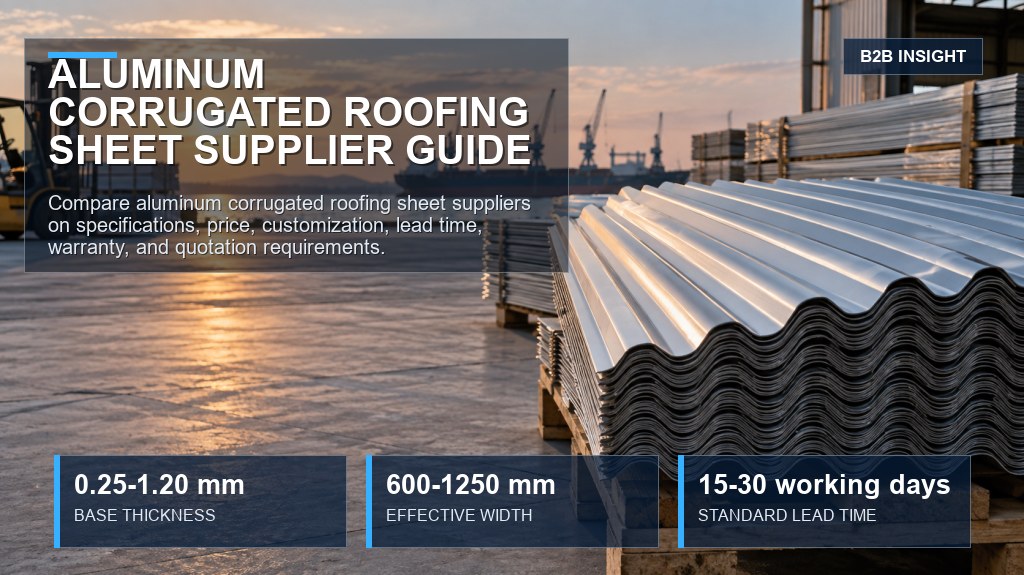
An indicative procurement benchmark for base thickness is 0.25–1.20 mm. This is an industry sourcing range, not a certified specification or performance guarantee. The correct thickness depends on structural design, support spacing, wind conditions, handling requirements, and the supplier’s technical data. A responsible manufacturer should confirm tolerances, profile drawings, and recommended installation details before production.
Buyers should also compare total delivered cost rather than only the raw sheet price. A lower-cost thin sheet may create higher installation waste or deformation risk, while thicker material, premium coatings, custom lengths, protective film, special pallets, and export packaging can increase the quotation. Ask the supplier to separate material, forming, tooling, packaging, inland transport, freight, and trade-term costs so competing offers can be evaluated consistently.
Compare Profile, Finish, and Factory Capability
Effective cover width directly affects roof layout, overlap, material consumption, and labor. For aluminum corrugated roofing sheets, an indicative effective-width range is 600–1250 mm. The actual usable width depends on the corrugation design and side-lap arrangement, so buyers should not confuse nominal coil width with installed coverage. Confirm sheet length tolerance, edge condition, wave height, pitch, flatness, and the method used to protect finished surfaces.
Surface selection should reflect the installation environment. Buyers may compare mill finish, painted, coated, or other specified finishes according to appearance, corrosion exposure, maintenance expectations, and project requirements. Request coating details, color references, adhesion or appearance inspection records where relevant, and confirmation that the finish is suitable for forming without unacceptable cracking. If a project requires a particular building standard or compliance document, the buyer’s engineering team should verify the applicable requirement rather than assuming that every supplier holds the same certification.
For custom or OEM orders, evaluate whether the factory can produce the required profile, cut-to-length panels, perforations, accessories, labeling, and export packaging. A credible aluminum corrugated roofing sheet manufacturer should be able to provide a technical datasheet, sample or profile drawing, inspection process, raw-material traceability, loading photographs, and a clear response procedure for nonconforming goods. Low price alone is not evidence of reliable production capacity.
Evaluate Quotation, Delivery, and Warranty Terms
For standard specifications, an indicative lead-time benchmark is 15–30 working days. This range is not a guaranteed delivery commitment and should be confirmed in the formal quotation. Custom tooling, unusual colors, large quantities, raw-material availability, production scheduling, port congestion, and shipping arrangements can extend the schedule. Ask the supplier to distinguish production lead time from transit time and to state the planned inspection, packing, and dispatch milestones.
A complete quotation should identify alloy, temper, thickness tolerance, profile, effective width, length tolerance, finish, quantity, packing method, minimum order quantity, payment terms, quotation validity, trade term, loading port, and estimated delivery date. If the buyer is comparing aluminum corrugated roofing sheet price offers from different factories, the same specification and commercial basis must be used. Otherwise, an apparently cheaper offer may exclude packaging, tooling, inland charges, or the required finish.
Warranty language also deserves careful review. Confirm what is covered, the stated period, exclusions, evidence required for a claim, inspection responsibilities, and the available remedy. Coating appearance, corrosion behavior, installation damage, storage conditions, and incorrect application may be treated differently. Buyers should avoid interpreting an indicative benchmark or sales statement as an unconditional warranty.
Prepare a Precise Supplier Inquiry
To obtain a useful aluminum corrugated roofing sheet quotation, send the supplier your estimated quantity, destination country or port, required alloy and thickness, profile drawing or reference sample, effective width, panel length, color, finish, packaging, trade term, target delivery date, and any applicable project standard. If the project is still at the design stage, request alternative thickness and profile options with separate pricing rather than accepting an unspecified substitute.
Ask for a datasheet, drawing approval process, sample policy, inspection documents, production schedule, loading plan, warranty terms, and replacement or shortage procedure. Comparing these details helps distinguish a factory-direct manufacturer from a trading offer with limited technical control. Buyers can then select on measurable quality, total landed cost, delivery confidence, and after-sales responsibility. Submit the complete specification to shortlisted suppliers and request a line-item quotation before placing an order.