
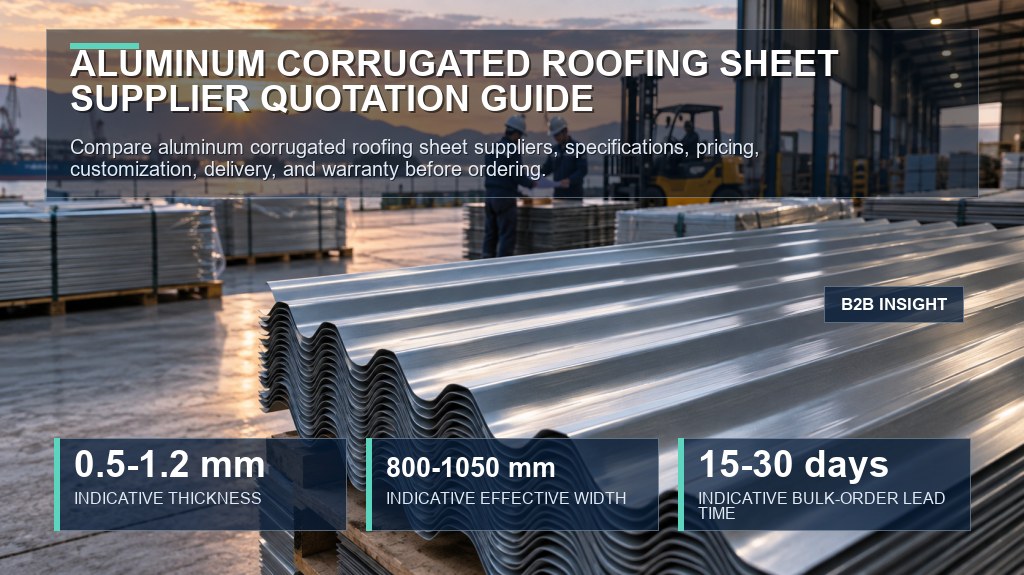
Aluminum Corrugated Roofing Sheet Supplier Quotation Guide
Applications and Specification Priorities
Aluminum corrugated roofing sheets are used for warehouses, factories, agricultural buildings, carports, canopies, temporary structures, and roof renovation projects. Their low weight, corrosion resistance, and relatively simple installation make them suitable for many building envelopes, but the right product depends on the project rather than on material name alone. Before requesting an aluminum corrugated roofing sheet supplier quotation, define the roof span, local weather exposure, support spacing, drainage direction, installation method, and expected service environment.
For initial supplier comparison, an indicative thickness range is 0.5-1.2 mm. This is a procurement benchmark, not a certified specification or a performance guarantee. The final thickness should be confirmed against the supplier datasheet, structural requirements, alloy information, and quotation. Buyers should also review corrugation height, effective cover width, sheet length, edge condition, flatness, surface finish, and compatibility with fasteners or insulation systems.
How to Compare Price and Supplier Capability
The aluminum corrugated roofing sheet price is influenced by alloy, thickness, profile tooling, sheet length, coating or finish, order volume, packaging, and destination. Comparing only the price per square meter can create an inaccurate cost picture. Ask whether the quoted area is based on nominal width or effective cover width, and check whether cutting, protective film, accessories, export packing, and freight are included.
A common indicative effective-width range is 800-1050 mm, although the actual value varies by profile and forming equipment. Treat this range as a preliminary buying reference and verify the supplier’s drawing before approval. A capable aluminum corrugated roofing sheet manufacturer should be able to provide a clear profile drawing, material details, tolerances, packing method, inspection approach, and sample or production reference where appropriate. Factory-direct purchasing may improve communication and customization control, but buyers should still assess quality consistency, export experience, documentation, and response speed.
Customization, Delivery, and Warranty Checks
Custom requirements should be stated at the inquiry stage. These may include non-standard sheet lengths, profile dimensions, pre-drilled holes, color or surface treatment, protective film, private labeling, pallet design, or OEM packaging. Confirm which items affect tooling charges, minimum order quantity, production cost, and approval samples.
For planning purposes, an indicative bulk-order lead-time range is 15-30 days. It is not a guaranteed delivery commitment and should be confirmed in the supplier’s formal quotation. Actual timing can depend on raw-material availability, tooling, production scheduling, inspection, packing, port arrangements, and international transport. Ask the supplier to separate production lead time from transit time and to state the quotation validity period.
Warranty terms also require careful review. Instead of accepting a general statement, request the covered defects, claim process, exclusions, inspection evidence, and remedy options. Confirm the availability of matching fasteners, closures, replacement sheets, and other spare parts or accessories if the project may require future maintenance. Any compliance documents required by the destination market should be identified before production, without assuming that a supplier holds a particular certification.
What to Include in Your Quotation Request
Send an organized inquiry to several aluminum corrugated roofing sheet suppliers. Include estimated quantity, thickness, effective width, length, profile drawing if available, alloy or material preference, finish, color, packaging, destination port, target delivery date, and any custom or OEM requirements. Request an itemized quotation covering material, forming, cutting, packaging, accessories, and shipping where applicable.
Also ask for the technical datasheet, product photos or samples, packing dimensions, loading information, payment terms, warranty conditions, and production schedule. This approach helps buyers compare total landed cost rather than headline price and reduces the risk of incorrect dimensions, transport damage, unclear responsibility, or delayed installation. A concise, complete inquiry is the fastest way to receive a useful aluminum corrugated roofing sheet supplier quotation.