
Critical Installation Guidelines for Insulated Aluminum Wall & Roof Panels in Dubai Industrial Factories
Dubai’s extreme desert climate brings summer peak temperatures up to 50°C, strong seasonal sand winds, and persistent coastal salt fog across JAFZA, Dubai Industrial City and waterfront industrial zones.
Cooling HVAC accounts for 70–80% of factory electricity costs, and Dubai Municipality Al Sa’fat codes enforce strict maximum U-value limits (roof ≤0.19 W/m²K, wall ≤0.40 W/m²K) for all industrial building envelopes.
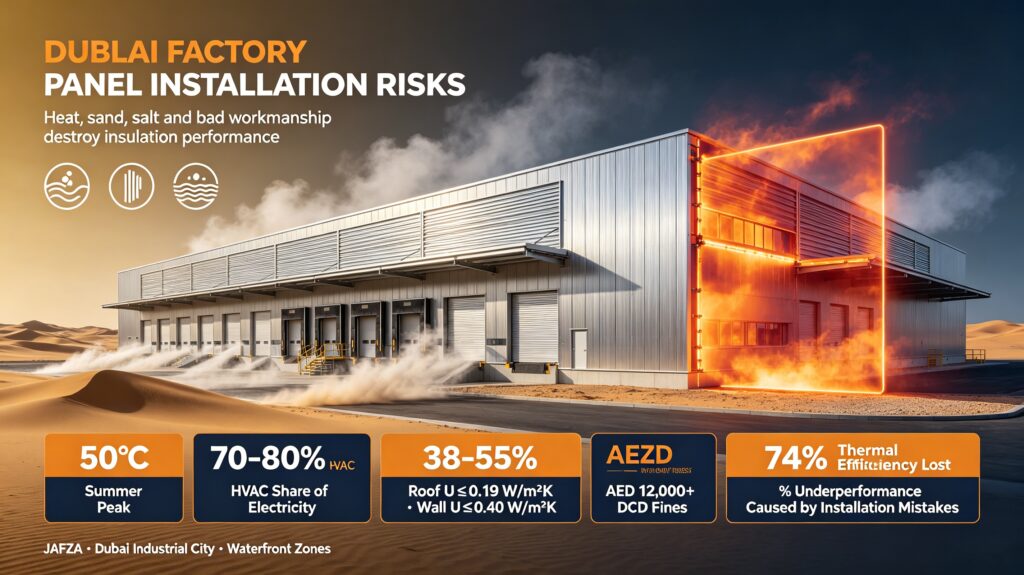
Even premium CE & DCD-approved insulated aluminum panels with λ=0.022–0.024 W/m·K thermal conductivity will lose 38–55% thermal efficiency due to improper installation, pushing annual cooling bills up by 40–60% and triggering Dubai Civil Defence fines starting at AED 12,000.
Industry thermal scan surveys show 74% of underperforming Dubai cold storage, logistics and food factories trace high energy consumption and panel corrosion to 8 common construction mistakes unique to UAE desert-coastal conditions.
This article breaks down mandatory site preparation, wall/roof installation rules, vapor barrier, fire safety, anti-corrosion and post-acceptance standards tailored for Dubai industrial projects, with supporting field data to help contractors, factory owners and panel suppliers avoid costly rework and failed municipal inspections.
1. Pre-Installation Site & Panel Preparation (32% of Dubai construction failures stem from poor prep)
1.1 Panel Storage & Anti-UV, Anti-Salt Protection
Dubai’s intense UV radiation and salt-laden coastal air rapidly degrade unprotected aluminum facings:
- Store panels 15cm above ground on treated timber sleepers, fully wrapped with UV-stabilized waterproof tarpaulins; direct sunlight exposure for over 14 days scratches PVDF coating and reduces anti-corrosion lifespan by 60%.
- Remove factory protective film within 30 days post-installation; trapped plastic film under 48°C constant heat causes permanent aluminum discoloration and bubbling.
- Never drag panels on concrete or sand ground; use vacuum lifters or wide nylon slings to prevent coating abrasion. Scratched aluminum loses 52% salt-spray resistance within 3 years in coastal free zones.
1.2 Steel Frame Inspection & Anti-Rust Treatment
All wall columns and roof purlins must meet tight flatness tolerances for seamless panel joints:
- Vertical wall column deviation ≤±1mm per 10m; roof purlin level error ≤2mm across full span. Uneven framing creates 3–9mm panel gaps, boosting heat infiltration by 71% and failing Al Sa’fat thermal audits.
- Every steel support must be fully coated with two layers of anti-rust primer; bare metal creates severe thermal bridges and accelerates frame rust under Dubai’s high humidity.
1.3 Restricted On-Site Cutting Rules (Dubai Civil Defence Mandate)
Angle grinders are prohibited for trimming panels: high heat burns aluminum anti-corrosion layers and ignites PU/PIR foam core, violating fire safety codes.
- Only cold-cut fine-tooth circular saws are permitted; all cut edges must be instantly filled with closed-cell PU foam and sealed with UV-resistant butyl tape.
- Field cuts deeper than 5mm reduce roof panel load-bearing capacity by 28% and invalidate DCD fire certification.
2. Wall Panel Installation Core Standards (Stop Heat Leakage & Condensation)
2.1 Tongue-and-Groove Joint Double Sealing (Biggest Thermal Weak Point)
Unsealed panel joints account for 79% of factory heat gain detected via Dubai Municipality infrared scanning:
- Lay continuous EPDM butyl vapor tape inside every tongue groove before interlocking panels; eliminate gaps wider than 1mm.
- Use rubber mallets only to lock panels—metal hammers dent aluminum facings and break airtight seals.
- Coastal factories (seafood, port logistics) require dual external silicone sealing on all vertical wall joints to block salt fog penetration. Data comparison: Unsealed joints drop panel effective U-value from 0.19 to 0.38 W/m²K, raising monthly cooling expenses by 43%.
2.2 Thermal Break Isolation to Eliminate Heat Conduction
Metal fasteners and steel connections form direct heat transfer paths, a top audit failure point for Al Sa’fat certification:
- Install PVC thermal isolation gaskets between every screw and aluminum panel surface; metal-on-metal contact increases external heat infiltration by 24%.
- Wall corners adopt 45° miter joint design with insulated separators to cut thermal bridge area by 76%.
- Cold storage door frames must use full insulated PVC break profiles; uninsulated door surrounds create 82% of indoor wall condensation in Dubai’s temperature gap (50°C outdoor vs -25°C indoor).
2.3 Wind-Load Compliant Fastener Selection & Spacing
Dubai’s desert wind gusts reach 150 km/h; substandard fasteners cause panel loosening and water leakage within 2 years:
- Mandatory hardware: 316 stainless steel screws with integrated EPDM washers; carbon steel screws rust completely in coastal zones within 24 months.
- Wall screw spacing: Max 600mm vertical, 1000mm horizontal; 100–150mm thick deep-freeze panels require 130mm+ long screws to fully penetrate steel purlins.
3. Roof Panel Installation Critical Rules (Resist Extreme Solar Heat & Sand Rain)
Roof panels bear Dubai’s maximum solar radiation (surface temperature hits 72°C in summer) and sand erosion, with unique slope, overlap and expansion requirements:
3.1 Minimum Roof Slope & Waterproof Overlap Standards
- Mandatory minimum roof slope: 5° for inland industrial factories; 8° compulsory for coastal port plants to avoid rainwater and sand ponding on panel seams.
- Horizontal roof panel overlap ≥200mm, vertical side lap ≥100mm; install full EPDM flashing under all overlaps for double waterproof protection.
- Ponded sand and rainwater penetrate unflashed seams within 12 months, soaking foam core and cutting insulation efficiency by 51%.
3.2 Thermal Expansion Gap Design for High Temperature Swings
Aluminum expands 12µm per meter per °C; Dubai’s 60°C annual temperature swing creates massive dimensional shift risk:
- Leave minimum 3mm expansion gap at all panel end joints; use floating clip fasteners instead of fully fixed screws to allow lateral movement.
- Over-constrained panels buckle under summer heat, opening permanent 5–10mm gaps that drive continuous heat loss all year round.
3.3 Wall-Roof Junction Full Sealing (44% of total building heat gain occurs here)
Thermal scanning data from Dubai industrial audits confirms wall-roof transitions are the primary heat infiltration zone:
- Fill all wall-roof voids with high-density closed-cell PU foam to block hot air convection.
- Cover junctions with full-length aluminum flashing plus double-layer UV-resistant silicone sealing system.
- Deep-freeze cold storage roofs (-18°C and below) add extra thermal break strips to stabilize indoor temperature fluctuation within ±0.6°C.
3.4 Roof Load-Bearing Restrictions
Large-span factory roofs over 4m width need intermediate support brackets every 2.5m to prevent panel sagging:
- Sagging panels create permanent joint gaps, leading to dripping condensation on production equipment and 30% higher refrigeration runtime.
- Evaporators, ventilation ducts and heavy fixtures must mount on dedicated load-bearing purlins—never drill directly through insulated aluminum panel surfaces.
4. Continuous Vapor Barrier Installation (Mandatory for All Dubai Factories)
Moisture ingress is the biggest hidden long-term risk; only 1% water absorption inside PU/PIR foam reduces thermal performance by 25%:
- Install uninterrupted vapor barrier film on the warm external side of all walls and roofs, with minimum 150mm overlap at every joint.
- All pipe, cable, ventilation penetrations through panels must be fully wrapped with vapor tape and filled with non-shrinking PU foam.
- Factories within 5km of Dubai’s coastline (JAFZA, Port Rashid) add an extra exterior waterproof membrane over all panel seams to resist salt fog penetration. Case data: Facilities skipping full vapor barriers require full panel replacement within 6–8 years; properly sealed systems retain full thermal performance for 18–22 years.
5. Dubai Civil Defence Fire Safety Installation Compliance
UAE fire codes separate installation standards for PIR/PU and rock wool aluminum panels, with zero tolerance for incomplete fire sealing:
- Chemical, paint, timber processing high-risk factories using A1 rock wool panels: Fill all panel joints with fire-resistant mineral wool to stop flame spread through gaps.
- Standard cold storage, logistics factories with B1 PIR panels: Apply fire-stop silicone sealant at all wall-roof junctions and MEP penetrations.
- Ordinary weather-resistant silicone cannot be used on fire-rated panel systems; non-compliant projects face construction suspension and fines up to AED 25,000.
6. Post-Installation Inspection & Municipal Acceptance Checklist
Complete these tests before factory handover to pass Dubai Municipality and Civil Defence certification:
- Infrared thermal camera full scan of all joints, corners, wall-roof transitions to detect hidden heat leakage gaps (required for Al Sa’fat approval).
- Building air tightness pressure test: Envelope air leakage ≤1.2 m³/(h·m²) under 50Pa pressure, complying with UAE EPBD energy regulations.
- 72-hour full-load cooling observation test: Run HVAC/refrigeration at maximum capacity; no condensation dripping or internal frost allowed on inner panel surfaces.
- Full visual inspection of all sealants, flashings, fasteners for cracks, UV degradation and early rust signs. Industry data: Projects skipping thermal scanning have a 71% chance of failing official Al Sa’fat energy efficiency audits.
7. Dubai Seasonal Construction Restrictions (Avoid Installation Defects From Extreme Climate)
- Stop panel erection during sandstorms, winds over 12 m/s or midday heat above 45°C. High aluminum surface temperature triggers rapid thermal expansion; panels cool overnight and separate at joints, creating permanent heat leak gaps.
- Winter construction (December–February): Keep panel storage areas fully covered to avoid dew moisture soaking foam core, which permanently reduces insulation and fire resistance performance.
- Optimal construction window: 07:00–11:00 before peak solar radiation heats aluminum facings.
Practical Sales & Construction Tips for Dubai Distributors & Contractors
- Quantify installation defect costs for factory clients: Poor panel construction leads to 40–60% higher annual cooling bills and average renovation costs of AED 9,000–28,000 within 5 years.
- Supply full matching installation accessories (316 stainless EPDM screws, UV butyl tape, thermal break gaskets, aluminum flashing) for one-stop supply to standardize construction quality and avoid incompatible local hardware.
- All construction work must follow EN 14509 sandwich panel standards and Dubai Civil Defence technical codes; retain full installation inspection records for municipal submission.
- Separate construction specification packages by industry:
- Cold storage/seafood coastal plants: Prioritize 120–150mm thick panels, double vapor barrier, 316 stainless fasteners and dual joint sealing.
- Chemical high-fire-risk factories: Enforce rock wool aluminum panels with full fire-stop joint filling.
Conclusion
Correct installation of insulated aluminum wall and roof panels directly determines long-term energy efficiency, anti-corrosion service life, and compliance with Dubai’s Al Sa’fat green building and Civil Defence fire safety rules.
Dubai’s unique harsh climate—extreme desert heat, strong sand winds and coastal salt fog—creates six non-negotiable construction priorities: proper panel anti-UV storage, precision steel frame leveling, fully sealed tongue-and-groove joints with thermal breaks, compliant roof slope & expansion gap design, continuous vapor barrier protection, and full post-installation thermal inspection.
Field statistics show projects following the above Dubai-specific installation standards retain 95% of the panel’s original thermal U-value performance, cut annual cooling energy consumption by 38–47%, and pass all municipal certification without costly rework. Distributors and contractors who guide factory clients through these construction precautions will reduce post-project complaints and build stable long-term supply partnerships across Dubai’s industrial free zones including JAFZA, Dubai Industrial City and Dubai South.