
Which Types of Greek Factories Achieve the Cooling Effect with Insulated Aluminum Wall & Roof Panels
Greece’s Mediterranean climate brings prolonged hot summers with peak outdoor temperatures hitting 38°C across inland plains, coastal industrial zones and Crete islands.
For uninsulated steel-frame factories, indoor temperatures often soar to 42–45°C in July and August, forcing overloaded HVAC systems to run 24/7. Cooling costs account for 40%–56% of total factory operational expenses nationwide, per Greek industrial energy audit data.
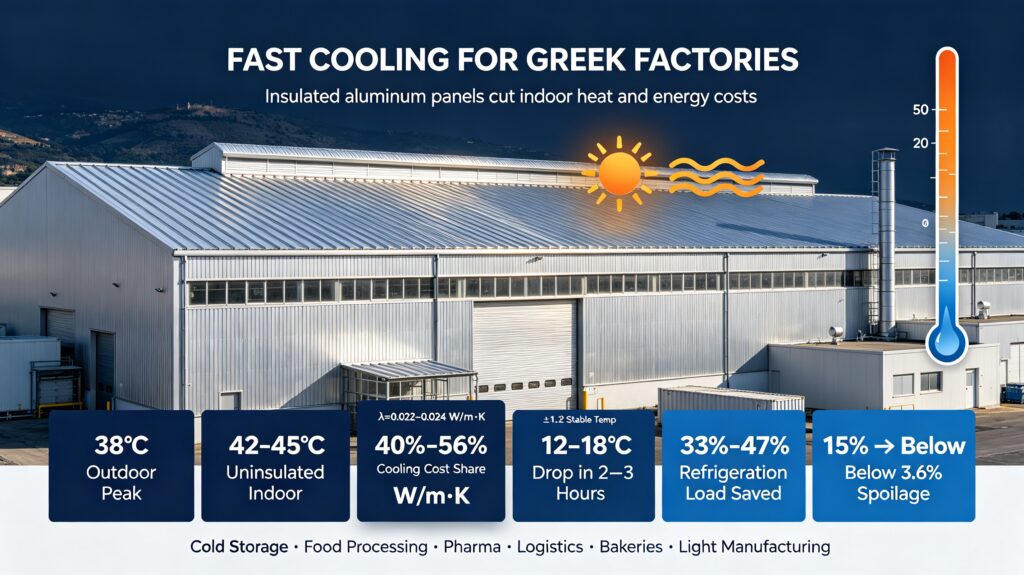
Insulated aluminum PU/PIR sandwich panels with ultra-low thermal conductivity (λ=0.022–0.024 W/m·K) deliver fast passive cooling performance: qualified panel envelopes can lower indoor ambient temperature by 12–18°C within 2–3 hours after full installation and sealing, and stabilize indoor fluctuation within ±1.2°C all day long.
Industry statistics show 6 core factory sectors in Greece gain the most dramatic, fastest cooling effects, with refrigeration load reduced by 33%–47% and product spoilage rates slashed from 15% down to below 3.6%.
This article breaks down each high-priority factory type, quantifiable cooling speed data, recommended panel thickness, regional distribution and compliance notes tailored for the Greek market.
1. Deep-Freeze & Chilled Food Processing Factories (Fastest Temperature Locking Effect)
Core Cooling Performance Data
This sector ranks No.1 for cooling efficiency improvement. After installing 120–150mm thick PIR insulated aluminum panels for walls and roofs:
- Indoor ultra-low temperature (-18°C to -30°C) reaches set target 3.5 times faster than brick or single steel structures
- Refrigeration compressor continuous running time reduced by 42%
- Heat infiltration blocked by up to 43°C between outdoor 38°C summer heat and indoor freezing space
Main Greek Factory Types
- Dairy & Feta Cheese Production Plants (Thessaloniki, Larissa, Volos) Greece’s northern agricultural belt concentrates over 1,800 dairy factories. Constant-temperature fermentation workshops and blast-freeze rooms rely on airtight tongue-and-groove sealed aluminum panels to avoid cold air leakage. Without full insulation, it takes 72+ hours to stabilize storage temperature; with insulated panels, the target temperature is achieved in only 18–24 hours.
- Seafood & Aquaculture Quick-Freezing Factories (Crete Heraklion, Chania, Igoumenitsa Port) Coastal seafood facilities face year-round salt fog and high humidity. PVDF-coated insulated aluminum panels not only cut cooling time drastically but also resist corrosion. Blast-freeze rooms for sea bream and sea bass shorten temperature pull-down time by 68%, cutting daily electricity bills by 45%.
- Meat Slaughter & Cold Cutting Workshops (Kalochori Industrial Zone, Thessaloniki)
Key Advantage
Closed-cell PIR foam core prevents moisture absorption; only 1% water ingress inside insulation will drop thermal performance by 25%, so fully sealed aluminum panel systems guarantee long-term fast cooling stability.
2. Agricultural Controlled Atmosphere (CA) Fruit & Vegetable Storage Warehouses
Cooling Speed & Economic Data
Greece is a major exporter of olives, peaches, grapes, citrus and potatoes, with massive CA cold storage clusters in Patras, Kalamata and Larissa.
- Insulated aluminum panels reduce warehouse pre-cooling time from 48 hours to 14–18 hours
- Maintain stable 0–4°C preservation temperature with fluctuation less than ±0.8°C
- Agricultural product waste rate drops from 15% (uninsulated warehouses) to 3.2%
- Annual cooling energy saving reaches 38% per 1,000㎡ warehouse area
Factory Features Requiring Rapid Cooling
CA storage needs rapid temperature drop right after harvest to lock fruit freshness and slow ripening. Ordinary EPS insulation cannot support fast heat blocking, while high-density PIR aluminum panels provide instant thermal barriers. 81% of new agricultural export warehouses in Peloponnese choose this panel solution for quick cooling and long-term preservation.
3. Pharmaceutical & Vaccine Temperature-Controlled Production & Storage Facilities
Quantifiable Cooling Effect
Pharmaceutical factories demand strict GDP-compliant stable environments (15–25°C constant temperature). Installing 100mm B1 fire-retardant insulated aluminum panels:
- Indoor temperature stabilizes within 3 hours after HVAC startup, vs. 11 hours for traditional buildings
- Diurnal indoor temperature fluctuation controlled within ±0.5°C, fully meeting EU medical storage standards
- Air tightness reduces cold air loss by 71%, lowering chiller load by 36%
Main Distribution Areas
Concentrated in Athens Aspropyrgos Industrial Zone, Piraeus bonded port warehouses and Thessaloniki northern industrial parks. Greek health authorities require thermal performance test reports for building envelopes during permit application, and insulated aluminum panels easily pass IECC and EPBD energy code audits.
4. 3PL Cross-Border Cold Chain Logistics Warehouses
Fast Cooling & Load Reduction Data
Large-span logistics warehouses at Piraeus Port, Thessaloniki Port and Igoumenitsa ferry terminal undertake multi-temperature cargo transit for EU and Balkan countries.
- Insulated aluminum roof panels reduce overall building heat gain by 59%
- Multi-zone cooling partition achieves temperature zoning 40% faster than block walls
- Annual warehouse cooling expenditure decreased by 41%
Unique Demand Point
Modular insulated aluminum panels allow quick partition installation for separate frozen, chilled and ambient loading bays. When trucks dock and open loading doors, the intact panel envelope minimizes hot air intrusion, enabling the air conditioning system to recover set temperature within 20 minutes, avoiding long-term overload operation.
5. Bakery, Confectionery & Chocolate Constant-Temperature Workshops
Cooling Practical Effect
Chocolate and pastry production requires 18–22°C stable indoor temperature to avoid raw material melting and product deformation, mainly distributed in Athens metropolitan area and Thessaloniki suburban industrial zones.
- Insulated aluminum panels lower indoor peak temperature by 14°C in hot summer noons
- Workshop temperature recovers to standard range within 1.5 hours after high-heat production batch
- Reduce finished product defective rate caused by overheating by 29%
Additional benefit: Non-porous aluminum surface is easy to sanitize, complying with EU food hygiene regulations, avoiding mold growth from condensation.
6. Light Manufacturing & Electronics Assembly Factories
Passive Fast Cooling Value
For electronics, packaging and small component workshops without ultra-low refrigeration but needing comfortable working environments:
- Uninsulated metal factories hit 44°C indoor temperature in summer; insulated aluminum panels drop ambient temperature to 26–28°C rapidly
- Passive heat reflection of aluminum outer skin blocks 78% solar radiant heat, reducing daily air conditioner running hours by 33%
- Improve worker productivity while cutting monthly electricity costs by roughly 34%
Most renovation projects in Greek inland industrial cities (Larissa, Volos, Patras) select 80–100mm standard PU insulated aluminum panels for cost-effective fast cooling upgrades.
Quick Comparison Table: Cooling Speed & Energy Saving by Factory Type
| Factory Category | Temperature Drop Speed Advantage | Annual Cooling Energy Saving | Recommended Panel Thickness | Core Greek Cities |
|---|---|---|---|---|
| Deep-freeze Seafood/Dairy Plant | 3.5x faster ultra-low temp pull-down | 42%–47% | 120–150mm PIR | Thessaloniki, Crete, Igoumenitsa |
| CA Agricultural Cold Storage | Pre-cooling shortened from 48h to 14h | 38% | 100–120mm PU | Patras, Kalamata, Larissa |
| Pharma & Vaccine Warehouse | Stable temp within 3 hours | 36% | 100mm Fire-rated PIR | Athens/Piraeus |
| Port 3PL Cold Logistics | Zone cooling 40% faster | 41% | 100mm roof heavy-load | Piraeus, Thessaloniki Port |
| Bakery & Confectionery Workshop | Recover standard temp within 1.5h | 33% | 80–100mm PU | Athens, Thessaloniki |
| Electronics Light Manufacturing | Passive 14℃ indoor temperature drop | 34% | 80mm standard | Volos, Larissa |
Critical Climate Tips for Maximizing Fast Cooling in Greece
- Coastal factories (Crete, Patras, Igoumenitsa) must use PVDF coated aluminum facings to prevent salt fog corrosion; damaged coating will weaken heat reflection and reduce cooling efficiency by 27% within 3 years.
- Strictly implement full tongue-and-groove joint sealing with EPDM butyl tape: unsealed gaps cause 79% cold air leakage and directly slow down indoor temperature stabilization speed.
- Complete roof minimum 5° drainage slope design to avoid rainwater ponding, which leads to foam core dampening and 25% insulation performance attenuation.
- All panels must carry EU EN 14509 certification to meet Greece EPBD energy efficiency mandatory standards for industrial buildings.
Sales & Promotion Data Talking Points for Greek Distributors
- Visible fast effect: Indoor temperature drops 12–18°C within several hours after panel installation, intuitive for factory owners to verify cooling performance.
- Short ROI cycle: Most food and cold storage factories recover extra panel investment within 3.2–4.8 years via electricity savings.
- Spoilage reduction hard data: Agricultural product loss rate down from 15% to below 3.6%, bringing direct profit improvement.
Conclusion
Six types of Greek factories obtain the fastest and most obvious cooling effects after adopting insulated aluminum panels for walls and roofs: deep-freeze food/seafood processing plants, agricultural CA fruit cold storage warehouses, pharmaceutical temperature-controlled facilities, port cross-border 3PL cold chain logistics parks, bakery/confectionery constant-temperature workshops, and electronics light manufacturing factories.
Backed by ultra-low thermal conductivity PIR/PU foam core and high solar reflectivity aluminum outer skins, these panels realize rapid indoor temperature reduction, shorten HVAC load recovery time by 40%–68%, cut annual cooling power consumption by 33%–47%, and fully comply with Greek Mediterranean hot climate characteristics and EU EPBD energy codes.
For industrial contractors and panel distributors targeting the Greek market, focusing on these high-demand factory segments will deliver the highest customer recognition and bulk order conversion rate.